
 Worksheets
MITOSIS VS. MEIOSIS (REVIEW GAME)
Total questions: 20
Worksheet time: 5hrs 0mins
Which type of cell is created by meiosis?
blood
liver
skin
sperm
In which phase of meiosis does crossing-over occur?
anaphase I
anaphase II
interphase
prophase I
Each body cell of an octopus contains 32 chromosomes. The number of chromosomes in an octopus egg cell will be
8.
16.
32.
64.
How are the processes of mitosis and meiosis similar to each other?
Both processes result in the same number of cells produced.
Both processes involve only one division of cellular material.
Both processes begin with similar events, including chromosome replication.
Both processes end with the same number of chromosomes present in each cell.
What is the outcome when a cell undergoes meiosis?
two diploid cells
two haploid cells
four diploid cells
four haploid cells
__________ = an error in meiosis in which homologous chromosomes fail to separate
apoptosis
crossing-over
cytokinesis
nondisjunction
By the end of mitosis, _____ cells are produced, whereas by the end of meiosis, _____ cells are produced.
one; three
two; four
three; one
four; two
Which of the following cells are produced through meiosis?
sex cells
somatic cells
stem cells
all of these
When new cells are formed through the process of mitosis, the number of chromosomes in the new cells
decreases every time the cell divides.
increases every time the cell divides.
is half of that of the parent cell.
remains the same as in the parent cell.
If the somatic cells of a human contain 46 chromosomes, then after meiosis new sex cells would contain __________ chromosomes.
23
46
64
92
__________ = a fertilized egg
blastula
embryo
gamete
zygote
Mitosis and meiosis are processes by which animal and plant cells divide. Which statement best describes a difference between mitosis and meiosis?
Mitosis contains many steps.
Mitosis occurs only in prokaryotic cells.
Meiosis is used to repair damaged cells.
Meiosis produces genetically diverse cells.
Haploid cells are
fused cells with double the chromosomes.
mutated cells with missing chromosomes.
sex cells with half the original chromosome number.
sex cells with the original chromosome number as the parent cell.

The genetic event shown in the diagram can occur during meiosis. Which statement best describes this type of event?
Gene sequences that are identical are replicated and added to the homologous chromosome.
Sections of DNA between nonhomologous chromosomes are exchanged, decreasing genetic diversity.
Segments of homologous chromosomes are exchanged, resulting in cells that will be genetically different.
The traits from two sections of the same DNA strand are altered, resulting in the production of a new species.
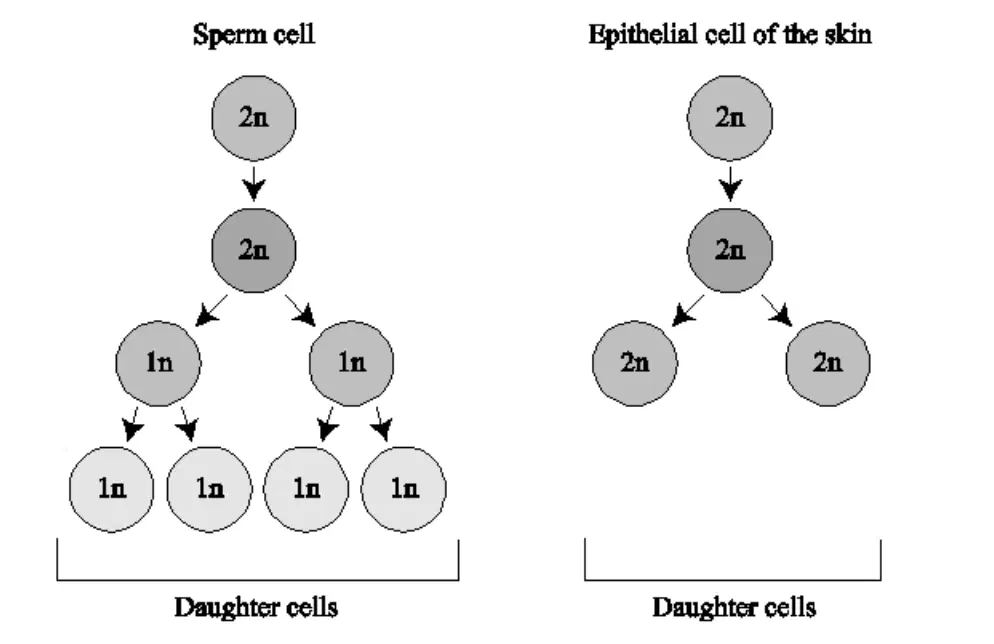
Cell division can occur either through meiosis or mitosis. The figure shown compares meiosis in a sperm cell with mitosis in a skin cell. Which key difference is observed in the daughter cells after both the cells complete cell division?
Sperm cells produce two daughter cells for each original cell.
The meiotic cell division of the sperm produces haploid daughter cells.
Daughter cells produced through mitosis in the skin cells have two nuclei.
Mitotic cell division of the skin cells causes a reduction in the chromosome number.
Which effect is most likely caused by nondisjunction during meiosis?
an increase in nuclei
an extra chromosome
only two types of nitrogenous bases
increased survival benefits from traits

Which part of the apple flower produces cells by meiosis?
style
anther
stigma
filament
What are the products of oogenesis?
1 ovum
1 ovum + 3 polar bodies
2 ova + 1 polar body
4 sperm

A ferret sex cell divides by meiosis. The daughter cells produced each have _______ chromosomes.
12
20
40
48
What is the meaning of the word part "non-"?
less
one
not
end

