
Font size
S
M
L
XL
 Worksheets
Current in Series and Parallel Circuits
Total questions: 17
Worksheet time: 17mins
Name
Class
Date
1.

This is an example of a _______ circuit
a)
open
b)
series
c)
parallel
d)
square
2.
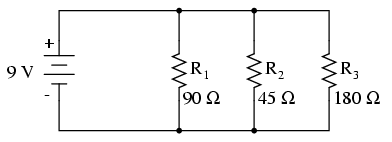
This is an example of a ______ circuit
a)
Series
b)
Parallel
c)
Open
d)
Dihexihedral
3.
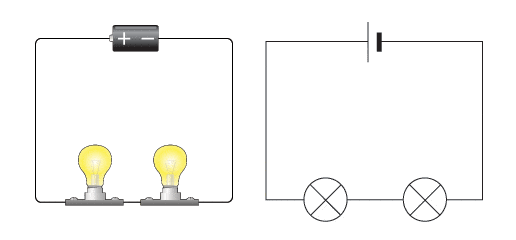
What kind of circuit is this?
a)
Series
b)
Consecutive
c)
Parallel
d)
Training
4.

What kind of circuit is this?
a)
Series
b)
Consecutive
c)
Parallel
d)
Training
5.

What will happen if one light bulb is removed from this circuit?
a)
The other bulbs will go out.
b)
The other bulbs will stay on
c)
The other bulbs will get dimmer.
d)
The battery will become stronger.
6.

Which of the two circuits would have the brightest bulbs?
a)
A
b)
B
7.

When you remove a bulb from a three bulb circuit, and the other two bulbs go off, then the bulbs must have been connected in __________.
a)
parallel
b)
series
c)
open
d)
closed
8.
Does this statement best describe a parallel or a series circuit.
When more light bulbs are added they all remain bright.
When more light bulbs are added they all remain bright.
a)
Parallel circuit
b)
Series circuit
9.

This circuit does not work because…
a)
the bulbs are not connected properly
b)
the single cell is not powerful enough
c)
there is a break in the circuit
d)
there is a short crcuit
10.

what is this symbol for?
a)
light bulb
b)
switch
c)
battery
d)
resistor
11.
In a series circuit...
a)
the current is the same everywhere.
b)
the current is split between components.
c)
the voltage is the same everywhere.
d)
the voltage is split between components.
12.
Ammeters should always be connected in (a) .
13.
In parallel circuits...
a)
the current is the same everywhere.
b)
the current splits at a junction.
c)
the voltage is the same everywhere.
d)
the voltage splits at a junction.
14.

What is the missing value on the ammeter?
(a)
15.

What is the reading on the labelled ammeter?
(a)
16.

What is the reading on the labelled ammeter?
(a)
17.
Voltmeters should always be connected in (a) around a component.
Reset

