
 Worksheets
Quiz - Evidence for Evolution
Total questions: 25
Worksheet time: 2hrs 5mins


In stage one (top row) of these embryos, most of the embryos look very similar. This is most likely because they....
all will develop into animals with backbones.
all will develop into land animals.
all will develop into animals that hatch from eggs.
all will develop into animals that live in water.

What type of evidence is represented in the picture above:
Fossil
Embryologic
Biochemical
Anatomic

What type of evidence is shown in the image above?
Fossil
Embryologic
Anatomic
Biochemical
_____________________are structures present in modern organisms which are no longer used.
DNA
Vestigial structures
Fossils
Homologous structures

What type of evidence are shown in the picture above?
Fossil
Embryologic
Anatomic
Biochemical


If an organism has a vestigial structure, that structure likely once served a purpose in a(n)
close relative
early ancestor
unrelated organism
embryological stage
Recently, scientists have been able to use ___________to find common proteins and amino acids to determine how closely related species are.
DNA
Vestigial structures
Fossils
Homologous structures
Click on ALL examples of a vestigial structure?
A whale's pelvis and femur.
A snake's hind legs.
A human's nose.
A human's appendix.
A human's wisdom teeth.
Which IS NOT used as evidence for evolution?
Fossils
Natural Selection
Early Development/Embryos
Body Structure/Anatomy
DNA/Proteins
Which type of evidence for evolution deals with identifying and dating the ancient remains of dead organisms?
Fossil
Embryologic
Biochemical
Anatomic

Structures with the same parts but have different functions; suggests that organisms share a common ancestry
vestigial structures
homologous structures
adaptive radiation
fossil

Which of the following is the collection of life's remains found in sedimentary rock?
natural selection
homologous structures
Charles Darwin
the fossil record
A bat wing and a butterfly wing are both used for flying but they are made differently. What type of structure is this?
Homologous structure
Analogous structure
Vestigial structure
Fossil structure
When comparing the DNA of two different organisms, the more differences in the DNA base pairs the more-
Closely related they are.
Distantly related they are.
It doesn't prove anything.
They look alike.

Which of the pictures above would be examples of homologous structures?
1 & 2
1 & 3
2 & 3
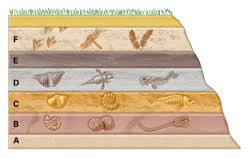
Which rock layer contains the newest fossils?
B
C
D
E
F
Why do you think sharks and dolphins look so much alike?
They have a recent common ancestor
They live in similar environments
They are both fish

How do whales benefit from a nostril at the top of the head?
It doesn’t interfere with the eyesight of the whale.
A whale can emerge from the water, inhale and resubmerge without stopping or tilting its snout to breathe.
The whale doesn’t need to breathe air because it has gills like fish.
The whale can use the nostril to smell prey so that it will not starve.
The evolution of whales began
550 million years ago.
in the water with fish and then continued on land
on land and then continued in water.
Before whales could leave land behind completely and live in the oceans permanently they had to develop the ability to ....
Swim quickly
Dive deeply
Drink salt water
Digest fish
In order to evade predators that were better swimmers ancient whales developed a shrunken ____________ which allowed them to swim acrobatically without getting dizzy.
Organ of balance
Hind leg
Tail
Brain
What unique adaptation did modern whales develop in order to hunt in the darker waters farther from the equator?
Larger eyes
A very sensitive sense of smell
Sonar/echolocation
The ability to sense vibrations in the water with the whiskers on the tip of their mouth

