
NEW
Font size
 Worksheets
Enzymes :D
Total questions: 22
Worksheet time: 12mins
With what 3 letters do enzymes typically end?
-ose
-ase
-ese
-tic
Enzyme molecules normally interact with substrate molecules. Some medicines work by blocking enzyme activity in pathogens. These medicines are effective because they
(1) are the same size as the enzyme
(2) are the same size as the substrate molecules
(3) have a shape that fits into the enzyme
(4) have a shape that fits into all cell receptors
Enzymes are an example of
Lipids
Carbohydrate
Protein
Nucleic Acid
What is the purpose of an enzyme?
give permission for the reaction
raise activation energy
speed up reactions
control how many reactions occur
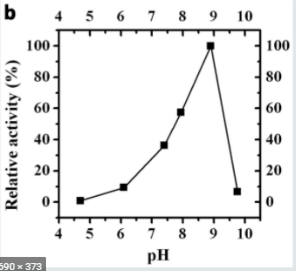
What is the optimal pH for this enzyme?
6
10
9
7
Once a new product leaves an enzyme, the enzyme is unchanged and ready for the next substrate. What is this called?
fragile
reusable
specific
catalyst
What will most likely happen if an appropriate enzyme is added to a chemical reaction?
The reaction rate will increase.
The equilibrium of the reaction will be maintained.
The reaction rate will decrease.
The reaction will stop.
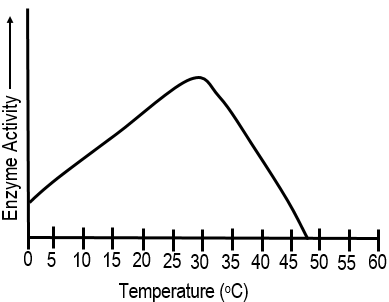
Based on the graph, what is the optimal temperature for this enzyme?
15oC
40oC
30oC
35oC

Which statement is supported by the information in the graph below?
The enzymes respond in a similar way to changes in temperature.
The enzymes in bacteria function best at 40°C.
The enzymes function best at the same temperature.
The enzymes break down the same substances.Listen

Base your answer to the following question on the graph above and on your knowledge of biology. The graph shows the relative rates of action of four enzymes, A, B, C, and D. Which enzyme shows the greatest change in its rate of action with the least change in pH?
A
B
C
D
Most enzymes are composed of .....
Lipids
Carbohydrates
Proteins
Nucleic Acids

(1) The amount of product formed will be equal to that produced at pH 6.
(2) The amount of product formed will be greater than that produced at pH 6.
(3) The amount of product formed will be less than that produced at pH 6.
(4) The amount of product formed can not be accurately predicted.
What is another name for enzymes?
chemical catalysts
microorganisms
biological catalysts
inorganic catalysts
When a piece of liver is dropped into hydrogen peroxide, the peroxide bubbles vigorously as the hydrogen peroxide (H2O2) decomposes into water (H2O) and oxygen (O2). This rapid change in reaction rate suggests
that liver contains lots of germs
the liver contains an enzyme that breaks down hydrogen peroxide
that liver is a substrate for hydrogen peroxide
that hydrogen peroxide is a powerful enzyme

The diagram best illustrates the relationship between
enzymes and synthesis
amino acids and glucose
antigens and immunity
ribosomes and sugar
What is the purpose of an enzyme?
give permission for the reaction
raise activation energy
speed up reactions
control how many reactions occur
Which of these is NOT true?
Enzymes can denature (change shape) when the temperature gets too high.
Enzymes can only be used once in a chemical reaction.
Extreme pH can denature enzymes.
Enzymes speed up chemical reactions.
What happens when enzymes are cooled down?
The enzymes die
The shapes of the enzyme are altered or denatured
The enzyme slows down
The active site is altered
Each enzyme only has 1 substrate that will fit its active site. What is this called?
reusable
catalyst
specific
fragile
How does an enzymes shape relate to its function?
the shape of the enzyme has no relation to its function
the enzyme is shaped specially for certain molecules to perform a specific reaction
the enzyme shape acts as a receptor to certain hormones
the enzyme shape can fit into specific molecules to stop a reaction
What happens when enzymes are cooled down?
The enzymes die
The enzyme slows down
The active site is altered

