
NEW
Font size
 Worksheets
Entropy, Enthalpy and Spontaneous Reactions
Total questions: 30
Worksheet time: 2hrs 30mins
What information do we need to perform a calculation of Gibbs Free Energy?
Enthalpy of the reaction.
Entropy of the reaction.
The temperature of the reaction in Kelvin.
All of the above are needed.
Your enthalpy is high and negative but your entropy is also negative. What type of temperature would you want to get a spontaneous reaction?
low
high
Which represents a decrease in entropy?
sublimation of CO2
boiling water
condensation of steam on cold glass
NaCl dissolving in water
Which has a +ΔS (system)?
AgNO3(aq) + NaCl(aq) → AgCl(s) + NaNO3(aq)
H2O(g) + CO2(g) → H2CO3(aq)
H2(g) + I2(g) → 2Hl(g)
C2H2O2(g) → 2CO(g) + H2(g)
Which of these have a DECREASE in entropy?
CaCO3(s) → CaO(s) + CO2(g)
2NO2(g) → N2O4(g)
2NH3(g) → 3H2(g) + N2(g)
C6H6(l) → C6H6(g)
The entropy will usually increase when
a molecule is broken into two or more smaller molecules
a reaction occurs that results in an increase in the number of moles of gas
a solid changes to a liquid
all of these
Which represents a -ΔS?
ice melting
salt dissolving
water heating up
none of these
Which combination of ΔH and ΔS NEVER has a spontaneous reaction?
+ΔH and +ΔS
+ΔH and -ΔS
-ΔH and -ΔS
-ΔH and +ΔS
Systems in nature tend to undergo changes toward
lower energy and less disorder
lower energy and more disorder
higher energy and less disorder
higher energy and more disorder
Which sample has the lowest entropy?
1 mole of KNO3(l)
1 mole of KNO3(s)
1 mole of H2O(l)
1 mole of H2O(g)
What is a spontaneous process ?
slow process
fast process
process that needs an external intervention to occur
process that does not need external intervention to occur / keep happening
Which of these reactions shows a DECREASE in entropy?
CaCO3(s) → CaO(s) + CO2(g)
3O2(g) → 2O3(g)
2NH3(g) → 3H2(g) + N2(g)
C6H6(l) → C6H6(g)
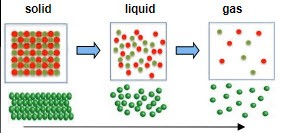
Which phase change represents a decrease in entropy?
solid to liquid
gas to liquid
liquid to gas
solid to gas
Which of these have a DECREASE in entropy?
CaCO3(s) → CaO(s) + CO2(g)
2NO2(g) → N2O4(g)
2NH3(g) → 3H2(g) + N2(g)
C6H6(l) → C6H6(g)
ΔS will be positive for the reaction
2H2 (g) + O2 (g) -> 2H2O (g)
2NO2 (g) -> N2O4 (g)
BaF2 (s) ->Ba2+ (aq) + 2F- (aq)
2Hg (l) + O2 (g) ->2HgO (s)
A reaction that is not spontaneous at low temperature can become spontaneous at high temperature if ΔH is __________ and ΔS is __________.
+, +
-, -
+, -
-, +
For a reaction to be spontaneous under standard conditions at all temperatures, the signs of ΔHΟ and ΔSΟ must be __________ and __________, respectively.
+, +
+, -
-, +
-, -
+, 0
Which reaction has a +ΔS ?
AgNO3(aq) + NaCl(aq) → AgCl(s) + NaNO3(aq)
H2O(g) + CO2(g) → H2CO3(aq)
H2(g) + I2(g) → 2Hl(g)
C2H2O2(g) → 2CO(g) + H2(g)
Which of the reactions below has a negative ∆S?
CuCO3 (s) + 2HCl (aq) → CuCl2 (aq) + CO2 (g) + H2O (l)
C (s) + O2 (g) → CO2 (g)
CuO (s) + H2SO4 (aq) → CuSO4 (aq) + H2O (l)
BaCl2 (aq) + Na2SO4 (aq) → BaSO4 (s) + 2NaCl (aq)
Entropy of a system decreases when mixing occurs.
True
False
As NaCl dissolves according to the equation
NaCl(s) → Na+(aq) + Cl-(aq), the entropy of the system
Increases
Decreases
Remains the same
Which of the following would have the highest entropy?
A cold solid
A hot liquid
A hot gas
A cold gas
1. The temperature increases when calcium chloride dissolves in water.
2. Steam condenses to liquid water
3. Water boils
4. Dry ice sublimates


