
 Worksheets
Atomic theory
Total questions: 30
Worksheet time: 17mins
Greek philosopher that was the first one to propose that everything in the world was made of tiny particles
Aristotle
Platon
Democritus
Dalton
What is the meaning of "atomo"
Small
Indivisible
Unbreakable
Invisible
Greek philosopher that proposed the theory of the four elements
Aristotle
Dalton
Democritus
Plato
Dalton thought that the atom was indivisible
True
False
Democritus thought that the atom could be divided into smaller particles
True
False
Dalton proposed that all the atoms of different elements were identical
True
False
He discovered the electron
Rutherford
Dalton
Bohr
Thomson
Chadwick
What atomic structure did Rutherford discover?
Protons
Neutrons
Electrons
Nucleus
Orbitals
Who developed the Plum pudding model of the atom?
Thomson
Rutherford
Bohr
Chadwick
Dalton
Who developed the planetary model of the atom?
Thomson
Rutherford
Aristotle
Bohr
Chadwick
Who developed the uncertainty principle?
Walter White
Heisenberg
Chadwick
Bohr
Rutherford
What is the particle that Chadwick discovered?
Protons
Neutrons
Electrons
alpha particles
Which equipment was used in the discovery of electrons?
Cathode ray tube
Particle collider
Microscope
Gold foil and detector screen
Why did Thomson conclude that cathode rays were made up of small particles that had mass?
Because they were bent by a magnet
Because they did not have an electric charge
Because they produced light
Because they needed batteries to move
Which subatomic particle has a negative charge?
proton
neutron
electron
Quark

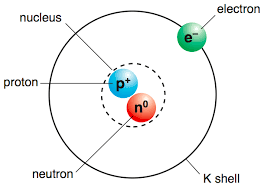
Which subatomic particles contribute the most to the mass of an atom?
Protons and Neutrons
Protons and Electrons
Protons only
Neutrons only
All matter is made of what
cells
atoms
electrons
compounds
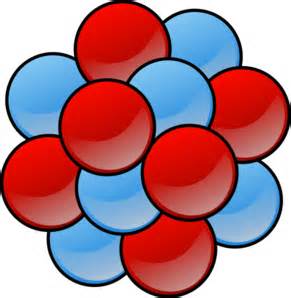
What does the nucleus of an atom contain?
Electrons and neutrons
Protons and neutrons
Neutrinos and positrons
DNA and RNA
Most of an atom's mass can be found where?
outerspace
in the atom
in the nucleus
in the electron cloud
According to Thomson, atoms are made up of mostly
mass
the nucleus
empty space
electrons
Why have Scientists only recently been able to see atoms?
Atoms are too small to see with ordinary microscopes
Early experiments disproved the idea of atoms
Scientist didn't know atoms existed
Scientist were not looking for atoms
Which subatomic particle has a positive charge?
proton
neutron
electron
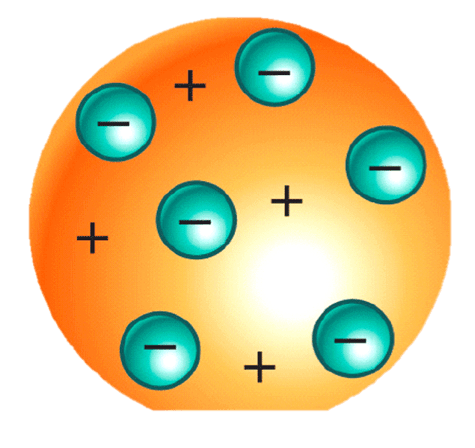
What is the atomic model that is being represented in this image?
Dalton's model
Bohr's model
Democritus' model
Thomson's model

What model is being represented by the following image?
Dalton
Bohr
Thomson
Rutherford
Atomic model that proposed that electrons are spinning around the nucleus of atoms in circular orbits with different energy levels
Bohr's model
Einstein's model
Quantum model
Thomson's model
Electrons are located:
In the nucleus
All around the atom
In electron clouds
Outside of the atom
Subatomic particle that has the lowest mass
electron
proton
neutron
Nucleus
Which picture represents the actual atomic model?


Subatomic particle that was the last one to be discovered
Electron
Proton
Neutron
Orbitals

