
 Worksheets
Chapter 21: Geometric optics
Total questions: 50
Worksheet time: 50mins
Your image behind a plane mirror is at a distance equal to
a. half your height.
b. half your distance from the mirror.
c. your distance in front of the mirror.
d. slightly more than your distance in front of the mirror.
Refraction occurs when a wave crosses a boundary and changes
a. speed and direction.
b. intensity.
c. frequency.
d. amplitude.

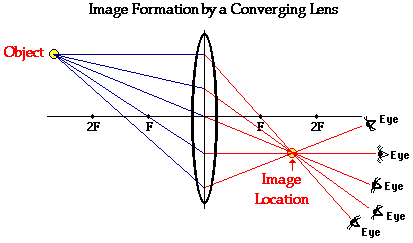
Compared to the object in front the lens, its image is.....
inverted and diminished
inverted and magnified
upright and diminished
upright and magnified
Concave lenses always produce images that are
Virtual, upright, diminished
Real, inverted, magnified
Real, inverted, diminished
Virtual, upright, magnified

A lens that curves inwards
Converse
Convex
Convection
Concave

A lens that curves outwards
Converse
Concave
Convex
Convection


This image is
real.
virtual.
When light rays reflect off a concave mirror they
Converge
Diverge
Polarize
None of the above
When light rays reflect off a convex mirror they
Converge
Diverge
Reflect
None of the above
The enlarged image can be obtained from............. Mirror.
Convex
Concave
Plane
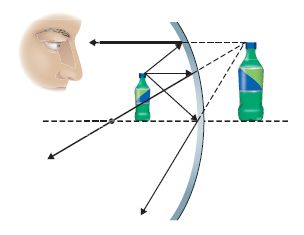
In a concave mirror, if an incident ray passes through F and hits the mirror then it will reflect
Towards C
Towards F
Parallel to the principle axis
towards from the mirror

A student is conducting an experiment with four different types of mirrors. Which mirror in the experiment is a convex mirror?
mirror 1
mirror 2
mirror 3
mirror 4
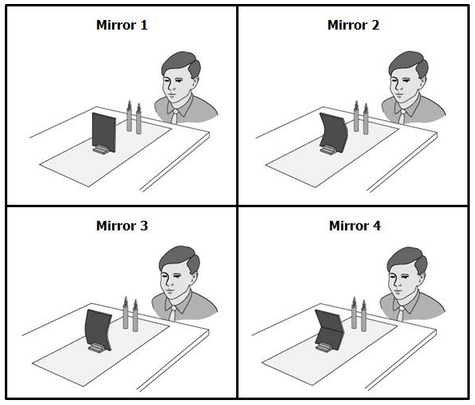
A student is conducting an experiment with four different types of mirrors. Which mirror in the experiment converges light and UP CLOSE, produces an upright, magnified image of the candles? (hint: no two mirrors are the same)
mirror 1
mirror 2
mirror 3
mirror 4
image above the principal axis (PA) is
virtual
real
upright
upside down
Which lens represents the path light takes through a diverging lens?


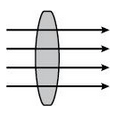
Which figure represents the path light takes through a converging lens?
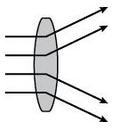
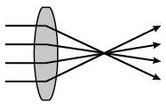
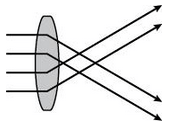

The diagram represents a converging lens forming an image of an object. Which of the following lines show the focal length of the lens?
PQ
PR
QR
QS

A student draws three rays of light from point P through a converging lens. Each point labelled F is a principal focus of the lens. Which of the rays are drawn correctly?
ray Y only
ray Z only
ray X and ray Y
ray X and ray Z
No image is formed when the object is placed at a distance .................. from the concave mirror.
equal to radius of curvature
more than radius of curvature
less than radius of curvature but more than focal length
equal to focal length
When the object is placed at .................. infront of a concave an equal image is fomred.
centre of curvature
focus
less than focal length
more than radius of curvature
What is the position of the image when an object is placed between the centre of curvature and the focal point of a concave mirror?
At the focus
At the centre of curvature
Beyond the centre of curvature
Between the focus and the centre of curvature
A shopkeeper wants to keep an eye on his store in order to prevent shoplifting. What could the shopkeeper hang on the wall in order to see a wider image of his store and his customers?
a convex mirror
a concave mirror
a convex lens
a concave lens
A dentist uses a small dental mirror to help magnify teeth in your mouth. What type of mirror is this?
a convex mirror
a concave mirror
a convex lens
a concave lens

What type of lens creates the image seen in the eyeglasses?
convex
concave
reflection
plane
When an object is placed between the focal point and the convex lens, the image produced is ___.
real, diminished, and inverted
real, magnified, and inverted
virtual, magnified, and upright
virtual, diminished, and upright

If an object's distance from a convex lens were increased, the image would become which of the following?
Same size
Magnified
Diminished
Magnified and diminished
A real image...
is produced by virtual rays and can be projected on a screen
is produced by real rays and cannot be projected on a screen
is produced by virtual images and cannot be projected on a screen
is produced by real rays and can be projected on a screen
Where can you place an object in front of a convex lens but not create an image?
At 2F
At F
Beyond 2F
Before F
The principle on which mirrors work is
Refraction.
Polarization.
Dispersion.
Reflection.
A light ray, traveling parallel to a concave mirror's axis, strikes the mirror's surface near its midpoint. After reflection, this ray
Again travels parallel to the mirror's axis.
Travels at right angles to the mirror's axis.
Passes through the mirror's center of curvature.
Passes through the mirror's focal point.
An object is situated between a concave mirror's surface and its focal point. The image formed in this case is
real and inverted.
real and upright.
virtual and upright.
virtual and inverted.
If you stand in front of a convex mirror, at the same distance from it as its radius of curvature,
You won't see your image because there is none.
You won't see your image because it's focused at a different distance.
You will see your image and you will appear smaller.
You will see your image and you will appear larger.
Convex spherical mirrors produce images which
Are always smaller than the actual object.
Are always larger than the actual object.
Are always the same size as the actual object.
Could be larger than, smaller than, or the same size as the actual object, depending on the placement of the object.
A convex lens has focal length f. An object is located at infinity. The image formed is located
Between f and 2f.
At f.
Between the lens and f.
At 2f.
Which of the following best describes the image for a thin concave lens that forms whenever the magnitude of the object distance is less than that of the lens' focal length
Inverted, enlarged and real.
Upright, enlarged and virtual.
Upright, diminished and virtual.
Inverted, diminished and real.
The process of blending of light as it passes from air into glass and vice versa is called
Reflection of light.
Deflection of light.
Defraction of light.
Refraction of light.
When light travels in water or glass, its speed
Increases.
Remains constant.
Becomes zero.
Decreases.
If R1 and R2 are the radii of curvature of a plano convex lens,
R1 is positive and R2 is negative.
Both R1 and R2 are negative.
R1 is positive and R2 is infinity.
R1 is negative and R2 is infinity.

