
 Worksheets
Muscular System Review
Total questions: 34
Worksheet time: 14mins

Take your time looking at the picture. You have 60 seconds. Which number represents the Fascicle?
(a)

The functional unit of the myofibril that can contract is the:
Sarcomere
Osteon
Myofilament
Muscle fiber
The point at which the nerve cell reaches the sarcolemma of the muscle fiber is the _____.
Neurotransmitter
Acetylcholine
Synaptic cleft
Neuromuscular Junction
One neuron and all the skeletal muscle cells it stimulates is the ____ ___.
Neurotransmitter
Neuromuscular junction
Motor unit
Synaptic cleft
The gap between the nerve cell and sarcolemma is the ____ ___.
Synaptic cleft
Neurotransmitter
Motor unit
Neuromuscular junction
What is the specific neurotransmitter that stimulates the movement of skeletal muscles?
GABA
Acetylcholine
Serotonin
Dopamine
Once the action potential reaches the end of the axon terminal what takes place?
ACh is released into the synaptic cleft.
Calcium is pumped into the sarcolemma of the muscle cell.
Calcium is pumped into the axon terminal of the neuron.
The muscle contracts.
Once ACh binds to receptor cells on the sarcolemma, what takes place?
Sarcolemma becomes temporarily permeable to sodium.
The muscle contracts.
Calcium is pumped into the axon terminal.
Synaptic vesicles move to the end of the terminal.
A ___extends from one Z disc to another Z disc.
Sarcolemma
Neuromuscular junction
Sarcomere
Motor end plate

Higher Questioning: What happens to the H zone and I Band during contraction?
They grow in size
They stay the same
They shrink in size
What causes the muscle to stop contracting?
Lack of effort
Myosin-Heads fail to attach
Calcium Ions are pumped away
Muscle fibre tears

What term best describes the movement in the picture?
Flexion
Extension
Abduction
Adduction

What term best describes the movement in the picture?
Adduction
Abduction
Flexion
Extension
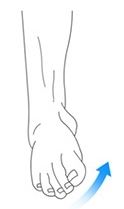


What movement is occurring here?
Eversion
Flexion
Dorsiflexion
Plantar flexion

Hamstrings
Quadriceps
Tibialis Anterior
Gastrocenmius

This is showing the major muscle group on your back, called what?
latissimus dorsi
trapezius
pectorals
external obliques

What muscle is the arrow pointing to?
Biceps
Triceps
Lats
Quads


The prime mover of arm abduction is the ________ muscle.
trapezius
deltoid
triceps brachii
biceps brachii
Which of these muscles is located on the ventral (anterior) side of the body?
pectoralis major
occipitalis
gastrocnemius
gluteus maximus
latissimus dorsi

