wayground logo

Free Printable Worksheets

NEW

Font size

S
M
L
XL
Worksheets

Natural Selection Review

Total questions: 35

Worksheet time: 19mins

Name
Class
Date
1.
What is the basis for all variation among organisms?
a)
Mutation
b)
Genetic Drift
c)
Migration
d)
Inbreeding
2.
Whether or not a variation is an adaptation is dependent on the organism's
a)
Environment
b)
Genotype
c)
Phenotype
d)
Selection
3.
Brown mice survive and reproduce in their desert environment better than white mice because owls can see and eat the white mice more easily. In this situation, what is doing the selecting?
a)
Owl
b)
Desert Background
c)
Brown Mice
d)
White Mice
4.
Why are advantageous traits more likely to be passed onto offspring?
a)
Because organisms with those traits are more likely to survive and reproduce.
b)
Because they come from dominant alleles.
c)
Because they come from recessive alleles.
d)
Because the trait is an acquired (learned) phenotype.
5.
Some lizards have different size legs.  Lizards with longer legs are able to better access food.  Overtime Lizards with short legs became less common.
What is the adaptation?
a)
Lizards
b)
Long legs
c)
Leg size 
d)
Food
6.
Some lizards have different size legs.  Lizards with longer legs are able to better access food.  Overtime Lizards with short legs became less common.
What is the inherited variation (trait)?
a)
Lizards
b)
Long legs
c)
Leg size
d)
Food
7.
Some lizards have different size legs.  Lizards with longer legs are able to better access food.  Overtime Lizards with short legs became less common.
What is the struggle to survive?
a)
Lizards
b)
Long legs
c)
Food
d)
Leg sizes
8.

Only populations can adapt and evolve.

Individuals cannot adapt and evolve.

a)

True

b)

False

9.
Which if these is a statement that Darwin would have rejected?
a)
The smallest entity that can evolve is an individual organism
b)
Environmental change plays a role in evolution
c)
Natural populations tend to produce more offspring than the environment can support
d)
Inherited variation in a population is a necessary precondition for natural selection to operate
10.
Which of these would be considered an adaptation of an animal that lives in the snowy tundra?
a)
Large webbed feet
b)
A thick coat of fur and blubber
c)
Green scales
d)
A diet that consists of pineapples and coconuts
11.
Giraffes long necks are an adaptation that allows them to feed on leaves of the tall trees in their environment. A giraffe is born with an unusually short neck. What will most likely happen as a result of this?
a)
It will run faster
b)
It will feed on termites instead
c)
It will have an easier time reproducing
d)
It will have a hard time getting food
12.

Which of these conditions is most likely to cause a species to become extinct due to environmental change?

a)

Less genetic variation

b)

More genetic variation

c)

Specific food preferences

d)

More competition for food

13.

Suppose a few brown mice had a mutation that resulted in a new allele that caused their fur to turn white in colder temperatures. Which of the following factors has the greatest effect on whether brown fur will become more common in mice population?

a)

If enough food and water were available

b)

If the new allele for fur color increases the survival of the mice

c)

If the new allele is presented more in females

14.

A long drought caused the plant species that produced seeds between 3 - 9 mm in size to go extinct. What does the Theory of Natural Selection predict will most likely happen to the population of seed-eating birds over time?

a)

It will adapt and the birds that ate the medium sized seeds will learn to eat fish, insects, or other animals

b)

It will diverge into two species: one that eats small seeds and one that eats large seeds.

c)

It will permanently shrink to approximately 25% of its current size

d)

It will go extinct because there aren’t enough seeds to support all of the individuals

15.
Of the following, which is NOT part of Darwin's theory of natural selection?
a)
Suitable variations in a population tend to be passed on while unsuitable variations in a population are not. 
b)
Variations in a population exist and those variations are inherited. 
c)
Individuals with variations suitable to their environment have shorter lifespans and produce fewer offspring.
d)
Living things tend to produce more offspring than can survive. 
16.

Darwin called the ability of an organism to survive and reproduce...

a)

variation.

b)

fitness.

c)

overproduction.

d)

adaptation.

17.

The change that occurs over long periods of time in the characteristics and diversity of organisms

a)

natural selection

b)

artificial selection

c)

evolution

d)

acquired characteristics

18.

The theory proposes that variability exists in a population and that the environment acts on this variation so that only the most fit individuals survive and reproduce

a)

theory of natural selection

b)

artificial selection

c)

evolution

d)

theory of acquired characteristics

19.

The breeding of organisms for a specific and desirable trait

a)

natural selection

b)

artificial selection

c)

evolution

d)

acquired characteristics

20.
A lion makes more cubs than the Sahara Desert can support (there's not enough prey around), so only a few of the cubs survive to become adults. They live on to reproduce.
Of the four parts of natural selection, which is this an example of?
a)
overproduction
b)
genetic variation
c)
selection
d)
adaptation
21.
Due to a mutation, some jaguars inherit larger jaw sizes than other jaguars within that population and this trait is passed down from parent to offspring. This gives those jaguars an advantage when it comes to hunting down turtles as prey.
Of the four parts of natural selection, which is this an example of?
a)
overproduction
b)
genetic variation
c)
selection
d)
adaptation
22.
Tigers with larger paws hunt deer more easily to survive in an environment where resources are limited. As a result, the tigers with larger paws are “selected” (the larger paws become more common in the next generation of tigers).
Of the four parts of natural selection, which is this an example of?
a)
overproduction
b)
genetic variation
c)
selection
d)
adaptation
23.
A beetle's ability to camouflage (blend in) with a nearby leaf allows it to escape a hungry frog's appetite.
Of the four parts of natural selection, which is this an example of?
a)
overproduction
b)
genetic variation
c)
selection
d)
adaptation
24.
How does embryology support the Theory of Evolution?
a)
It shows that they have a common ancestor because of their similarities.
b)
         I'm not sure.
c)
Animals change over time. 
25.
The most recent ancestral form or species from which two different species evolved is known as ________________________.
a)
a common ancestor.
b)
an embryonic stage.
c)
development.
d)
evolution.
26.
In the the third embryonic stage (bottom row), mammal embryos _____
a)
have more characteristics in common with each other than with reptiles or birds.
b)
are still hard to tell from reptiles and birds.
c)
have the same features as fish, reptiles, and birds.
d)
do not have tails.
27.

What type of evidence is represented in the picture above:

a)

Fossils

b)

Vestigial Structures

c)

DNA

d)

Homologous Structures

28.

What type of evidence is shown in the image above?

a)

Fossils

b)

Vestigial structures

c)

Homologous Structures

d)

DNA

29.
The similarities of the bones in the diagram provide evidence that---
a)
The organisms shown lived in the same natural envionrment
b)
The organisms shown may have developed from a common ancestor
c)
The organisms shown have the same genetic diseases
d)
All vertebrate species have identical forelimbs
30.
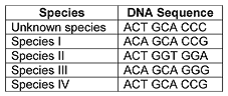
According to this data, the unknown bacterial species is most closely related to: 
a)
Species I
b)
Species II
c)
Species III
d)
Species IV
31.

The three species pictured do not share a common ancestor, yet have evolved to have a similar anatomy and life style. This is an example of ?

a)

Homologous Structures

b)

Divergent Evolution

c)

Vestigial Organs

d)

Convergent Evolution

32.

The three species pictured share a common ancestor and have adapted so that each lives in a different environment. This is an example of

a)

Law of Superposition

b)

Evolutionary Arms Race

c)

Divergent Evolution

d)

Convergent Evolution

33.

Some organisms that share a common ancestor have features that have different functions, but are similar in terms of their structure. These are known has

a)

vestigial structures

b)

analogous structures

c)

homologous structures

34.

Dolphins and sharks both have streamlined bodies, dorsal fins, and pectoral fins. The simililarities between dolphins and sharks are due to _______ evolution.

a)

divergent

b)

convergent

c)

homologous

d)

Darwinian

35.

Dolphins and sharks both have streamlined bodies, dorsal fins, and pectoral fins. The structures are similar in terms of function, but dolphins are mammals and sharks are not. Their fins are examples of

a)

homologous structures

b)

Vestigial structures

c)

analogous structures

d)

fitness