wayground logo

Free Printable Worksheets

NEW

Font size

S
M
L
XL
Worksheets

Physical Science Electricity & Magnetism

Total questions: 37

Worksheet time: 6hrs 10mins
Name
Class
Date
1.
When several light bulbs are connected in a series circuit, what will happen if one bulb burns out?
a)
All of the light bulbs will go out.
b)
The other bulbs will continue to burn.
c)
The other bulbs will burn together.
d)
There will be a short circuit.
2.
When electricity moves through a metal wire, the wire is
a)
a generator
b)
an insulator
c)
a generator
d)
a conductor
3.
Which material conducts electricity?
a)
piece of glass
b)
cotton t-shirt
c)
 rubber ball
d)
 copper coin
4.
To have an electric current when using batteries, there MUST be a
a)
 switch
b)
lightbulb
c)
complete circuit
d)
 motor
5.
Which term refers to the flow of electrical charges?
a)
conductance
b)
resistance
c)
current
d)
 energy
6.
Which of these is a conductor?
a)
a short length of string
b)
a plastic drinking straw
c)
 a piece of aluminum foil
d)
a piece of chalk
7.
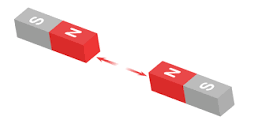
What will happen when these magnets are brought close together?
a)
They will attract each other.
b)
They will repel each other.
c)
Both magnets will turn to the left
d)
Both magnets will turn to the right
8.
Amy and Grayson have built a series circuit using a battery, some copper wire, and three light bulbs.  What should happen to the brightness of the light bulbs if they add another light bulb to the circuit?
a)
Nothing; the four bulbs will remain as bright as the original three bulbs.
b)
The fourth bulb will be dimmer, and the first bulb will be brightest.
c)
The four bulbs will be brighter than the original three bulbs.
d)
The four bulbs will be dimmer than the original three bulbs.
9.
The flow of electricity through a circuit can be compared to the flow of water through a pipe.  Using this comparison, the friction caused by the pipe wall would be similar to 
a)
the resistance of the circuit.
b)
the amperage of the circuit.
c)
the voltage of the circuit.
d)
the coulombs in the circuit.
10.
Atoms are made up of?
a)
sugar, spice and nice
b)
neutrons, protons, electrons
c)
copper, water, nuclear
d)
air, solid, liquid
11.

An electron's charge is:

a)

negative

b)

positive

c)

neutral

d)

forward

12.

A proton's charge is:

a)

negative

b)

positive

c)

copper, water, nuclear

d)

reverse

13.

A neutron's charge is

a)

negative

b)

positive

c)

neutral

d)

forward

14.
What type of circuit is shown in the picture?
a)
Double circuit
b)
Series circuit
c)
Magnetic circuit
d)
Parallel circuit
15.
What type of circuit is shown in the picture?
a)
Series
b)
Parallel
c)
Double
d)
Switch
16.
David is making an electric circuit. The circuit is correctly linked in two parallel paths. What will happen if one of the lights burns out?
a)
None of the lights will shine.
b)
All current flow will stop
c)
Only the burnt out light will not shine.
d)
A short circuit will occur
17.
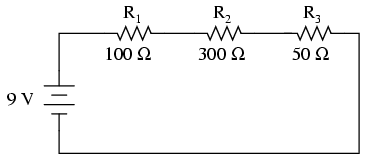
The total resistance in this circuit is 
a)
100 ohms
b)
450 ohms
c)
400 ohms
d)
30 ohms
18.
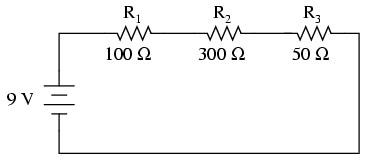
The total current through this circuit is
a)
0.02 amps
b)
0.09 amps
c)
50 amps
d)
9 amps
19.
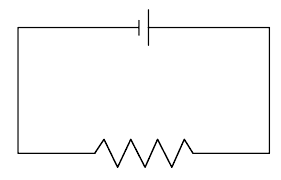
Pick the correct sentence.
a)
This circuit will work because it is a closed circuit.
b)
Energy will freely flow in this circuit.
c)
This circuit will not work because there is no energy source.
d)
This circuit will not work because there is no switch.
20.
what is this symbol for?
a)
light bulb
b)
switch
c)
battery
d)
resistor
21.
What size resistor would produce a 3 Amp current flow with a 12 Volt battery
a)
1 Ohm
b)
3 Ohms
c)
4 Ohms
d)
12 Ohms
22.
What is current measured in?
a)
Ω (Ohms)
b)
V (Volts)
c)
A (Amps)
d)
W (Watts)
23.
What is resistance measured in?
a)
Ω (Ohms)
b)
V (Volts)
c)
A (Amps)
d)
W (Watts)
24.
What is the Voltage of a circuit that has a resistance of 5 Ω and a current of 2 A?
a)
25 V
b)
10 V
c)
2.5 V
d)
0.4 V
25.

Voltage divided by Resistance

(V / R)

a)

Current

b)

Power

c)

Ohms

d)

Watts

26.
Current times Resistance equals
 (I X R)
a)
Power
b)
Voltage
c)
Amperage
d)
Ohm
27.
This circuit has a 24 volt battery and the resistor is 8 ohms. How many amps are running through the circuit?
a)
3 Amps
b)
192 Amps
c)
2 Amps
d)
4 Amps
28.
What types of charges attract?
a)
Positive and Positive
b)
Positive and Neutral
c)
Negative and Neutral
d)
Positive and Negative
29.
The accumulation of excess electric charge on an object is called
a)
Static electricity 
b)
Electric discharge
c)
Resistance
d)
Circuit 
30.

What is the major difference between static electricity and current electricity?

a)

Current electricity involves a continuous flow of elecrons; static electricity is a sudden transfer of protons

b)

Current electricity can be deadly; static electricity is almost always safe

c)

In current electricity, there's a single transfer of electrons; in static electricity, there's a steady flow of electrons

d)

Current electricity involves a flow of electrons; static electricity involves a single transfer of electrons

31.

What can you say about the current in the series circuit?

a)

it splits across the components

b)

it changes constantly

c)

it is different in different places

d)

it is the same everywhere

32.

If the ammeter says the current is 5A, what is the current flowing through one bulb?

a)

2.5A

b)

10A

c)

5A

d)

0

33.

What is the voltage drop for R1

a)

2 Volts

b)

3 Volts

c)

5 Volts

d)

10 Volts

34.

What is the voltage drop for R2

a)

2 Volts

b)

3 Volts

c)

5 Volts

d)

10 Volts

35.

What is the voltage drop for R3

a)

2 Volts

b)

3 Volts

c)

5 Volts

d)

10 Volts

36.
A circuit with 3 resistors, 10 Ohms, 30 Ohms and 20 Ohms are in series. What is the total resistance
a)
30 Ohms
b)
50 Ohms
c)
60 Ohms
d)
100 Ohms
37.
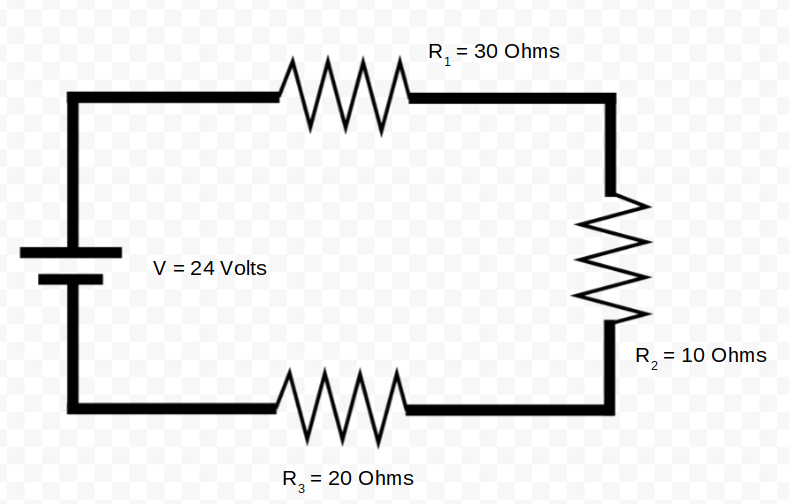
Find total resistance
total current
and the voltage through resistor 3

a)
60 Ohms, 0.4 A, 8 V
b)
60 Ohms, 2.5 A, 8 V
c)
90 Ohms, 2.5 A, 24 V
d)
60 Ohms, 0.4 A, 24 V