
 Worksheets
03/29 6wks Review
Total questions: 28
Worksheet time: 1hrs 18mins

(9A)
What is the domain?
All real numbers
All real numbers greater than 0
All real numbers less than 0
All real numbers greater than or equal to 0
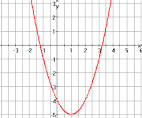
(6C)
What is the equation of this graph?
f(x) = (x -5)2 + 1
f(x) = (x - 1)2 - 5
f(x) = (x + 1)2 - 5
f(x) = (x + 5)2 +1
(8A)
The area of a notebook is given by the equation L2 - 5L = 6 where l represents the length of the notebook in centimeters. What is the length of the notebook?
6 cm
-6 cm
1 cm
-1 cm
y=4(x+2)2−8
Which of the following functions is equivalent?
y=4x2+16x+8
y=4x2+16x+16
y=16x2+64x−8
y=16x2+256x+8
(9C)
James' 70 in. giant peach doubles in size every week. Write an expression that would represent how big the peach is after 5 weeks.
70(2)35
70(2)5
2(70)5
5(70)2

(9A)
What would be the domain and range for this exponential graph?
Domain: All Real Numbers
Range: All Real Numbers Greater Than 0
Domain: All Real Numbers
Range: All Real Numbers
Domain: All Real Numbers
Range: All Real Numbers Greater Than 3
Domain: All Real Numbers
Range: All Real Numbers Less Than 3

(8A)
What are the zeros of the function?
Menu - 3, 3, 1
x = 4, -1
(-4, 1)
x = -4, 1
(4, 0) (-1, 0)
(6B)
y=−5(x+2)2−10
Which of the following functions is equivalent?
y = -5x2 - 20x - 30
y = -5x2 - 4x - 10
y = 25x2 + 100x + 90
y = 25x2 - 10x - 30
(9B)
What is a, the starting term, for the function: f(x) = 300(1.16)x?
300
1.16
.16
x

(9A)
What is the range of the function shown below?
0 < y < 12
-2 < y < 5
y > 0
All real numbers

(8A)
Solve the Quadratic. What are the 2 solutions?
Menu - 3, 3, 1
1.5, - 1.5
1.5
-1, 1
No real solution
(9C)
Suppose a culture of bacteria begins with 2000 cells and dies by 25% each year. Write an equation that represents this situation.
y=2000(0.75)x
y=25(2000)x
y=2000(1.25)x
y=2000xx
(9B)
What is b, the common ratio (growth factor), for the function: f(x) = 300(1.16)x?
300
1.16
.16
x
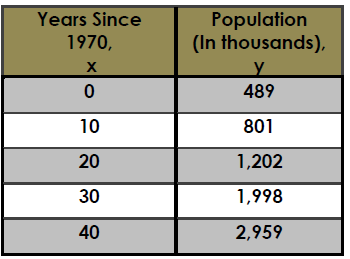
Find the best fitting quadratic model for the data given.
Lisits & Spreadsheets (label x and y and plug in x and y values)
Data (label x and y axis, press menu, 4, 6, 4)
1.2x2+13x+504.3
12x2+13x+504.3
0.12x2+1.3x+504.3


(9D)
Which equation is representative of the graph?
match the y-intercept.
y=4(1/2)x
y=1/2(4)x
y=4(2)x
y=8(1/2)x
(9C)
Which of the following functions shows an initial amount of $15 and an increase of 35% each year?
y = 15(35)x
y = 15(1.35)x
y = 15(0.35)x
y = 35(1.15)x
(9B)
What is the decay rate in the following model?
A=1200(.85)6
1200
.15
.85
6

(9D)
What is the asymptote of y = 2x - 3
y = 0
y = -3
x = 0
x = -3

(9A)
A
B
C
D
What is another word for zeros?
y-intercepts
Solutions
vertex
axis of symmetry
(9B)
What is r, the growth rate, for the function: f(x) = 300(1.16)x?
300
1.16
.16
x

(9A)
A
B
C
D

(9B)
Does the equation represent an exponential function?
Yes
No
(6C)
What is the equation of this graph?
f(x) = (x -5)2 + 1
f(x) = (x - 1)2 - 5
f(x) = (x + 1)2 - 5
f(x) = (x + 5)2 +1

(9A)
What is the Range of the function?
0 < y < 180
y > 80
All Real Numbers
0 < x < 6
(9D) or (9B)
Identify the y-intercept (initial value/ 'a') in the function
f(x)= 13(.27)x
(.27)x
.27
13
1+.27

(9D)
Whats the horizontal asymptote?
(0,3)
y=3
y=-2
y=2

