
 Worksheets
Net Force, Friction, and Gravity Quiz Review
Total questions: 38
Worksheet time: 1hrs 19mins
All of the following are true about forces EXCEPT
the SI unit is the newton
They can be applied as either a push or a pull on a object.
They always cause acceleration
They can cancel each other out
What does the magnitude of gravity between two objects depend upon?
Mass of the objects and the distance between them
Mass of the objects and their weights
The size of the bodies and their position relative to earth
The velocity of the bodies and the friction between them
All of the following are TRUE about frictional force EXCEPT
Friction acts in a direction opposite to the direction of an object's motion.
Friction is affected by weight and roughness of the surfaces in contact.
Friction is produced when objects move past each other.
Friction always acts in the same direction
Your feet push down on the floor and the floor pushes up with a balanced force. What force pulls you down? What force supports upward?
gravity, normal
normal, gravity
gravity, lift
normal, lift?
Which of these is opposed by static friction?
a player sliding on the ground
a skier sliding down a mountain
a guy jumping out of a plane
a chair being pushed backward but not moving
Which of these is opposed by kinetic friction?
a guy leaning against a building
a standing house of cards
a box sliding on the floor
a book sitting still on a desk

What is the net force for the following diagram?
0 N
100 N upward
400 N
50 N downward

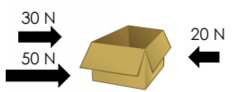
What is the net force for this picture?
0 N
5 N leftward
485 N rightward
240 N leftward

In this force diagram, which arrow is representing drag (air friction)?
A
B
C
D


An apple falls from the top of a tree and strikes the ground in 5 seconds. What is its approximate final velocity?
4.9 m/s
9.8 m/s
29.4 m/s
49.0 m/s
What is the definition of "weight"?
measure of the force of gravity on your body
the time it takes to get on a ride
the amount of matter in an object
the volume of an object
What is the rate of acceleration due to gravity acting on all objects on Earth?
9.8 m/s
9.8 m leftward
9.8 m/s2 upward
9.8 m/s2 downward
When will the forces of gravity between two objects be the GREATEST?
when the masses of both objects are small and the objects are far apart
when the masses of both objects are large and the objects are close together
when the masses of both objects are small and the objects are close together
when the masses of both objects are large and the objects are far apart
When will the gravity between two objects be the LEAST?
when the masses of both objects is small and the objects are close together
when the masses of both objects is small and the objects are far apart
when the masses of both objects is large and the objects are close together
when the masses of both objects is large and the objects are far apart

An object in freefall that moves along a path controlled by gravity is said to be _____
in orbit
in constant motion
in uniform motion
massless


What would happen to your weight if Earth's mass was cut in half?
double
decrease by one-half
decrease by by one-fourth
stay the same

Which object will hit the ground first if dropped at the same time at the same height in a perfect vacuum?
Object A because it is round
They will hit at the same time.
Object B because it has a large surface area
There is no way to tell.

Which ball will hit the ground first if dropped at the same time and at the same height in a perfect vacuum?
Metal first, then plastic, then wood last
Wood first , then plastic, then metal last
They will all hit at the same time
There is no way to tell.

When only the force of gravity is acting on an object, we say that the object is in ___________________________.
Terminal Velocity
Free Fall
Projectile motion
Centripetal acceleration
Force of gravity is inversely proportional to the square of ____:
mass
weight
distance
tangential speed
Which of the following statements is always TRUE?
An object at rest has no forces acting on it.
Unbalanced forces lead to a change in speed or direction (cause acceleration).
Gravity always leads to an unbalanced force.
The net force on a moving object can never be zero.
The weight of a body varies from location to location. Where would the weight of the body be greatest?
On top of Mount Everest
In space
On the moon
At sea level on Earth
How could you change the mass of an object?
Change the shape of the object.
Increase or decrease the amount of matter in the object.
Move the object to a smaller celestial body.
Increase the gravitational pull on the object.
When a pair of balanced forces acts on an object, the net force that results is
greater in size than one of the forces.
equal to zero.
equal in size to one of the forces.
greater in size than both forces combined.

A boy standing on a high cliff dives into the ocean below and strikes the water with a velocity of 29.4 m/s. How long was the boy in the air before he dove into the water?
1 second
2 seconds
3 seconds
4 seconds
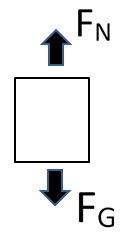
Which of the following is true about this net force diagram?
the forces are are balanced
the object is free-falling
the object is moving upward
the forces are unbalanced
To keep a heavy box sliding across a carpeted floor at constant speed, a person must continually exert a force on the box. This force is used primarily to overcome which of the following forces?
A. Air resistance.
B. The weight of the box.
C. The frictional force exerted by the floor on the box.
D. The gravitational force exerted by the Earth on the box.


The diagram shows a box being pulled up the ramp. Which letter represents applied force?
A
B
C
D

The biker travels at constant velocity. All of the following are true EXCEPT
He has a net force acting on him.
The normal force is equal to his weight.
The force of friction acts opposite the direction of his motion.
The force of friction is equal to the forward force he applies.
Mass and weight are not the same, but they are related.
A book has a mass if 1.2 kilograms. What is its weight?
1.2 newtons
0.012 newtons
0.12 newtons
12 newtons
A woman stands on a weighing scale which reads 650 newtons. What is her mass?
0.65 kg
650 kg
6.5 kg
65 kg

