wayground logo

Free Printable Worksheets

NEW

Font size

S
M
L
XL
Worksheets

Champion of Sound Unit Review Science March 29 2021

Total questions: 70

Worksheet time: 2hrs 43mins

Name
Class
Date
1.

Sound travels through all of the following except

a)

air

b)

gas

c)

solid

d)

vacuum

2.

Sound is a form of

a)

energy

b)

hearing

c)

listening

d)

light

3.

Sound travels ........

a)

inward to its source

b)

away from its source in all directions

c)

away from its source in some directions

d)

only in air

4.

Sound moves when ......

a)

particles hit each other and pass on the vibration

b)

particles standstill

c)

particles float off in spaces

d)

particles are suspended inside the air

5.

Sound needs a ......... to travel

a)

point

b)

medium

c)

destination

d)

echo

6.

Through which medium does sound travel the slowest?

a)

air

b)

liquids

c)

solids

d)

vacuum

7.

Through which medium does sound travel the fastest?

a)

air

b)

liquids

c)

solids

d)

vacuum

8.

Sound does not travel in which of the following

a)

air

b)

liquids

c)

solids

d)

vacuum

9.

In which medium are particles loosely packed?

a)

air

b)

liquids

c)

solids

d)

vacuum

10.

In which medium are particles closely packed?

a)

air

b)

liquids

c)

solids

d)

vacuum

11.

Through which medium does sound travel the slowest?

a)

air

b)

liquids

c)

solids

d)

vacuum

12.

Sound needs a ......... to travel

a)

point

b)

medium

c)

destination

d)

echo

13.

Sound is a form of

a)

energy

b)

hearing

c)

listening

d)

light

14.
An ________ is a reflected sound.
a)
Vibration
b)
Echo
c)
Pitch
d)
Volume
15.
_____________ is the highness or lowness of a sound.
(Hint: Think about our sound song.)
a)
Amplitude
b)
Pitch
c)
Volume
d)
Vibration
16.
__________ means to move back and forth quickly.
a)
Pitch
b)
Amplitude
c)
Vibration
d)
Echo
17.
______________ is the amount of energy in a sound wave.
a)
Amplitude
b)
Echo
c)
Volume
d)
Vibration
18.
Sound is a form of energy produced by ______________.
a)
vibrations
b)
distances
c)
prisms
d)
Ms. Crews
19.
Your ear changes the vibration of sound waves into signals. The signals are then interpreted by your brain.
a)
True
b)
False
20.
Sound waves travel the FASTEST through _____________.
a)
gases
b)
liquids
c)
solids
21.
Sound waves travel the SLOWEST through _____________.
a)
gases
b)
solids
c)
liquids
22.

An object that does not vibrate cannot produce

a)

Sound

b)

Light

c)

Heat

d)

Electricity

23.

A place where no sound exists is...

a)

in the air.

b)

under water.

c)

space.

d)

all of the above

24.

Why do we see lightning before we hear the thunder?

a)

Our eyes trick us.

b)

Light travels faster than sound.

c)

they're two separate things.

25.

When people speak their ________ vibrate.

a)

Ear drums

b)

Vocal chords

c)

Ears

d)

Tongue

26.

What is Pitch?

a)

How loud or soft a sound is.

b)

Muscle that holds vocal cords.

c)

Movement back and forth.

d)

How high or low a sound is.

27.

Which device measures sound waves?

a)

Oscilloscope

b)

Stethoscope

c)

Radio

d)

None of the above

28.

A sound with a high frequency has a _____ pitch. A sound with a ____ frequency has a low pitch.

a)

high, low

b)

low, high

c)

medium, high

d)

high, medium

29.

______________ sounds have a larger amplitude

a)

Quiet

b)

Loud

30.

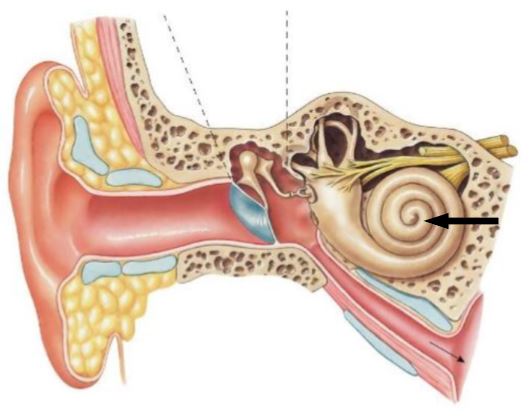
What is this?

a)

Nerve

b)

Ear canal

c)

Cochlea

d)

Ear Drum

31.
If you had to make some headphones to isolate sound, which material would you use?
a)
Soft, because they absorb sound. 
b)
Hard, because they reflect sound. 
32.
___________ is made when something vibrates
a)
light
b)
sound
c)
drum
d)
pounding
33.
Two identical strings are the same length. One of the strings is pulled tightly and the other string is more loose.
Identify which string will produce a higher-pitched sound when the strings are plucked
a)
the tight string
b)
the loose string
34.
The part of the ear that vibrates first when hearing a sound
a)
eardrum
b)
cochlea
c)
Outer ea
d)
Lobe
35.
If you hear a LOUD sound, what should you not do? 
a)
Use ear plugs
b)
Get closer/ Make the sound louder
c)
Turn down the music or move away from the sound
36.
How will loud sound affect your hearing? 
a)
More Ear Wax 
b)
Make it better 
c)
Damage it 
d)
No affect 
37.
If you want to change the pitch of a sound, you have to change the ___
a)
frequency
b)
amplitude
c)
speed
d)
volume
38.
What happens when you increase the amplitude of a sound?
a)
it makes the sound louder
b)
it makes the sound travel faster
c)
it increases the wavelength of the sound
d)
it increases the frequency of the sound
39.
This is the unit used to measure the volume of a sound. 
a)
Decibel
b)
Medium
c)
Vibration
d)
Oscilloscope
40.
True or False: Can sound travel through a vacuum (space).
a)
True
b)
False
41.
True or False: Sound travels better through solids than through liquids
a)
True 
b)
False
42.
Bats use ________ TO LOCATE MOSQUITOES IN THE AIR.
a)
solar
b)
ecology
c)
echolocation
d)
evolution
43.
Why is sound able to travel faster through a solid than a gas?
a)
Gas molecules are packed tightly.
b)
Sound does not travel faster through a solid than a gas.
c)
Solid molecules are packed tightly.
d)
Gas molecules move slowly.
44.
How does a sound wave interact with a human ear?
a)
vibrates the ear drum
b)
bounces off the ear canal
c)
rotates the ear drum
d)
vibrates the ear canal
45.
To make a sound from a stringed instrument louder you must
a)
hit it
b)
pluck it harder
c)
hold it higher
d)
pluck it softer
46.

A sound wave can travel through....

a)

Solids only

b)

Liquids only

c)

Solids, Liquids, and Gas

d)

Gas only

47.
High pitch sounds are caused by a ______ vibration
a)
fast 
b)
slow
c)
hard
d)
soft
48.
Low pitch sounds are caused by a ______ vibration
a)
fast 
b)
slow
c)
hard
d)
soft
49.

True or False: Sound waves are produced when something vibrates.

a)

True

b)

False

50.

Sound waves are _______ waves.

a)

Transverse

b)

Seismic

c)

Longitudinal

d)

Slow

51.
An object that does not vibrate cannot produce
a)
sound
b)
light
c)
heat
d)
electricity
52.
Sound is a form of? 
a)
energy
b)
pitch
c)
volume
53.
Sound travels FASTEST through which of these materials?
a)
Air
b)
Empty space
c)
Metal
d)
Water
54.
Why is the school library covered with carpet?
a)
So everyone can make a lot of noise
b)
to help absorb sounds to keep it quiet
c)
because it looks good
d)
to help absorb sounds so it can stay noisy
55.
To make a sound from a stringed instrument louder you must
a)
hit it
b)
pluck it harder
c)
hold it higher
d)
pluck it softer
56.
How does sound travel?
a)
Sounds travels in waves
b)
sound travels slow
c)
sound travels fast
d)
sound doesn't travel
57.
How can we protect our ears from hearing loss?
a)
wear ear plugs
b)
put our fingers in our ears
c)
Try not to listen to loud things
d)
All of the above
58.

What is the range of frequencies audible to the human ear

a)

lower than 20 Hz

b)

20 Hz - 20.000 Hz

c)

higher than 20.000 Hz

d)

0 Hz - infinite Hz

59.

What is ultrasound?

a)

Sound with a frequency higher than 20.000 Hz

b)

Sound with a frequency lower than 20 Hz

c)

Sound with a frequency 20 Hz

d)

sound with a frequency 20.000 Hz

60.

Which of these is NOT a medium?

a)

light

b)

air

c)

wood

d)

metal

61.

Sarah and Maria made a telephone using two cans and a string. It was a very long string. Maria went upstairs in her house and Sarah stayed downstairs. Maria spoke softly into the can. "I can hear you!' Sarah said back. How can this happen?

a)

Sound waves travel through a vacuum.

b)

Sound waves travel from high to low.

c)

Sound waves travel through solids like the string.

d)

Maria talked so loudly that Sarah could hear her without the phone.

62.

Will a homemade telephone made of two cans and a string work better with a tightly-woven string or a loosely-woven string?

a)

a tightly woven string because it will not come apart as easily

b)

a loosely woven string because the sound waves have more room to move

c)

a tightly woven string because sound waves travel best through dense materials

d)

a loosely woven string because sound waves travel best through less dense materials

63.

Sound travels faster in objects that have a greater.....

a)

Mass

b)

Density

c)

Volume

d)

Yards

64.

Research ships use sound waves to find objects underwater. What happens to the sound waves when they are emitted from the ship?

a)

They are absorbed by the water around the ship.

b)

They are reflected off objects they strike in the water.

c)

They are absorbed by the air above the ship.

d)

They are refracted as they strike the water.

65.
Fishermen use a depth finder to send ultrasonic waves into the water.  The time it takes for sound waves to return helps them determine where to fish.  WHich property of sound reveals the location?
a)
frequency
b)
intensity
c)
pitch
d)
reflection
66.

Why can't humans hear sounds made by animals such as whales?

a)

Humans have a great range of sounds that can be heard.

b)

There are ultrasounds and infrasounds beyond human hearing.

c)

Whales live in the water where sound is unable to be transmitted.

d)

Whales are too large to make any sounds.

67.
Caroline tapped a glass filled with water and heard a sound. Which action would raise the pitch?
a)
pour some water out of the glass
b)
put more water into the glass
c)
heat the water
d)
coll the water
68.
Which of the following best shows how sound waves travel?
a)
a branch on a tree moving
b)
a car speeding down the road
c)
a baseball hit by a bat
d)
a pebble dropped in a bowl of water
69.
Sound travels through solids.
a)
True
b)
False
70.
Why does cupping your hands around your mouth when you shout make the sound travel further?
a)
The sound spreads out.
b)
Your voice gets louder.
c)
You are screaming.
d)
The sound energy is directed in one direction.