wayground logo

Free Printable Worksheets

NEW

Font size

S
M
L
XL
Worksheets

ENZYMES JEDI TRAINING

Total questions: 15

Worksheet time: 6mins

Name
Class
Date
1.
What is a catalyst?
a)
Process that changes one set of chemicals into another
b)
Element or compound that enters into a chemical reaction
c)
Element or compound produced by a chemical reaction
d)
Substance that speeds up the rate of the chemical reaction
2.
Which of the following decreases the activation energy necessary to initiate the chemical change within the body?
a)
nucleotides
b)
enzymes
c)
amino acids
d)
fatty acids
3.
The human body maintains a temperature of around 98.6 degrees at all times. Enzymes are involved in almost every chemical reaction in the body. Which of the following describes the connection between these two statements? 
a)
Enzymes function best at a specific temperature.
b)
The body needs to be warm to prevent hypothermia.
c)
The body is kept relatively warm to prevent too much enzyme action. 
d)
There is no connection between the two statements. 
4.

What is it called when a protein loses its shape?

a)

Denaturation

b)

Unfolding

c)

Coiling

d)

Inactivation

5.
Which of these is NOT true.
a)
Enzymes can denature (change shape) when the temperature gets too high.
b)
Enzymes can only be used once in a chemical reaction. 
c)
Enzymes can denature when the pH changes. 
d)
Enzymes speed up chemical reactions. 
6.
Which of these do NOT affect enzyme activity?
a)
Temperature
b)
pH
c)
Competitive Inhibitors
d)
Carbohydrates
7.
Enzymes need certain environmental conditions in order to function properly.  What happens when enzymes are heated to a high temperature?
a)
they die
b)
they denature
c)
they change their amino acid sequence
d)
they work better
8.
How do enzymes work?
a)
Slow down chemical reactions
b)
Prevent chemical reactions from working
c)
increase the activation energy
d)
speed up the chemical reaction
9.
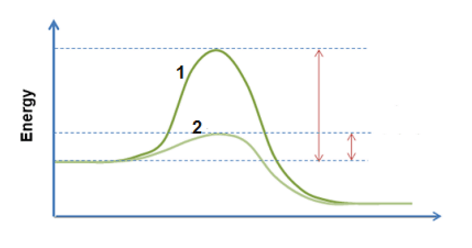
The graph shows how enzymes affect reactions in cells. Which statement best summarizes the information shown in the graph?
a)
Enzymes increase the energy of the reactants.
b)
Enzymes decrease the energy level of the products.
c)
Enzyme decrease the activation energy of the reaction.
d)
Enzymes reverse the direction of the reaction.
10.
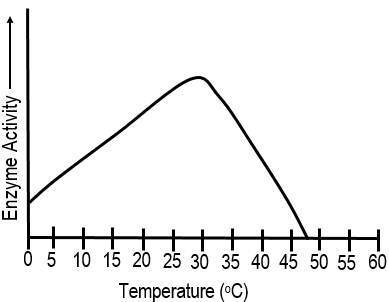
Based on the graph, what temperature does this enzyme work best? 
a)
15 C
b)
40 C
c)
30 C
11.
Which line represents an enzyme-catalyzed reaction? 
a)
Line 1
b)
Line 2
12.

As food travels through the digestive system, it is exposed to a variety of pH levels. The stomach has a pH of 2 due to the presence of hydrochloride acid (HCl), and the small intestine has a pH ranging from 7 to 9. HCl converts pepsinogen into pepsin, an enzyme that digests proteins in the stomach. Which of the following most likely happens to pepsin as it enters the small intestine?

a)

It becomes inactive.

b)

It begins to replicate.

c)

It's shape changes to engulf large proteins.

d)

It's activity increases to digest more proteins.

13.

In living cells, enzymes act as catalysts, which may reduce the amount of activation energy required for a chemical reaction to occur. In the graphs below, pathway x is a solid line representing the uncatalyzed reaction. The dotted line shows the catalyzed reaction. Which graph best illustrates the changes in a reaction when the catalyst reduces the amount of energy required?

a)
b)
c)
d)
14.

Which of the following best explains why enzymes are necessary for reactions in our cells?

a)

The reactions are too slow to meet the needs of the cell if enzymes are missing.

b)

Enzymes supply the oxygen necessary for the reactions.

c)

Enzymes change reactants from solid to liquid during the reactions.

d)

The reactions take up too much space in the cell if enzymes are missing.
15.

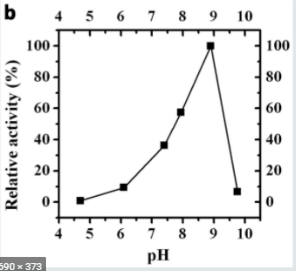
What is the optimal pH for this enzyme?

a)

6

b)

10

c)

9

d)

7