Wayground logo

Free Printable Worksheets

Font size

S
M
L
XL
Worksheets

Exponential Growth & Decay

Total questions: 47

Worksheet time: 1hrs 29mins

Name
Class
Date
1.
What is the pattern you see in this table?
a)
Common Ratio = 1/3
b)
Common Difference = 8
c)
Common Ratio = 3
d)
Common difference = 3
2.
Which equation matches the graph?
a)
y=2(2)x
b)
y=2(1/2)x
c)
y=2x
d)
y=1/2(2)x
3.
If a table's pattern is that the f(x) values are being divided by 3, what is the common ratio?
a)
3
b)
-3
c)
1/3
d)
-1/3
4.
What is the y-intercept of the function?
a)
2
b)
3
c)
1
d)
-2
5.
What is the equation that represents the exponential function in the image below?
a)
y=3(½)x
b)
y=3(2)x
c)
y=(2)x
d)
y=2(3)x
6.
What type of function is y = 7(5/4)x?
a)
Exponential Growth
b)
Exponential Decay
c)
Linear
d)
None of the above
7.
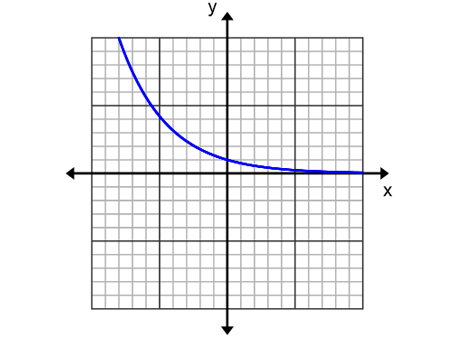
Is the pictured graph growth, decay, or linear or none?  
a)
Exponential Growth
b)
Exponential Decay
c)
Linear
d)
None
8.
Is this exponential growth or decay?
a)
Growth
b)
Decay
9.
Classify the model as Exponential GROWTH or DECAY.
A=1200(.85)6
a)
Growth
b)
Decay
10.
Is this exponential growth or decay?
a)
Growth
b)
Decay
c)
Linear
11.
What type of function is f(x)=2(1/7)x ?
a)
Exponential Growth
b)
Linear
c)
Exponential Decay
d)
None of the Abovee
12.
Is this exponential growth or decay?
a)
Growth
b)
Decay
13.

Is y = 5(1.04)x growth or decay?

a)

Growth

b)

Decay

14.
Is the pictured graph growth, decay, or linear or none?  
a)
Exponential Growth
b)
Exponential Decay
c)
Linear
d)
None
15.
Is this exponential growth or decay?
a)
Growth
b)
Decay
16.

What is the Domain of this exponential function?

a)

y=1

b)

x=0

c)

All Real Numbers

d)

x>0

17.

What is the Range of this function?

a)

y>0y>0  

b)

x> 0

c)

All Real Numbers

d)

y= 1

18.

What is the Domain of the function?

a)

80 < y < 180

b)

0 < x < 6

c)

All Real Numbers

d)

x > 0

19.

What is the Range of the function?

a)

0 < y < 180

b)

y > 80

c)

All Real Numbers

d)

0 < x < 6

20.

What is the Domain of this function?

a)

25 < x < 10

b)

All Real Numbers

c)

0 < x < 30

d)

0 < y < 30

21.
a)

A

b)

B

c)

C

d)

D

22.
What is the equation that represents the exponential function in the image below?
a)
y=3(½)x
b)
y=3(2)x
c)
y=(2)x
d)
y=2(3)x
23.

What type of function is f(x)=2⋅(1/7)x ?

a)

Exponential Growth

b)

Linear Function

c)

Exponential Decay

d)

Quadratic Fuction

24.

What is the y-intercept of the function f(x)=2(4)x ?

a)

2

b)

4

c)

(4)x

d)

8

25.

Identify the y-intercept (initial value) in the function

f(x)= 13(.27)x

a)

(.27)x

b)

.27

c)

13

d)

1+.27

26.

What is the exponential factor of the following graph?

a)

Growth

b)

Deccay

c)

Linear

d)

None

27.

What is the horizontal Asymptote of exponential functions?

a)

y=0

b)

y>0

c)

All real numbers

d)

Idk, I need tutoring

28.
What is the y-intercept represented by the equation y = 10(5x)
a)
5
b)
5x
c)
10
d)
2
29.
What is the range of f(x) = 5x?
a)
-∞ ≤ x ≤ ∞
b)
-∞ ≤ y ≤ ∞
c)
x > 0
d)
y > 0
30.
Given y=3x determine the y-intercept 
a)
(0,1)
b)
(0,3)
c)
No Y-intercept
d)
y=1
31.
Given y=3x determine the asymptote
a)
(0,1)
b)
(0,3)
c)
x=0
d)
y=0
32.
Is the graph exponential growth or decay?
a)
Exponential growth
b)
Exponential decay
33.
Is the following function exponential growth, exponential decay, linear, or none of the above.
g(x) = 740(.001)3x
a)
Exponential growth
b)
Exponential decay
c)
Linear
d)
None of the above
34.

Does the equation represent an exponential function?

a)

Yes

b)

No

35.

Does the equation represent an exponential function?

a)

Yes

b)

No

36.

Does the equation represent an exponential function?

a)

Yes

b)

No

37.
What is a, the starting term, for the function: f(x) = 800(0.85)x?
a)
800
b)
0.85
c)
0.15
d)
x
38.
Pick the equation that is exponential decay
a)
y=2000(0.88)
b)
y=0.5(1.88)
39.
In an exponential function, what does the 'a' represent? 
a)
SLOPE
b)
RATE OF CHANGE
c)
Y-INTERCEPT
d)
COMMON RATIO
40.
Identify the following exponential function
y = 31(1.54x) 
a)
Exponential Growth
b)
Exponential Decay
41.
Identify the following exponential function
y = 74(10.743x)
a)
Exponential Growth 
b)
Exponential Decay
42.

Write the function for the following table:

a)

f(x)= 1(2)^x

b)

f(x)= 2(1)^x

c)

f(x) = 2x+1

d)

f(x)= x+2

43.

Write the function for the following table:

a)

f(x) = 1(3)^x

b)

f(x) = 3(3)^x

c)

f(x) = 3x+3

d)

f(x)= 6x+1

44.

Write the function for the following table:

a)

f(x)= 1/3x + 27

b)

f(x)= 3x+27

c)

f(x)= 243(3)^x

d)

f(x) = 27(1/3)^x

45.

What is the growth/decay factor?

a)

1

b)

.8

c)

1.8

d)

.2

46.

What type of pattern do exponential functions have?

a)

Adds by the same number every time

b)

Multiplies by the same number every time

c)

Square roots all the inputs

d)

Squares all the inputs

47.
Pick the equation that is exponential growth
a)
y=2(0.5)x
b)
y = 0.5(2)x