
 Worksheets
Evidence for Evolution
Total questions: 21
Worksheet time: 44mins

Humans, birds, whales and lizards all have similar arm bones. What do evolutionists consider is the reason for this?
The function of these bones is the same in all animals
They live in similar environments
They have a common ancestor
All organisms resemble humans

The process by which populations slowly change over time is called__________
selective breeding
adaptation
sepeciation
evolution

From an evolutionary perspective, organisms that share a common ancestor have structures that are similar, but have different functions.These similar structures are known as
vestigial structures
analogous structures
homologous structures
fossil structures

The diagram shows fossils in different rock layers. Which of these statements about the age of these fossils is most likely correct from the evolutionary perspective?
Fossil A and C are the same age
Fossil B is older than fossil C
Fossils A is older than fossil B
Fossil D is older than fossil C

An inherited trait that helps the organisms that have it to survive is known as a/an
niche
structure
characteristic
adaptation
Which scientist is credited with coming up with the theory of natural selection?
Charles Darwin
Gregor Mendel
Isaac Newton
Albert Einstein
Which term means that only the best suited organisms will survive and reproduce?
geographic isolation
extinction
natural selection
evolution
Structures are similar in function but not in anatomical structure
Vestigial
Homologous
Analogous Structures
Embryonic

Which process of evolution is demonstrated below?
Comparative anatomy
Homologous structures
Comparative embryology
Vestigial structures
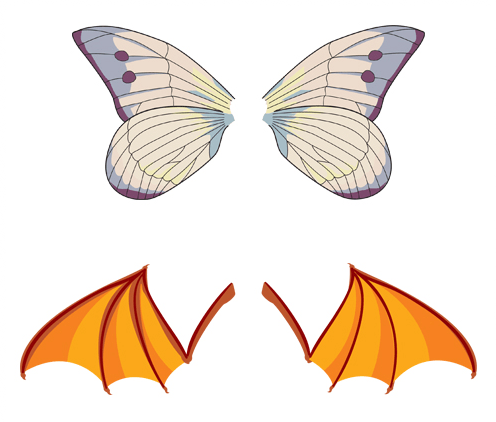
What type of structures are these?
Homologous
Analogous
Vestigial
Fossils
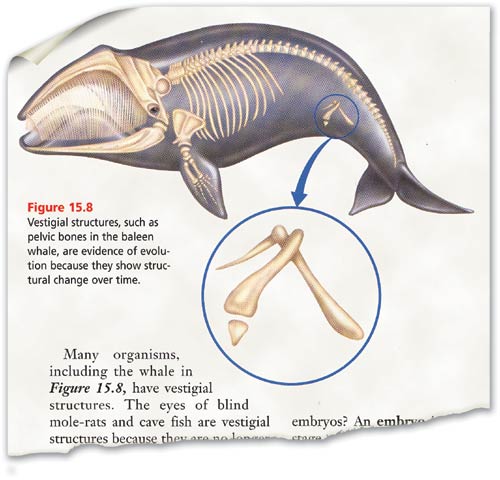
Which of the following is an example of a vestigial structure?
the wings of a red-tailed hawk
the hind limbs of a house cat
the fins of sharks
the tailbone of a human

What type of evidence of evolution is being demonstrated?
Fossil record
Vestigial structures
Homologous structures
Comparative DNA
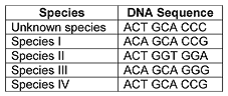
According to this data, the unknown species is most closely related to ...
Species I
Species II
Species III
Species IV
The human gene for muscle protein differs from the muscle protein in monkeys in 4 places. It differs from chickens in 25 places. According to this information, which organism is more closely related to humans?
Monkeys are more closely related because their proteins have fewer differences.
Chickens are closer to humans because there are more genes.
Monkeys are closer to humans because they both have the exact same genes.
Neither organism is related to humans.

About how long ago did the first primates appear on Earth according to fossil evidence?
About 100 million years ago
About 100 years ago
About 2 million years ago
About 225 million years ago

Which of the following did NOT occur during the Paleozoic Era?
The first mammals appeared on Earth.
The first chordates appeared on Earth.
There was a greater diversity of jawed fish.
Major extinctions took place.

Which piece of evidence did Wegener use to support continental drift?
The shape of the continents
Similar fossils found on separate continents
Plant fossils found in odd places
All of the above

The large ground finch obtains food by cracking seeds. Its short, strong beak is an example of
a vestigial structure
an analogous structure
an adaptation
a mutation

Charles Darwin traveled to the Galapagos Islands and studied a variety of species including tortoises, finches, and mockingbirds. Which type of evidence was he NOT able to use to form and support his theory?
DNA (Biochemistry) evidence
Comparative Anatomy
Biogeography (where organisms live)
Fossil evidence

