
 Worksheets
Electric Field, Force and Potential
Total questions: 27
Worksheet time: 19mins
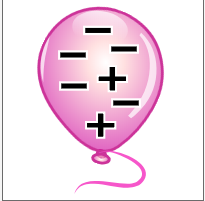
This model of the balloon shows ______ positive charges than negative charges. So this balloon is _____ charged.
fewer/positively
more/positively
fewer/negatively
more/negatively
Electric potential ____________ as distance increases.
Increases
Decreases
Remains Constant
Is 0
The difference in electrical potential energy between two places is called …………...
resistance
friction
induction
voltage

The direction of electric field lines shows the
direction of the force on a test positive charge.
size of the field.
strength of the field.
all of the above

An electrostatic force of 2 X 10⁻² Newtons is exerted on a charge of 4 micro coulomb at point P in an electric field. The magnitude of the electric field intensity at P is
5 X 10² N/C
5 N/C
50 N/C
5000 N/C
Electric field is directly proportional to the charge and inversely proportional to the magnitude of electric force. True or False?
True
False
What is the magnitude of the electric force between two charges of 1.0C separated by a distance of 1.0m?
9.0x10^9 N
1.1x10^10 N
9.0x10^19 N
1.1x10^-10 N

what is the type of this charge?
positive
negative

which of the following has more electric filed?
B
c
A
B and A
Which diagram represents the electric fields of a negative point charge, shown by º


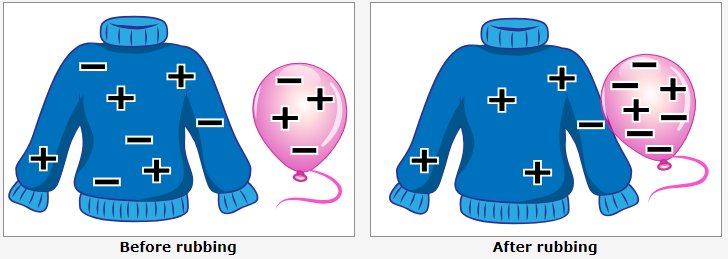
Before the balloons and sweaters are rubbed together, both objects are __________ charged. After they are rubbed together the sweater is __________ charged and the balloon is ___________ charged
negative/positive/negative
neutral/positive/negative
positive/negative/neutral
neutral/negative/positive
The magnitude of electric potential is ______ at an infinite distance.
0
negative infinity
positive infinity
200
The work required to move a charge from infinity to a point in an electric field is called ...
electric field strength
electric potential
electric potential energy
electric force
Which is a characteristic of most electrical conductors?
They can be cut easily.
They are very thin.
Charges move easily through them.
They are soft and flexible.
Two tiny beads are 25 cm apart with no other charges or fields present. Bead A carries 10 µC of charge and bead B carries 1 µC. Which one of the following statements is true about the magnitudes of the electric forces on these beads?
The force on B is 100 times the force on A.
The force on A is 10 times the force on B.
The force on A is 100 times the force on B.
The force on A is exactly equal to the force on B.
The force on B is 10 times the force on A.

A small charged plastic ball is vertically above another charged small ball in a frictionless test tube as shown in the figure. The balls are in equilibrium a distance d apart. If the charge on each ball is doubled, the equilibrium distance between the balls in the test tube would become
d
2d
4d
4d
8d

Four tiny charged particles (two having a charge +Q and two having a charge -Q) are distributed on the x- and y-axes as shown in the figure. Each charge is equidistant from the origin. In which direction is the net electric field at the point P on the y-axis?
directly left (-x direction)
upwards and towards the right
directly up (in the +y direction)
upwards and towards the left
Electric Field of Point-Charges: What is the magnitude of the electric field 2.8 cm from a tiny object that carries an excess charge of —16 nC? (k = 1/4πε0 = 9.0 × 10⁹ N ∙ m2/C2)
180,000 N/C
1.8 × 10¹⁴ N/C
-5100 N/C
Moving an electron within an electric field would change the ____ the electron.
mass of
amount of charge on
potential energy of

