wayground logo

Free Printable Worksheets

Font size

S
M
L
XL
Worksheets

8th REVIEW

Total questions: 165

Worksheet time: 8hrs 47mins
Name
Class
Date
1.
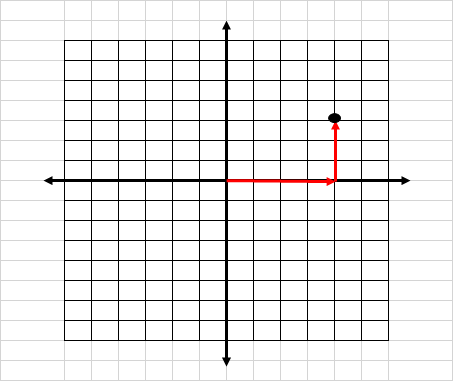
What error did the student make when plotting the point (3, 4) according to the picture?                                                                                                                                                                                                                                                                                                                                                                         
a)
The student moved left along the x-axis when he should have moved right
b)
The student plotted the y-coordinate in place of the x-coordinate
c)
The student didn't make a mistake
d)
Both Options 1 and 2
2.
Where is point E located?
a)
( 2, 0 )
b)
( 2 , 2 )
c)
( 0 , 2 )
d)
( 0 , 0 )
3.
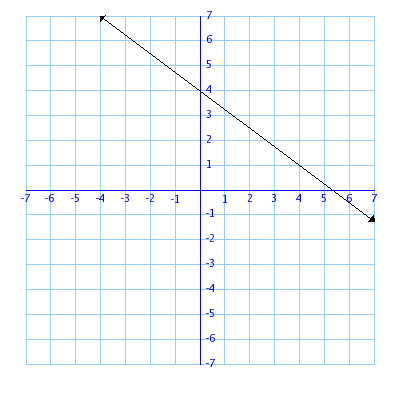
Which line is being represented by the graph?
a)
y = 3/4 X -3
b)
y = -3/4x + 4
c)
y = 3/4x + 4
d)
y = -3/4 x - 3
4.
Which is the graph of y= -x + 2?
a)
A
b)
B
c)
C
d)
D
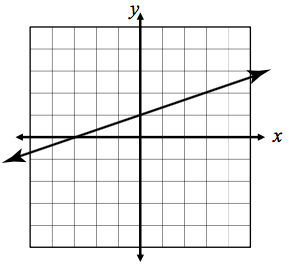
5.
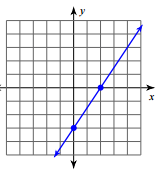
What type of slope does the following graph have?
a)
Postive
b)
Negative
c)
Zero Slope
d)
Undefined
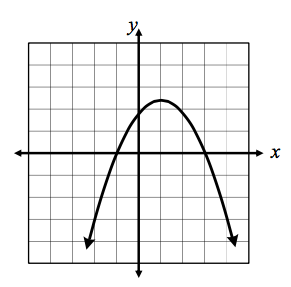
6.
Find the slope.
a)
3/2
b)
-3/2
c)
(-0,-3)
d)
none of the above
7.
Find the slope of the line that passes through the points (2, 4) and (6, 12)
a)
1/2
b)
-1/2
c)
2
d)
-2
8.
Find the slope of the line.
a)
3/2
b)
2/3
c)
-3/2
d)
-2/3
9.
In the equation, y = mx + b, the letter b is the ___________.
a)
y-intercept
b)
x-intercept
c)
slope
d)
rate of change
10.
Identify the y-intercept for the function:
y=-3x
a)
-3
b)
0
c)
1
d)
-1
11.
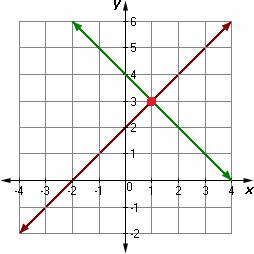
Consider the equation:
y=-x+4
Identify the slope and y-intercept.
a)
m=4, b=-x
b)
m=-x, b=4
c)
m=1, b=4
d)
m=-1, b=4
12.
Given the equation y = 2x+3, what is the slope?
a)
2
b)
x
c)
3
d)
2/3
13.
Given the equation y=-4x+5, what is the y-intercept?
a)
-4
b)
x
c)
5
d)
-4/5
14.
What does "m" represent in y=mx+b?
a)
y-intercept
b)
slope
c)
macaroni
d)
x-intercept
15.
What does 'b" represent in y=mx=b
a)
y-intercept
b)
macaroni
c)
x-intercept
d)
slope
16.
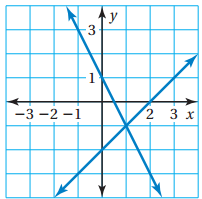
What is the solution to the system?
a)
(0, 3)
b)
(1, -1)
c)
(-3, 1)
d)
(1, 3)
17.
What is the solution? 
a)
1
b)
-2
c)
(1, 2)
d)
(1, -1)
18.
What is the solution?
a)
(6, 3)
b)
(3, 6)
c)
(-6, 3)
d)
No solution
19.
Parallel Lines never intersect because...
a)
they have the same slopes. 
b)
they have the same y-intercept.
c)
they have different slopes.
d)
they have different y-intercepts. 
20.
Does the system have one, none or infinite solutions?
8x + 4y = 12
y = -2x + 3
a)
(0,3)
b)
(3,0)
c)
No solution(parallel lines)
d)
Infinitely many solutions
21.

2x - y = 0

4x - y = 0

a)

(1,2)

b)

(0,0)

c)

No Solutions

d)

Infinite Solutions

22.


How many solutions?
a)
One Solution
b)
No solution
c)
Infinitely Many Solutions
23.
Solve for x and y.
y = 2/3x - 2
y = -x + 3
a)
(0,3)
b)
(0,-3)
c)
(3,0)
d)
(-3,0)
24.

2x - y = 0

4x - y = 0

a)

(1,2)

b)

(0,0)

c)

No Solutions

d)

Infinite Solutions

25.
The equations of two lines are:
 2x-y=4 and y=-2x+8.
What is the value of x in the solution for this system?
a)
x=8
b)
x=3
c)
x=11
d)
x=5
26.
If a system of equations has no solution, what does the graph look like? 
a)
intersecting lines
b)
parallel lines
c)
skew lines
d)
intersecting lines
27.
What is the value of the y-coordinate of the solution to the system of equations 
x-2y=1
x+4y=7 
a)
1
b)
-1
c)
3
d)
4
28.
What is the solution?
a)
One Solution
b)
No solution
c)
Infinitely Many Solutions
29.
What is the solution?
a)
(1, -1)
b)
(-1, 1)
c)
(0, -2)
d)
(2, 0)
30.
Solve the following system by setting the two equations equal to each other.  What is the solution?
HINT:  - 1/3x + 4 = 2/3x + 1 and then solve for x.  Once you find x go back and find y.
a)
Infinite number of solutions
b)
(3, 3)
c)
(3, -3)
d)
(-3, 3)
31.
Which of the following is not a method to solve systems?
a)
Elimination
b)
Difference of Squares
c)
Substitution
d)
Graphing
32.
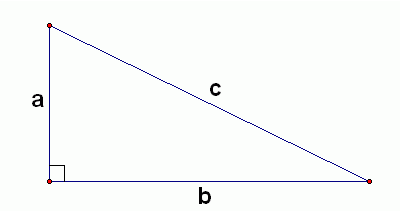
What is the formula for Pythagorean theorem?
a)
a2+b2=c2
b)
a+b=c
c)
a-b=c
d)
c-a=c
33.

Level 1

The Pythagorean Theorem ONLY works on which triangle?

a)

obtuse

b)

scalene

c)

isosceles

d)

right

34.

Level 1

If a right triangle has side lengths 6, 6.7 and 3, which side is the hypotenuse?

a)

6

b)

6.7

c)

3

d)

15.7

e)

None of them

35.

Level 2

Solve for the value of y

a)

13

b)

5

c)

23

d)

10

36.

Level 3

Find the length of the missing side.

a)

25 cm

b)

42 cm

c)

52 cm

d)

48 cm

37.
Find the missing side
a)
9
b)
41
c)
6.4
d)
3
38.
Find the missing side
a)
29.2
b)
20
c)
400
d)
10
39.
Find the missing side
a)
36
b)
76.8
c)
12
d)
40
40.
Find the missing side
a)
9
b)
26.9
c)
37
d)
18.2
41.
Find the missing side
a)
48
b)
108
c)
83.6
d)
72
42.
Do these 3 side lengths form a right triangle?
13, 80, and 81?
a)
yes
b)
no
43.
Given the 3 lengths of a triangle are 6 in, 8 in and 10 in.  Will this make a right triangle?
a)
yes
b)
no
44.

Find the distance between points A and B. Round to the nearest tenth.

(a)  

45.
Scientific Notation is made up of two number parts. The first part should be a number between 1 and 100.
a)
True
b)
False
46.
When writing a number in scientific notation, the first number must be greater than 1, but less than 10.
a)
False
b)
True
47.
How would you write 4.3756 x 10in standard form?
a)
437,560,000
b)
0.00043756
c)
43,756
d)
4,3756
48.
How would you write 0.0005 in scientific notation?
a)
50 x 105
b)
5 x 10⁴
c)
5 x 10³
d)
.5 x 103
49.
How would you write -5.6 x 10⁻³ in standard form?
a)
0.0056
b)
-5,600
c)
0.00056
d)
-0.0056
50.
How would you write -5.6 x 10⁻³ in standard form?
a)
0.0056
b)
-5,600
c)
0.00056
d)
-0.0056
51.
How do you write
8.317 x 10⁶
in standard form?
a)
8, 371, 000
b)
83, 170, 000
c)
837, 100
d)
8, 317, 000
52.
Which of the following is correct scientific notation?
a)
20.35 x 10⁴
b)
.2035 x 104
c)
2035 4
d)
2.035 x10⁴
53.
Express the following in scientific notation:
.000457
a)
457 x 106
b)
457 x 10-6
c)
4.57 x10⁴
d)
4.57 x 10⁻⁴
54.
Express the following in standard notation:
8.025 x 10⁻⁸
a)
.00000008025
b)
.000000008025
c)
802,500,000,000
d)
80,250,000,000
55.
Express the following in scientific notation:
10,030,400,000
a)
1.00304 x 10⁹
b)
1.00304 x 10¹⁰
c)
1.00403 x 10¹⁰
d)
1.00304 x10⁻¹⁰
56.
Express the following in scientific notation:
0.0000002203
a)
.02203 x 107
b)
22.03 x 10⁻⁶
c)
2.203 x 10⁻⁷
d)
22.03 x 10⁶
57.
Convert to scientific notation:
520,000,000  
a)
52 x 107
b)
5.2 x 10⁷
c)
5.2 x 10⁸
d)
0.52 x 10⁹
58.
Convert to standard notation:
2.4 x 10⁻³ 
a)
2400
b)
0.24
c)
0.024
d)
0.0024
59.
Convert to standard notation:
3.05 x 10⁵ 
a)
305,000
b)
305
c)
3,050,000
d)
30,500
60.
UNDERSTANDING
If the exponent is a positive number...
a)
you will get a large number
b)
you will get a smaller number
61.
UNDERSTANDING
If the exponent is a negative number...
a)
you will get a large number
b)
you will get a small number
62.
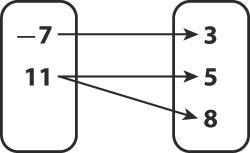
Is the relation a function? Why.
a)
Yes, because the x-value 11 has two y-values pair with it.
b)
Yes, because each x-value has only one y-value paired with it.
c)
No, because the x-value 11 has two y-values pair with it.
d)
No, because each x-value has only one y-value paired with it.
63.
a)
Function
b)
Not a Function
64.
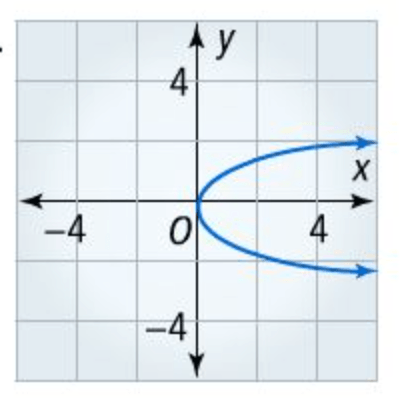
Is this graph a function or not a function? 
a)
Function
b)
Not a Function
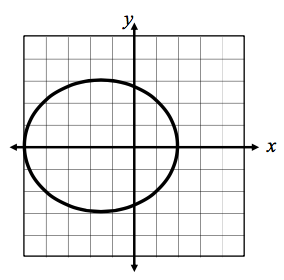
65.
Is this graph a function or not a function? 
a)
Function
b)
Not a Function
66.
Is this graph a function or not a function? 
a)
Function 
b)
Not a Function 
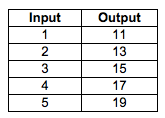
67.
Find the rate of change
a)
1
b)
2
c)
11
d)
Not a constant slope/Non-Linear
68.
Does this relation represent a function?
(1,5), (1,6), (1,7), (1,8), (1,9)
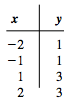
a)
Yes
b)
No
69.
You can identify a function from a graph by using the.....
a)
Horizontal Line Test
b)
Eye Test
c)
Vertical Line Test
d)
Diagonal Line Test
70.
Does this table represent a function?
a)
Yes 
b)
No
71.
Is this graph a function or not a function? 
a)
Function
b)
Not a Function
72.
Which set of values is a function?
a)
(9,5) (10,5) (9,-5) (10,-5)
b)
(3,4) (4,-3) (7,4) (3, 8)
c)
(6,-5) (7, -3) (8, -1) (9, 1)
d)
(2, -2) (5, 9) (5, -7) (1, 4)
73.
Which graph does NOT pass the vertical line test?
a)
Graph 1
b)
Graph 2
c)
Graph 3
d)
Graph 4
74.
.
a)
Function
b)
Not a Function
75.
a)
Function
b)
Not a Function
76.
Is this set of ordered pairs a function or not a function? 
a)
Function
b)
Not a Function 
77.

What is the number in a power that tells how many times, the base is used?

a)

Base number

b)

Exponent

c)

Multiplication

d)

Addition

78.

Using exponents is a short cut for using what mathematical operation?

a)

Division

b)

Addition

c)

Multiplication

d)

Subtraction

79.
25 is the same as 2 x 5.
a)
True
b)
False
80.
Which number is the BASE?
2= 8
a)
2
b)
3
c)
8
81.
Anything raised to a power of zero is always: 
a)
0
b)
1
c)
itself
d)
negative
82.
According to exponent rules, when we multiply powers we _______ the exponents.
a)
add
b)
subtract
c)
multiply
d)
divide
83.
According to exponent rules, when we raise a power to a power we _______ the exponents.
a)
add
b)
subtract
c)
multiply
d)
divide
84.
Simplify the following:
(x3)6
a)
x9
b)
x18
c)
x6
d)
x3
85.
Simplify: 
(2⁸)²
a)
2¹⁶
b)
2¹⁰
c)
2⁶
d)
2⁴
86.
Division Law states: keep the base the same and do this to the exponents.
a)
multiply
b)
add
c)
subtract
d)
divide
87.
According to exponent rules, when we multiply the same base we _______ the exponents.
a)
Multiply
b)
Add
c)
Divide
d)
Subtract
88.
According to exponent rules, when we divide powers we _______ the exponents.
a)
add
b)
subtract
c)
multiply
d)
divide
89.
Simplify (c5)(c3)(c3)
a)
c45
b)
3c11
c)
c11
d)
3c45
90.
Simplify:
9⋅ 94 = 912
a)
True 
b)
False 
91.
In order to multiply powers with the same base, we add their exponents. 
a)
True 
b)
False
92.
Simplify the expression: r6⋅r2⋅r3=
a)
r6+2+3
b)
r11
c)
11r
93.
Evaluate this expression using the quotient rule.
a)
95
b)
99
c)
15
d)
9-5
94.
Evaluate the expression using the quotient rule.
a)
122
b)
130
c)
622
d)
630
95.
40
a)
0
b)
1
c)
4
d)
-4
96.
 Evaluate the expression using the quotient rule.
a)
76
b)
7-5
c)
1/75
d)
75
97.
Rewrite using a positive exponent.
(-5)-4
a)
(-5)4
b)
1/(-5)-4
c)
1/(-5)4
d)
-625
98.
Rewrite using a positive exponent.
w-13
a)
-w13
b)
1/w13
c)
1/w-13
d)
w13
99.

Write the slope-intercept form of the equation of each line.

a)

x=1x=1

b)

y=15y=\frac{1}{5}

c)

y=1y=1

d)

x=1x=-1

100.

Write the slope-intercept form of the equation of each line.

a)


y=x+4y=-x+4

b)

y=4x1y=-4x-1

c)

y=5x+4y=5x+4

d)

y=4x1y=4x-1

101.

Write the slope-intercept form of the equation of each line.

a)


y=x+4y=-x+4

b)

y=4x1y=-4x-1

c)

y=5x+4y=5x+4

d)

y=4x1y=4x-1

102.

Write the slope-intercept form of the equation of each line.

a)

y=3x3y=3x-3

b)

y=13x3y=-\frac{1}{3}x-3

c)

y=83x3y=\frac{8}{3}x-3

d)

y=3x+3y=-3x+3

103.

Write the slope-intercept form of the equation of each line.

a)


y=52x4y=-\frac{5}{2}x-4

b)

 y=4x1.5y=-4x-1.5 

c)

y=52x4y=\frac{5}{2}x-4

d)

y=4x52y=4x-\frac{5}{2}

104.

Write the slope-intercept form of the equation of each line.

a)


y=xy=x

b)

x=0x=0

c)

y=0y=0

d)

y=xy=-x

105.
a)


y=xy=x

b)

y=xy=-x

c)

y=43xy=-\frac{4}{3}x

d)

y=0y=0

106.
a)


y=x4y=-x-4

b)

y=x4y=x-4

c)

y=x+4y=-x+4

d)

y=4y=-4

107.
a)


y=2x3y=2x-3

b)

y=2x+1.5y=2x+1.5

c)

y=3x+32y=-3x+\frac{3}{2}

d)

y=x+3y=-x+3

108.
Divide:
(6.9 x 10⁷) / (2.3 x 10⁻³)
a)
3 x 10¹⁰
b)
3 x 10⁴
c)
3 x 10⁻⁴
d)
3 x 10-11
109.
Solve:
(2.1×10²​​× (3.0×10⁴)
a)
5.1 x 10²
b)
6.3 x 10⁶
c)
5.1 x 10⁶
d)
6.3 x 10⁸
110.
Solve:
(6 x 10⁶) / (2 x 10³)
a)
12 x 103
b)
3 x 10⁹
c)
1.2 x 10⁴
d)
3 x 10³
111.
(2.8 * 108) (2.2*103)
a)
6.16 * 1024
b)
5.0 * 1011
c)
6.16 * 1011
d)
61.6 * 1011
112.

Solve and put your answer in Scientific Notation

(2 x 10³)3

a)

8 x 10⁹

b)

2 x 10⁹

c)

6 x 10⁶

d)

6 x 10⁹

113.

Solve and put your answer in Scientific Notation

(4 x 10⁴)2

a)

8 x 10⁸

b)

16 x 108

c)

1.6 x 10⁹

d)

1.6 x 10⁷

114.
Solve for x.
a)
-11
b)
9
c)
-9
d)
10
115.
Solve for x.
a)
8
b)
-10
c)
-7
d)
6
116.
Solve for x.
a)
5
b)
12
c)
-7
d)
-6
117.
Solve for x.
a)
4
b)
6
c)
7
d)
-10
118.
Solve for x.
a)
-11
b)
-12
c)
-6
d)
11
119.
Solve for x.
a)
7
b)
9
c)
-11
d)
-6
120.
Find the measure of angle A.
a)
20 degrees
b)
22 degrees
c)
21 degrees
d)
100 degrees
121.
Find the measure of angle A.
a)
21 degrees
b)
31 degrees
c)
128 degrees
d)
24 degrees
122.
Find the measure of angle A.
a)
30 degrees
b)
160 degrees
c)
140 degrees
d)
32 degrees
123.
Find the measure of angle A.
a)
21 degrees
b)
31 degrees
c)
128 degrees
d)
24 degrees
124.
Find the measure of the indicated angle. 
a)
35 degrees
b)
40 degrees
c)
25 degrees
d)
30 degrees
125.
Find the measure of the indicated angle. 
a)
38 degrees
b)
43 degrees
c)
22 degrees
d)
76 degrees
126.
Find the measure of the indicated angle. 
a)
87 degrees
b)
82 degrees
c)
83 degrees
d)
72 degrees
127.
Find the measure of the indicated angle. 
a)
145 degrees
b)
24 degrees
c)
20 degrees 
d)
21 degrees
128.
Find the measure of the indicated angle. 
a)
22 degrees
b)
130 degrees
c)
20 degrees
d)
25 degrees
129.
10x + 9 = 4x - 9
a)
0
b)
3
c)
-3
d)
-18
130.
7w + 5 = 3w - 15
a)
5
b)
-2
c)
2
d)
-5
131.
8w - 8 = -4x + 16
a)
8
b)
16
c)
24
d)
2
132.
Solve the equation:
7x - 4 = 3 + 8x
a)
x = 7
b)
x = -7
c)
x = 2/7
d)
x = 11
133.
Solve: 5x - 14 = 8x + 4
a)
6
b)
-6
c)
-18/13
d)
10/3
134.
2c - 12 = 9c + 2
a)
14
b)
2
c)
-2
135.
f - 4 = 6f + 26
a)
-5
b)
5
c)
6
d)
-6
136.
14p - 8 = 22 + 20p
a)
-5
b)
5
c)
30
137.
12x - 15 = 3(2x+3)
a)
x = 4
b)
x = -4
c)
x = 2
d)
x = -2
138.
2(x + 6) + 3 = 9 + 5x
a)
16
b)
2
c)
-8
d)
-10
139.
-6(1 - 6r) = -2(r + 3)
a)
14
b)
0
c)
-11
d)
4
140.
Solve:
5y+34 = -2(-7y+1)
a)
y = -4
b)
y = 9
c)
y = 4
d)
y = 36/19
141.
Solve: 2(4x - 3) - 8 = 4 + 2x
a)
5/3
b)
3
c)
1
d)
2
142.
Solve:
5y + 34 = -2(-7y+1)
a)
y = -4
b)
y = 9
c)
y = 4
d)
y = 36/19
143.
8 - 9t = 21t - 17
a)
t = 6/5
b)
t = 5/6
c)
t = 1
144.
3 - 5x = -9 + x
a)
4
b)
3
c)
2
d)
1
145.
A slide is also called a _________.
a)
Translation
b)
Reflection
c)
Rotation
d)
Transformation
146.
A turn is also called a ___________.
a)
Translation
b)
Reflection
c)
Rotation
d)
Transformation
147.
The image shows what type of transformation
a)
Rotation
b)
Translation
c)
Reflection
148.
What is this picture an example of? 
a)
An angle
b)
A cat vertex 
c)
Rotation 
149.
What is this picture an example of? 
a)
An angle
b)
A cat vertex 
c)
Rotation 
150.
 Describe the Transformation
a)
Translation
b)
Rotation
c)
Reflection
151.
 Describe the Transformation
a)
Translation
b)
Rotation
c)
Reflection
152.
Reflection or Rotation
a)
Reflection
b)
Rotation
153.
Turning an Object
a)
Reflection
b)
Rotation
c)
Translation
154.
Rotation or Reflection
a)
Rotation
b)
Reflection
c)
translation
155.

See the question in the picture.

a)

Reflection

b)

Rotation

c)

Dilation

d)

Translation

156.

See the question in the picture.

a)

M' (-3,1), N' (-3,3), and P' (-1,4)

b)

M' (-2,4), N' (2, -2), and P' (4, -1)

c)

M' (2, 6), N' (2, 8), and P' (4, 9)

d)

M' (7, 1), N' (7, 3), and P' (9, 4)

157.
a)

reflection

b)

rotation

c)

dilation

d)

translation

158.
a)

(-6, -5)

b)

(-5, -6)

c)

(5, 6)

d)

(6, 5)

159.
a)

(-1, -3)

b)

(1, -1)

c)

(-1, -1)

d)

(1, 1)

160.
a)

3/2

b)

2/3

c)

4/5

d)

5/4

161.

Figure XYZ is a triangle with a base of 12 inches. If XYZ is dilated by a scale factor of 1.5, what will be the length of triangle X'Y'Z's base?

a)

19

b)

22

c)

18

d)

7

162.
a)

(12, -9)

b)

(9, 6)

c)

(4, -2)

d)

(-6, 12)

163.
a)

M' (8, -3)

b)

M' (-8, -3)

c)

M' (8, 3)

d)

M' (-3, 8)

164.

*hint* find how many spaces are in between point A and line segment BC to see if it will help you find your answer.

a)

(13, 4)

b)

(13, 15)

c)

(8, 4)

d)

(13, 7)

165.
a)

A (4, 5) A' (-4, -5)

b)

A (4, 5) A' (-4, 5)

c)

A (4, 5) A' (4, -5)

d)

A (4, 5) A' (5, -4)