
 Worksheets
ICS numerical integration
Total questions: 13
Worksheet time: 1hrs 5mins
In numerical integration the width of the sub intervals is given by
h=nxn−x0
h=nxn+x0
h=nx0−xn
none of thesse
In Trapezoidal rule, for the interval (2,5) if h=0.5 then the value of n is_________
5
2
6
4
Simpson’s 1/3 rule is applicable for five ordinates.
True
False
Simpson’s 3/8 rule is applicable for nine ordinates.
True
False

h=0.25
0.388
0.188
0.288
0.488
Error in SIMPSON'S rule is of order
h
h2
h3
h4

Estimate f(1.5) using Lagrange interpolation.
−0.8673
-0.7214
−0.9773
-0.9113
Find f(2) for the data f(0) = 1, f(1) = 3 and f(3) = 55 using Newton's divided difference formula.
25
21
23
32

Find f(0.25) using Newton's divided difference formula
3.826
3.2567
3.2113
3.912
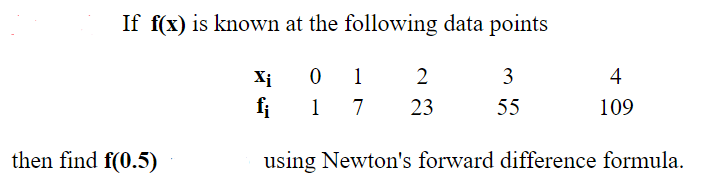
3.125
3.327
3.542
3.837
Given the two points (a,f(a)),(b,f(b)) , the linear Lagrange polynomial f1(x) that passes through these two points is given by
f1(x)=a−bx−bf(a)+a−bx−af(b)
f1(x)=b−axf(a)+b−axf(b)
f1(x)=f(a)+b−af(b)−f(a)(b−a)
f1(x)=a−bx−bf(a)+b−ax−af(b)

Based on the data given, which is the suitable type of polynomial to do the approximation?
Linear
Quadratic
Cubic
Quartic
The methods to find the polynomials approximation are ..
Lagrange interpolation
Newton's Divided Difference
Natural Cubic Spline
Clamped Cubic Spline

