Wayground logo

Free Printable Worksheets

Font size

S
M
L
XL
Worksheets

Structure & States of Matter

Total questions: 28

Worksheet time: 28mins

Name
Class
Date
1.

All matter is made of what?

a)

energy

b)

atoms

c)

electrons

d)

compounds

2.

Matter is anything that...

a)

has mass

b)

has volume

c)

has mass and volume (takes up space)

d)

is living

3.

A ________ has a definite volume, but it does not have a definite shape.

a)

solid

b)

liquid

c)

gas

4.

The state of matter that has no definite size or shape is

a)

solid

b)

liquid

c)

gas

5.

The process when a solid turns into a liquid (Hint: ice to liquid water)

a)

evaporation

b)

sublimation

c)

freezing

d)

melting

6.
Which form of matter does not take the shape of its container?
a)
liquid
b)
gas
c)
solid
d)
air
7.
What state of matter does the picture best describe?
a)
Solid
b)
Liquid
c)
Gas
8.

Water appearing on the exterior of a cold drink on a hot summer day is an example of what phase change?

a)

Condensation

b)

Melting

c)

Sublimation

d)

Vaporization

9.

Placing liquid water in the freezer will result in what phase change?

a)

Condensation

b)

Freezing

c)

Ionization

d)

Vaporization

10.
Name a property of gases that they share with liquids.
a)
have a fixed shape
b)
can be compressed easily
c)
take up the same amount of space
d)
take the shape of their container
11.
Which of the following is not a property of solids?
a)
It has a fixed shape.
b)
it has a fixed volume
c)
You can pick it up when it is not in a container.
d)
It can be squashed easily
12.
Particles in a _____________ have more energy than the other states of matter.
a)
gas
b)
solid
c)
liquid
13.
When the temperature of matter decreases the particles ...
a)
speed up and move farther apart
b)
speed up and move closer together
c)
slow down and move farther apart
d)
slow down and move closer together
14.

Adding heat energy causes particles to move _________.

a)

faster

b)

slower

15.

Which states of matter below have a definite volume?

a)

solids only

b)

liquids only

c)

solids & liquids

d)

gases only

e)

solids, liquids, and gases

16.

Which of the following is NOT an example of a gas?

a)

oxygen

b)

hydrogen

c)

water vapor

d)

carbon monoxide

e)

salt

17.

Which of the following is not made of atoms?

a)

pencil

b)

glass of orange juice

c)

helium gas in a party balloon

d)

sound waves from the police car siren

18.

What are the 3 parts of an atom?

a)

protons, neutrons, and positives

b)

neutrons, negatives, and electrons

c)

positives, negatives, and electrons

d)

protons, neutrons, and electrons

19.
These particles orbit around the nucleus of an atom.  What are they called?
a)
electrons
b)
protons
c)
neutrons
d)
photons
20.
What does the nucleus of an atom contain?
a)
Electrons and neutrons
b)
Protons and neutrons
c)
Neutrinos and positrons
d)
Electrons and megatrons
21.
An electron has a _____ charge.
a)
negative
b)
positive
c)
neutral
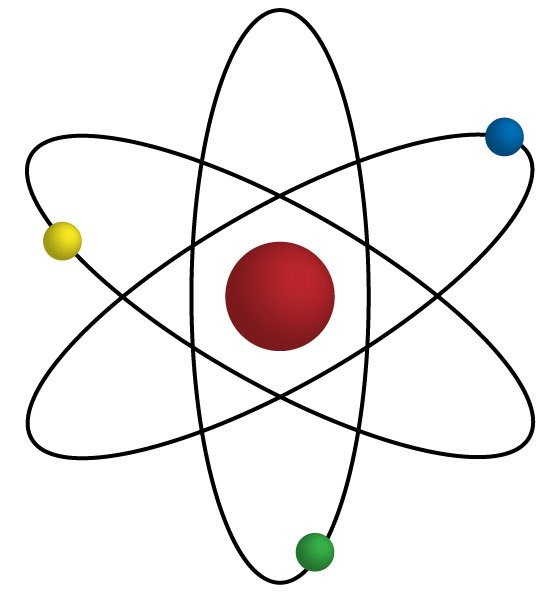
22.
How many electrons are in the atom pictured? 
a)
1
b)
2
c)
3
d)
0
23.
Which particle has a positive charge?
a)
electron
b)
orbital
c)
proton
d)
neutron
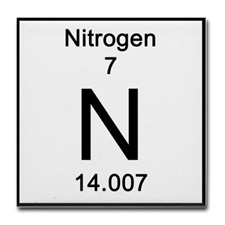
24.

What is the number of protons found in every atomic nucleus of the element shown?

a)

14

b)

7

c)

15

d)

18

25.
Choose the particle that has no charge.
a)
nucleus
b)
neutron
c)
proton
d)
electron
26.
This particle determines what element you have - the elements identity.
a)
electron
b)
proton
c)
neutron
d)
valence shell
27.
An element with a mass number of 10 and an atomic number of 6 has how many protons?
a)
5
b)
8
c)
6
d)
10
28.

What is the atomic mass of Nitrogen?

a)

14.007

b)

7

c)

14

d)

Can't determine from the picture