wayground logo

Free Printable Worksheets

NEW

Font size

S
M
L
XL
Worksheets

sustainable development and climate change

Total questions: 50

Worksheet time: 2hrs 45mins

Name
Class
Date
1.

What is the direct cause of rising sea levels?

a)

Melting Sea Ice

b)

Melting Land Ice

c)

Climate Change

2.

The main human activity that releases greenhouse gases is

a)

using public transportation and there by reduce the affects of greenhouse gases.

b)

burning fossil fuels

c)

texting on cellphones

d)

eating meat

3.

Which of the following is contributing to an INCREASE in carbon dioxide in the atmosphere?

a)

deforestation

b)

photosynthesis

c)

oceans

d)

all of the above

e)

the loss of animal species

4.
 What is the greenhouse effect?
a)
The warming of a planet due to trapped radiation.
b)
The cooling of Earth due to air pollution.
c)
The heating of a solid, such as a rock.
5.
What gas from the list below is a cause for global warming?
a)
Urethane
b)
Oxygen
c)
Carbon Dioxide
6.
T/F: Water vapor is a greenhouse gas
a)
True
b)
False
7.
Increased carbon dioxide may cause global warming by trapping more ____________ in the atmosphere.
a)
water
b)
gases
c)
heat
d)
water vapor
8.
Which is a natural source of greenhouse gases?
a)
aerosols
b)
deforestation
c)
volcanic eruptions
d)
burning fossil fuels
9.
Which natural process removes carbon dioxide from the atmosphere?
a)
forest fires
b)
volcanic eruptions
c)
cellular respiration
d)
photosynthesis
10.
Which is a green-house gas?
a)
Methane
b)
Oxygen
c)
Hydrogen
d)
Ammonium
11.
The condition of the atmosphere on different parts of the planet is called ___
a)
weather
b)
climate
c)
geosphere
d)
humidity
12.
The general weather patterns for a given region is called ___
a)
weather
b)
climate
c)
hydrosphere
d)
temperature
13.
A characteristic that helps an organism live in its environment is called ___
a)
a configuration
b)
a mutation
c)
an adaptation
d)
a translation
14.
The layer of gases surrounding our planet is called ___
a)
the biosphere
b)
the atmosphere
c)
the hydrosphere
d)
the geosphere
15.

All living things on earth are part of the....

a)

Biosphere

b)

Lithosphere

c)

Hydrosphere

d)

Cryosphere

16.

All frozen water on Earth is...

a)

Hydrosphere

b)

Lithosphere

c)

Cryosphere

d)

Atmosphere

17.
Climate change causes extreme weather conditions such as:
a)
Flooding
b)
Heat Waves
c)
Hurricanes
d)
All of the above
18.
1.  Why is the Ozone important to life on Earth?
a)
A.   The Ozone reflects all the Ultra Violet radiation
b)
A.  The Ozone absorbs all the heat that come up from the Earth.
c)
The Ozone provides all the oxygen to Earth.
d)
The Ozone protects the Earth’ s atmosphere and the life on Earth from harmful radiant energy emitted by the sun   
19.
1.  Certain gases in the atmosphere – water vapor, carbon dioxide, methane and nitrous oxide – help maintain the Earth’s temperatures and climate. These are called: __________ . 
a)
A.  ozone gases
b)
A.  solar gases
c)
A.  greenhouse gases 
d)
A.  stomach gases
20.
1.  In the past, refrigerators, aerosol spray propellants and cleaning solvents were all sources of a greenhouse gas known as
a)
carbon dioxide
b)
methane
c)
chlorofluorocarbon (CFC)
d)
nitrous oxide
21.
One thing people in the United States could do to reduce air pollution is
a)
drive their cars more.
b)
burn more fossil fuels.
c)
use more public transportation. (Which would mean less vehicles on road)           
d)
build more factories.
22.
Without the Greenhouse Effect the Earth would be
a)
warm 
b)
cold
c)
dead
23.

The area of human activity responsible for the highest greenhouse gas emissions is

a)

energy supply

b)

transport

c)

agriculture

d)

industrial

24.

The area of human activity responsible for the second highest greenhouse gas emissions is

a)

residential activity

b)

transport

c)

agriculture

d)

industrial

25.

The highest gaseous pollutant is

a)

methane

b)

nitrous oxide

c)

carbon dioxide

d)

fluorinated gases

26.
Solar energy is best absorbed by what material?
a)
dirt
b)
sand
c)
snow
d)
water
27.

How much UV radiation does the ozone layer normally filter out?

a)

99%

b)

10%

c)

50%

d)

0%

28.

The amount of ozone protecting us is decreasing.

a)

True

b)

False

29.

What harmful health effects do scientist say that the UV radiation that passes through our "shield" will cause?

a)

increase in skin cancer

b)

immune deficiencies

c)

cataracts

d)

all of the answers

30.

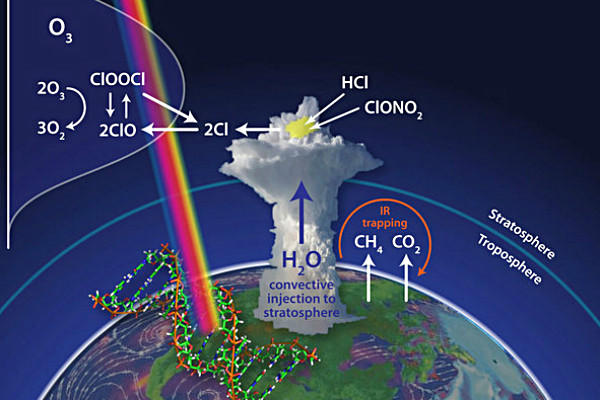
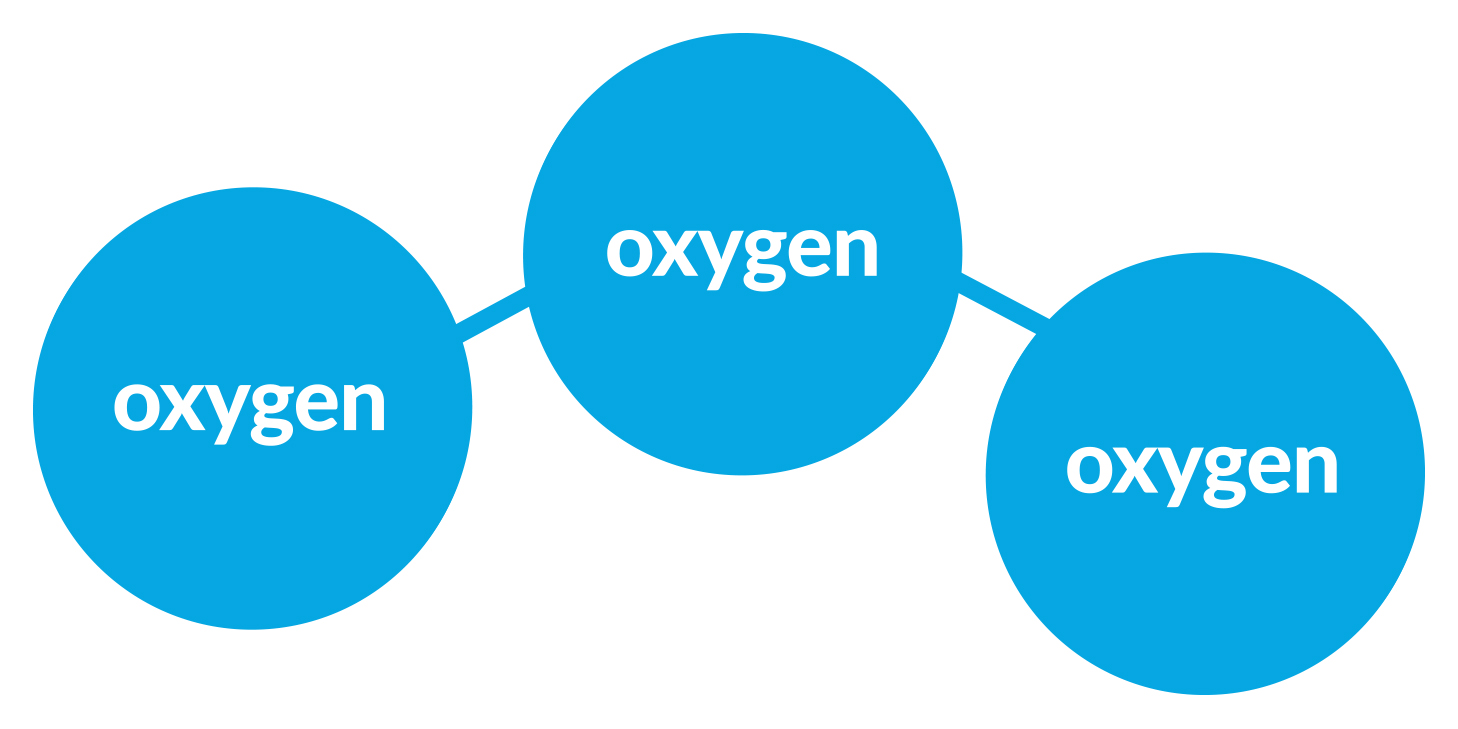
What happens to form ozone gas?

a)

Oxygen molecules interact with the UV rays from the Sun.

b)

Chlorine molecules interact with the UV rays from the Sun.

c)

Oxygen and chlorine molecules produce a gas.

31.

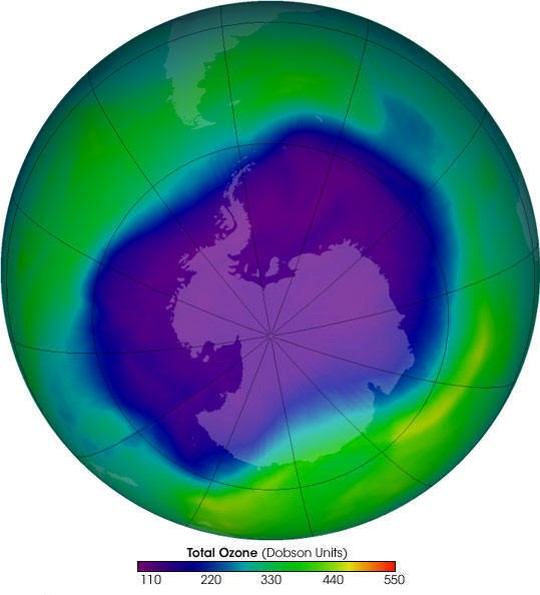
What are "holes" in the ozone layer?

a)

places where the ozone concentrations are lower than under normal conditions, allowing more UV radiation to reach the Earth's surface.

b)

places where the ozone concentrations are higher than under normal conditions, allowing more UV radiation to reach the Earth's surface.

c)

places where the ozone concentrations are higher than under normal conditions, allowing lessUV radiation to reach the Earth's surface.

32.

Which of the following is the most common ozone destroying pollutants?

a)

Chloroflurocarbons

b)

particular matter

c)

Nitrogen dioxide

d)

carbon monoxide

33.

The ozone destroying pollutants primarily comes from air conditioner coolants, refrigerator coolant, aerosol spray, and plastic foam.

a)

true

b)

false

34.
Second layer of the atmosphere, extending about 17-48 kilometers above the earth’s surface. It contains a layer of gaseous ozone, which filters out about 95% of the incoming harmful ultraviolet radiation emitted by the sun
a)
Mesosphere
b)
Troposphere
c)
Stratosphere
d)
Ozone
35.
Layer of gaseous ozone in the stratosphere that protects life on earth by filtering out most harmful ultraviolet radiation from the sun
a)
Greenhouse Gases
b)
Troposphere
c)
Stratosphere
d)
Ozone Layer
36.
The breakdown of stratospheric ozone
I. can originate from the emission of chlorofluorocarbons (CFCs).
II. is catalyzed through a free chlorine (Cl) atom.
III. prevents UV rays from reaching the earth’s surface.
a)
I only
b)
III only
c)
I,&II
d)
I,II,& III
37.
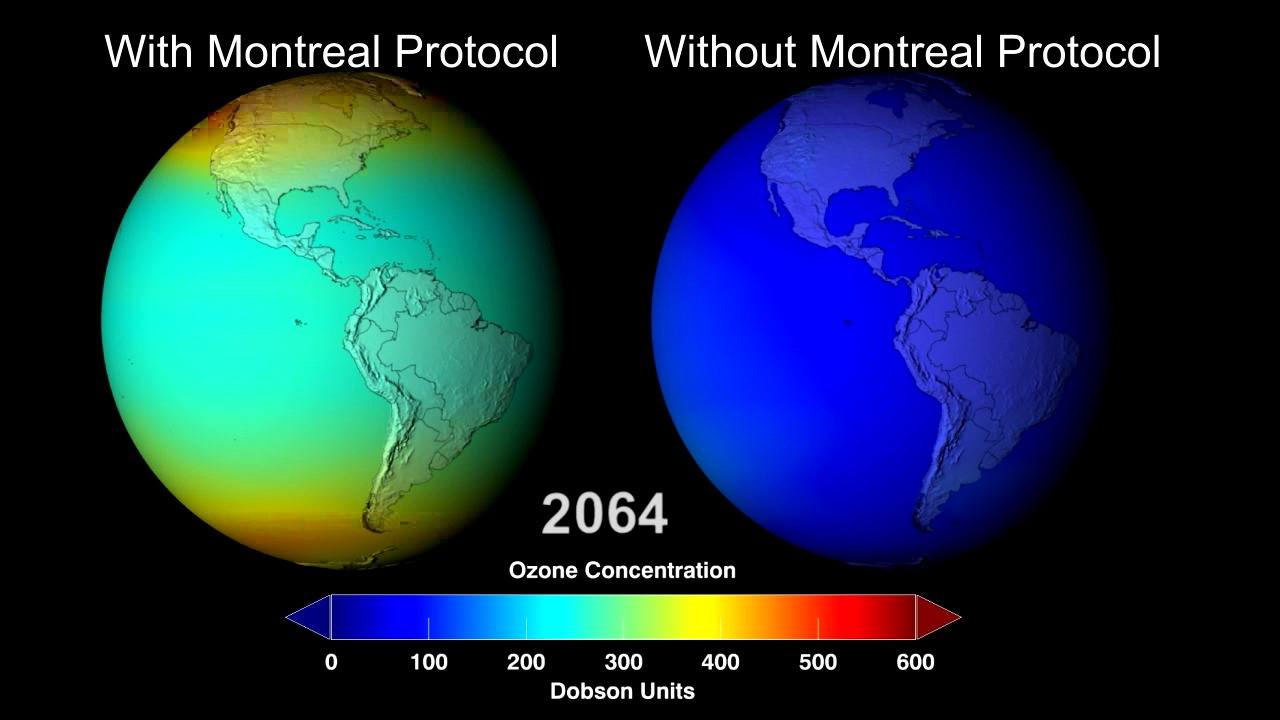
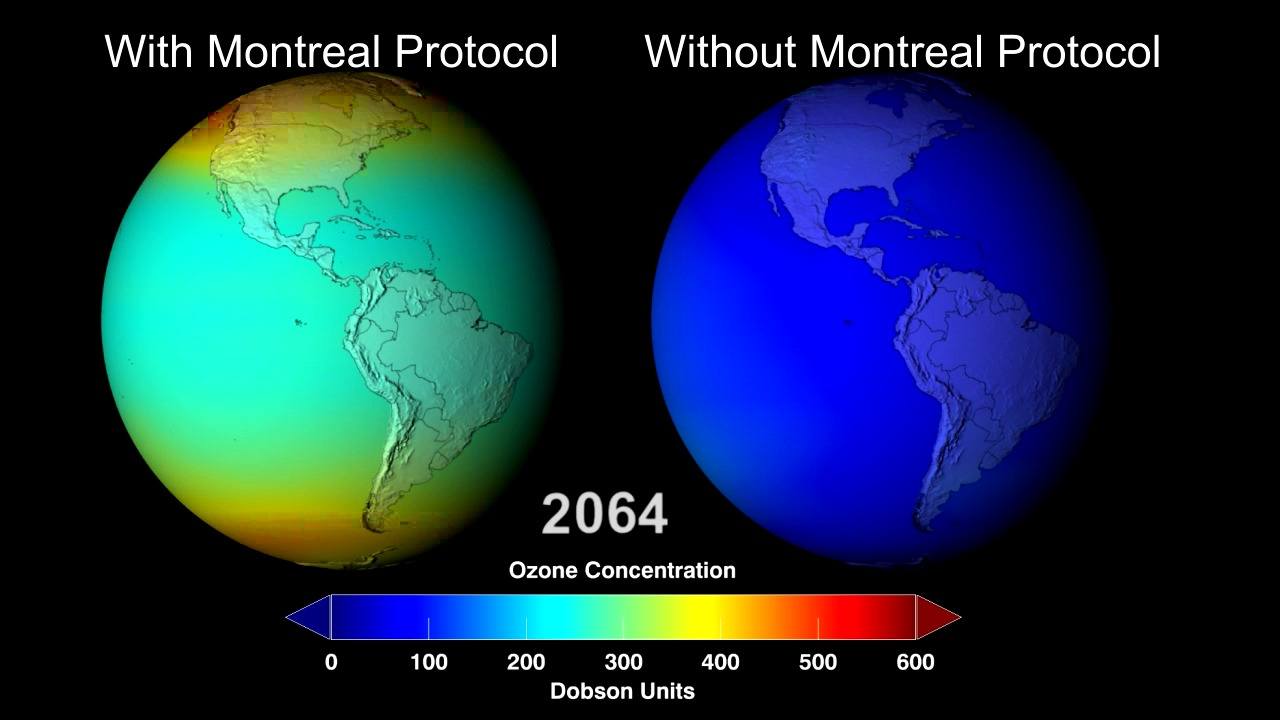
Which agreement allowed for a reduction, and eventual elimination, of CFC production and use?
a)
Montreal Protoccol
b)
Kyoto Protoccol
c)
Paris Agreement
d)
Yo MaMa
38.
How do CFCs affect ozone production?
a)
UV radiation frees a chlorine atom, which breaks down ozone.
b)
Infrared radiation frees a chlorine atom, which breaks down ozone.
c)
UV radiation frees a fluorine atom, which breaks down ozone.
d)
Infrared radiation frees a chlorine atom, which breaks down ozone.
39.
Which of these sets of three items produce CFCs
a)
cars, factories, and cardboard
b)
spray cans, cardboard, insulation
c)
spray cans, refrigerant, cardboard
d)
spray cans, refrigerant, insulation
40.
Though CFC production has been curtailed, the threat to upper atmosphericozone continues because CFCs
a)
become harmless quickly.
b)
destroy ozone for only a short time.
c)
persist but stop destroying ozone.
d)
persist and continue to destroy ozone for decades.
41.
The formation of ozone begins when and O2 molecule is split by
a)
UV-A radiation
b)
UV-B radiation
c)
UV-C radiation
d)
UV-A or UV-B radiation
42.
How many ozone atoms can a single chlorine atom break down?
a)
5,000
b)
10,000
c)
50,000
d)
100,000
43.

Which is NOT a result of the reduction in stratospheric ozone?

a)

reduced photosynthetic activity

b)

increased skin cancer

c)

increased likelihood of cataracts

d)

increased birth defects

44.
Through international cooperation, the concentration of chlorine in the atmosphere
a)
has already decreased below 3ppb
b)
will stabilize around 3ppb by 2030
c)
has stabilized at 5ppb
d)
is expected to stabilize at 5ppb by 2100
45.

When is the ozone hole largest?

a)

early Antarctic spring

b)

late Antarctic summer

c)

early Antarctic winter

d)

late Antarctic fall

46.

Which chemical that replaced CFCs in refrigerants is now a concern as a major greenhouse gas?

a)

CFCs

b)

HFCs

c)

DDT

d)

CFCl2

47.

Which is not an example of an ecological consequence of reduced stratospheric ozone?

a)

loss of biodiversity from reduced photosynthesis in plants

b)

collapse of marine food webs

c)

reduced crop yield

d)

reduced terrestrial biome productivity

48.

UV rays can cause obvious short term damage, such as sunburn, as well as long term damage that accumulates with each exposure to the sun.

a)

True

b)

False

49.

Which is most strongly absorbed by ozone in the statosphere?

a)

UV-A

b)

UV-B

c)

UV-C

d)

UV-B and UV-C

e)

UV-A and UV-B

50.

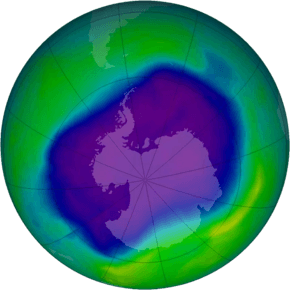
Location of the large whole in the ozone.

a)

Antarctica

b)

Artic

c)

Iceland

d)

Africa