

wayground logo

Free Printable Worksheets

Font size

S
M
L
XL
Worksheets

Electricity

Total questions: 60

Worksheet time: 10hrs 0mins
Name
Class
Date
1.
Two types of circuits are
a)
parallel and magnetic
b)
electromagnetic and series
c)
series and parallel
2.
The unit for current is the 
a)
Volt
b)
Ohm
c)
Electron
d)
Amp
3.
In a ________ circuit there are multiple paths for the current to take.
a)
Series
b)
Parallel
4.
In a _________ circuit, if one bulb goes out then the entire circuit doesn't work.
a)
Series
b)
Parallel
5.
The continuous flow of electric charges through a material is called...
a)
Electric Field
b)
Electric Force
c)
Electric Current
d)
Electric Circuit
6.
Identify the conductor below.
a)
cloth rag
b)
plastic bottle
c)
gold ring
7.
What is the unit for resistance?
a)
Volts
b)
Amperes
c)
Ohms
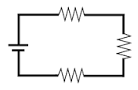
8.
What type of circuit is pictured?
a)
series
b)
parallel
9.
What kind of circuit is this?
a)
Series
b)
Consecutive
c)
Parallel
d)
Training
10.
If the battery produced 12.6 Volts and what would be the current flow be for a 6 Ohm resistor
a)
2.1 Amps
b)
2.4 Amps
c)
1.71 Amps
d)
15 Amps
11.
What voltage is needed to cause a 2A current flow through a 10Ω resistor?
a)
5V
b)
0.2V
c)
20V
d)
200V
12.
What resistance is needed to cause a 20A current flow because of a 100V battery?
a)
0.2Ώ
b)
2000Ώ
c)
120Ώ
d)
13.
What is the power of a 20V bulb with 5A through it?
a)
100W
b)
100V
c)
6.3W
d)
6.3A
14.
What is the current through a 11V bulb with a power of 99W?
a)
9W
b)
9A
c)
60V
d)
60A
15.

What voltage is needed to cause a 50A current flow through a 10Ω resistor?

a)

15V

b)

500V

c)

500 kV

d)

0.2V

16.
If the battery produced 12.6 Volts and what would be the current flow be for a 6 Ohm resistor
a)
2.1 Amps
b)
2.4 Amps
c)
1.71 Amps
d)
15 Amps
17.

Which choice describes the behavior of an electric charge?

a)

Like charges attract. Unlike charges repel.

b)

Like charges repel. Unlike charges attract.

c)

Like charges attract. Unlike charges attract.

d)

Like charges repel. Unlike charges repel.

18.
Two like charges:
a)
 neutralize each other.
b)
repel each other. 
c)
must be neutrons. 
d)
attract each other.
19.
The charge of an electron is:
a)
Positive. 
b)
Negative. 
c)
Electrons have no charge
20.
An object that has more electrons than protons would have what kind of charge?
a)
Positive
b)
Negative
21.
An object that is positively charged contains more protons than electrons.
a)
True
b)
False
c)
I need more information
22.
Electric charges that are alike _______ each other.
a)
Attract
b)
Repel
23.
The push or pull between charged objects is an
a)
electric force
b)
electric discharge
c)
electric field
24.
Consider the electric field lines shown in the diagram below. From the diagram, it is apparent that object A is ____ and object B is ____.
a)
+,+
b)
+,-
c)
-,+
d)
-,-
25.
The electrical force between charges is strongest when the charges are
a)
close together
b)
far apart
c)
 the electric force is constant everywhere.
d)
there is no pattern
26.

The electric field lines for a positive charge is always directed away from the charge. True or False?

a)

True

b)

False

27.
What does it mean when the electric field lines are close together?
a)
the field is positive
b)
the field is negative
c)
The field is strong
d)
the field is weak
28.
When a balloon is rubbed on clothes it acquires a charge by ___________
a)
Induction
b)
reduction
c)
friction 
d)
concuction
29.

Which diagram correctly shows the electric field around a negative charge?

a)

A

b)

B

c)

they are both positive

30.

When an object gains electrons it becomes __________

a)

Neutral

b)

Positively charged

c)

Negatively charged

31.

which is the field for opposite charges

a)
b)
c)
d)
32.

a)

3 A

b)

2.5 A

c)

2 A

d)

4 A

33.

a)

480 A

b)

120 A

c)

2 A

d)

1 A

34.

a)

A

b)

B

c)

C

d)

D

35.

a)

A

b)

B

c)

C

d)

D

36.

a)

A

b)

B

c)

C

d)

D

37.

Refer text book page 99

a)

2 x 10-21 electrons

b)

2000 electrons

c)

2.7 x 10²¹ electrons

d)

6.25 x 10¹⁸ electrons

38.
a)

a) 12 C b) 36 J

b)

a) 720 C b) 2160 J

c)

a) 0.2 C b) 0.6 J

39.

a)

0.25 A

b)

90 A

c)

1.5 A

d)

15 A

40.

Rate of flow of electric charge is

a)

Electric current

b)

Conventional current only

c)

Electronic current only

d)

Potential difference

41.

Instrument which transfers energy to electric charge in a circuit is

a)

Battery

b)

Voltmeter

c)

Ammeter

d)

Galvanometer

42.

If a current of 1A passes through a point in 1s then the charge passes that point is

a)

2C

b)

3C

c)

1C

d)

6C

43.

Energy transfer per unit charge is

a)

E.M.F

b)

Current

c)

Potential difference

d)

Conventional current

44.

Current in a circuit when a charge of 180C passes a point in a circuit in 2 minutes.

a)

1.00 AM

b)

2.00 A

c)

3.00 A

d)

1.5 A

45.

Thicker wire have ..........resistance than thinner wire.

a)

more

b)

less

c)

the same

46.

As the resistance in the circuit increases, the electric current

a)

increases

b)

decreases

c)

stay the same

47.

What characteristic impact resistance of material.

a)

Thickness

b)

Temperature

c)

Length

d)

All of the above

48.

If the current increases, it could be because of...

a)

Increase voltage

b)

Decreasing resistance

c)

Both

49.

Diagram shows voltmeter is placed

a)

Parallel

b)

Series

50.

Ammeter must placed .. in the circuit

a)

Series

b)

Parallel

51.

It is work done to move a unit of electrical charge from one point to another point in electric field. This refer to

a)

Current

b)

Potential difference

c)

Resistance

d)

Power

52.

Which of the formulae is correct about Ohm's Law?

a)

V = IR

b)

V =QR

c)

VI = R

d)

I = QR

53.

Which of the graph obey the Ohm's Law

a)
b)
c)
d)
54.

The thinner wire has low resistance because .... electric charges can flow throuh it.

a)

Same number

b)

Less

c)

More

55.

Diagram shows a conductor with same length but different size. Which wire has low resistance?

a)

S

b)

T

56.

If temperature getting higher, resistance of conductor become ...

a)

Unchange

b)

Increase

c)

Decrease

57.

Digram shows experiment to study the factor of .... Towards resistance

a)

Length

b)

Temperature

c)

Area

d)

Type of wire

58.

Wire S has lower resistance because

a)

Resistance directly proportional to length

b)

Resistance inversely proportional to length

59.

Between wire S and T. Which has higher resistance?

a)

S

b)

T

60.

Potential difference is directly proportional to current flows in conductor under standard tempertaure and pressure.

This refer to

a)

Current

b)

Potential difference

c)

Resistance

d)

Ohm's Law
