
 Worksheets
COMX 115 Exam 3 Practice Quiz
Total questions: 17
Worksheet time: 19mins
When you have lower concern for your OWN needs, and a high concern for OTHERS' needs, you sacrifice to let the other person "win" during a conflict. Which conflict management strategy does this describe? (Q15 on study guide)
avoiding
compromising
accommodating
competing
collaborating
True or False: People who are trying to deceive you typically use more "filler" words and stiffen up their bodies. (Q20 on Study Guide)
True
False
Which of the factors, below, determine whether someone's power is positive or negative when there is a power imbalance between two parties? (Note: There is more than one right answer.) Q13 on Study Guide
whether the two parties agree on the power arrangement
whether two parties are of different genders
whether the two parties are of the same or different cultures
whether the person in power uses it to benefit everyone
whether everyone got an equal vote in who has the power
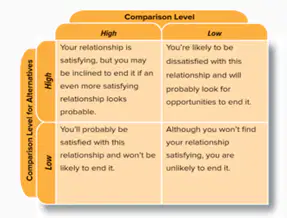
Which theory, based on this diagram, describes how humans decide whether to stay in relationships, based on how satisfied we are currently and how satisfied we think a new partner could make us? (Q4 on Study Guide)
Truth Bias Theory
Social Exchange Theory
Attribution Theory
Predicted Outcome Value theory
Attraction Theory
Julie has 1,400 followers on Instagram, who love her fashion sense and beauty tips. Julie's advice is trusted, and people respect her taste and style. Even though Julie has NO formal fashion training, her followers admire her, based on their admiration, respect and trust of her.
In this scenario, which form of power does Julie have? (Q14 on Study Guide)
expert
referent
coercive
reward
legitimate
What is the motivation impairment effect? (Q19 on Study Guide)
A pattern of behavior in which one person demands communication or attention, but the other partner withdraws from the conversation.
The theory that we want to form and maintain relationships that will be "worth" the effort, and if we have better options elsewhere, we will leave.
The hypothesis that our motivation to succeed in high-stakes lies impairs our non-verbal performance, making our lies less believable.
The tendency to believe that other people are being honest, if we don't have evidence otherwise.
The theory that good liars are better at detecting others' lies, too.
Larry enjoys spending time with his wife, Tina, but he also likes to spend time alone. To balance his love of his wife with his need for independence, Larry sometimes works on a crossword puzzle while his wife is in the same room watching TV. By finding a behavior that satisfies both sides of the autonomy-connection tension simultaneously, what TYPE of strategy is Larry using? (Q2 on Study Guide)
(a)
Darryl has always thought Marco is kind of a jerk. One day, Darryl and Marco are talking about cars, and Darryl realizes that Marco is a real "gearhead." Suddenly, Darryl decides he might want to be friends with Marco because he's so good with cars -- and Darryl’s car is always breaking down, so Marco could help him repair it for free. Which of the following terms best describes Darryl’s feelings for Marco? (Q3 on Study Guide)
task attraction
social attraction
physical attraction
talent attraction
legitimate power
True or False: Voluntary kin that meet needs that are unmet by your legal or biological family when those people are geographically dispersed are called extended family. (Q9 on Study Guide)
True
False
Julia and Sara have been dating for about six months. Julia works a lot and is usually distracted when they spend time together; Sara wishes Julia would be more “present.” Meanwhile, Julia gets annoyed that Sara is “clingy.” Neither Julia nor Sara enjoy fighting, so they haven’t voiced their problems with the other person. Instead, they make passive-aggressive comments about little things, like household chores, and spend time apart when they are secretly frustrated with the other. Which romantic conflict communication style do Julia and Sara embody? (Q7 on Study Guide)
conflict-avoidant
hostile
volatile
submissive
passive
Which of the following are acts of dissimulation? (Q21 on Study Guide)
omission
falsification
equivocation
exaggeration
fraud
Which of the following are crucial pieces of the definition of deception? (Q17 on Study Guide)
A speaker must intentionally transmitting information.
The information must be incorrect.
The speaker must be trying to make you believe the information.
The information must be about a third party (i.e. not about the speaker OR the listener).
The speaker must know the information is incorrect.
In the Social Exchange Theory, our realistic expectation of what we want, and think we deserve, from a current relationship is called our __________. (Q4 on Study Guide)
first impression
predicted outcome value
comparison level
comparison level of alternatives
relational calibration
Within close relationships, when you perceive that you receive more benefits from someone than you contribute – for example, if your older sister let you live with her, rent-free, for two years while you went through some difficult personal times and you don’t know how to repay her – your relationship is considered ____________________________________ (two words).
over-benefitted
under-benefitted
asymmetrical
unbalanced
complementary
We express power within relationships in different ways. Messages that communicate submission by deferring to the other person's decision, such as, "We can see whatever movie you want, dear," are called... (Q12 on Study Guide)
one-up messages
one-down messages
one-across messages
one-below messages
one-side messages
Within a close relationship, when both parties use the same types of messages (i.e. they both use one-down or one-up messages) because they both believe they each have the same amount of power, it is called a (a) relationship. (Q12 on Study Guide)
Sabrina forgot her best friend’s birthday; her friend is very upset. Sabrina quickly purchases an expensive present, then texts her friend and says, “Haha, of course I didn’t forget, buddy! I was just trying to freak you out! Come on over and let’s watch a movie—I’ll obviously have your gift waiting for you.” What type of relational repair is Sabrina exhibiting? (Q5 on Study Guide)
explanation
apology
denial
appeasement
avoidance

