wayground logo

Free Printable Worksheets

Font size

S
M
L
XL
Worksheets

Units 6 and 7 Review

Total questions: 30

Worksheet time: 27mins

Name
Class
Date
1.
An organism made of only one cell is called________.
a)
eukaryotes
b)
prokaryotes
2.
Which type of cell contains a nucleus?
a)
eukaryotes
b)
prokaryotes
3.
It is called the "powerhouse" of a cell.
a)
nucleus
b)
mitochondria
c)
lysosome
d)
ribosome
4.

The part of the cell often called "the brain of the cell".

a)

Cytoplasm

b)

Cell wall

c)

Nucleus

d)

Ribosomes

5.
It is the storage area for water and other substances.
a)
vacuole
b)
lysosome
c)
ribosome
d)
rough ER
6.
It is the jelly-like fluid inside of the cell.
a)
cytoplasm
b)
nucleus
c)
endoplasmic reticulum
d)
golgi bodies
7.
It is located outside the cell membrane of plants and some bacteria which serves as extra support.
a)
cell wall 
b)
chloroplast
c)
smooth ER 
d)
rough ER
8.
Two cells are shown. Which image represents a plant cell?
a)
A
b)
B
9.
What is the function of a cell wall?
a)
to protect and support the cell
b)
to perform different functions in each cell
c)
to prevent water from passing through it
10.
What is the function of the cell membrane found in both plant and animal cells?
a)
to produce energy
b)
to remove waste products
c)
to allow molecules to enter or exit the cell
11.
it uses sunlight to create food, photosynthesis (only found in plant cells),
a)
smooth ER
b)
golgi body
c)
cell wall
d)
chloroplasts
12.
Trey was looking at an unknown cell under a microscope. He observed cytoplasm, cell wall, and a nucleus. Which of the following organisms could the unknown cell belong to?
a)
centipede
b)
bird
c)
rose
d)
bacteria
13.

Which of the following organelles does a plant cell contain, but the animal cell does not contain?

a)

chloroplasts

b)

mitochondria

c)

DNA

d)

vacuole

14.

Some cells have a flagellum, as shown in the image. What is the function of the flagellum?

a)

Helps with movement of the cell

b)

Helps with making proteins for the cell

c)

Contains the cells genetic material (DNA)

d)

Converts glucose into ATP for the cell

15.

Adam observed a cat's skin cell under a microscope. Then he observed a sample of grass under a microscope. Which of the following did Adam observe in the cells of the grass but not in the cat's cell? Select two.

a)

chloroplasts

b)

cell wall

c)

ribosomes

d)

nucleus

e)

cell membrane

16.
What is diffusion?
a)
when molecules move from a low concentration to a high concentration 
b)
when molecules move from a high concentration to a low concentration.
c)
no movement 
d)
molecules move everywhere
17.
Osmosis is the movement of _____ across a membrane.
a)
food
b)
energy
c)
oxygen
d)
water
18.
_______ regulates what enters and leaves a cell.  
a)
Cell Membrane
b)
Nucleus
c)
Mitochondria
d)
Cytoplasm
19.
Equilibrium?
a)
a large  amount of substance on  side of the cell and a small amount on the other side
b)
a small  amount of substance on  side of the cell and a large amount on the otherside
c)
equal amount of substance on either side of the membrane  
d)
no particles on either side of the a cell membrane
20.
Which way will the water molecules move during osmosis?
a)
Out of the cell, so the cell shrinks.
b)
Out of the cell, so the cell swells.
c)
Into the cell, so the cell shrinks.
d)
Into the cell, so the cell swells.
21.
When both inside and outside of a cell have the same amount of water it is said that the cell has reached a state of
a)
Osmosis
b)
Diffusion
c)
Equilibrium
22.

Passive Transport means

a)

Energy is used

b)

No energy is used

c)

Energy is created

23.
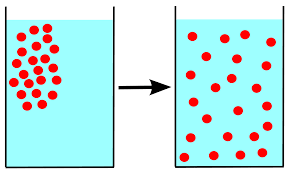
The picture below is an example of _________________.
a)
osmosis
b)
isotonic
c)
diffusion
d)
active transport
24.
Permeable means
a)
things can pass through
b)
the concentration levels are different
c)
it is permanent
d)
things are stuck
25.

Cell membranes are described as selectively permeable.

Four students were asked to explain what this means. Which one is correct?

a)

Student 1: Cell membranes prevent all materials from entering the cell.

b)

Student 2: Cell membranes only provide structural support for the cell.

c)

Student 3: Cell membranes regulate which substances can enter and exit the cell.

d)

Student 4: Cell membranes allow water and water-soluble substances to enter the cell.

26.
A person should never drink salty water because their cells would
a)
shrink
b)
expand
27.

What is the main function of the cell membrane?

a)

To maintain homeostasis

b)

To make energy

c)

To make proteins

d)

To maintain body temperature

28.

Diffusion moves along the __________

a)

concentration gradient

b)

Avogadro's constant

c)

conservation of energy

29.
 In the given scenario what will happen?  An egg with a dissolved shell is placed in pure water for 48 hours.
a)
Water will move in and out of the cell equally, and the cell with neither shrink nor swell.
b)
The egg will gain water and swell.
c)
The egg will lose water and shrink.
30.
A student noticed that placing wilted lettuce in a bowl of cool water caused the lettuce to become more crisp and firm. What is the best explanation for his observation?
a)
Water moved into the lettuce cells by active transport.
b)
Water moved into the lettuce cells by osmosis.
c)
Salt moved into the lettuce cells by diffusion.
d)
Water moved out of the lettuce cells by osmosis.