wayground logo

Free Printable Worksheets

NEW

Font size

S
M
L
XL
Worksheets

Module 2 DBA Review

Total questions: 22

Worksheet time: 13mins

Name
Class
Date
1.

The cohesion of water molecules at the surface of a body of water

a)

adhesion

b)

surface tension

c)

solubility

d)

polarity

2.

True or False: Water is a polar molecule.

a)

True

b)

False

3.

Which one has the lowest magnification?

a)

compound light microscope

b)

transmission electron microscope

c)

scanning electron microscope

4.

Which microscope would be the best choice to easily examine:

prepared slides

pond water

cells and organelles

a)

compound light microscope

b)

transmission electron microscope

c)

scanning electron microscope

5.

Which of the following statements is NOT part of the cell theory?

a)

Cells are the basic unit of structure and function in all living things.

b)

All cells are produced from other cells.

c)

Only animals are composed of cells.

d)

All living things are composed of cells.

6.
Which is true about active transport?
a)
It requires energy
b)
it does not require energy
c)
It moves substances down the concentration gradient
d)
it moves material from high to low concentration
7.
This cell organelle helps organisms maintain homeostasis by controlling what substances may enter or leave cells.
a)
vacuole
b)
nucleus
c)
cell membrane
d)
cell wall
8.
Eukaryotes include animal cells and plant cells? True or False?
a)
True
b)
False
9.
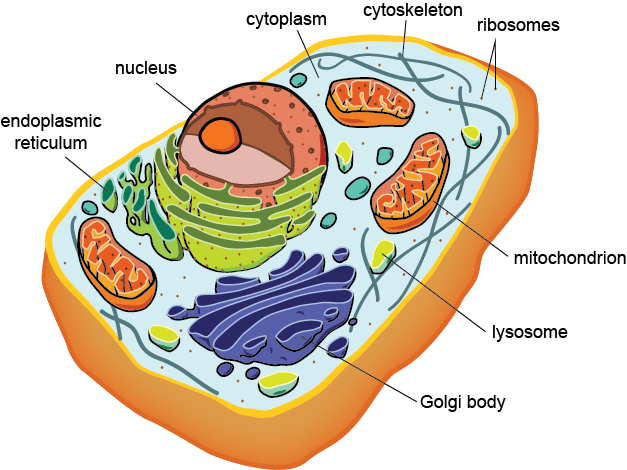
Which type of cell?
a)
Prokaryote
b)
Eukaryote
10.

Which is true of prokaryotic and eukaryotic cells?

a)

Prokaryotic cells are larger than eukaryotic cells.

b)

Eukaryotic cells do not have nuclei, and prokaryotic cells do have nuclei.

c)

Prokaryotic cells lack membrane-bound organelles, and eukaryotic cells contain membrane-bound organelles.

d)

Eukaryotic cells are simpler than prokaryotic cells.

11.

Jared observes a cell in biology lab with the light microscope. The cell has the following structures: nucleus, cell wall, and chloroplast. Identify the type of cell that Jared is observing.

a)

animal

b)

plant

c)

fungus

d)

bacteria

12.

Due to energy needs, muscle cells usually have a lot of which organelle?

a)

ribosomes

b)

mitochondria

c)

Golgi apparatus

d)

lysosomes

13.

Animal cells have all of the following in common with plants EXCEPT...

a)

nucleus

b)

cell wall

c)

mitochondria

d)

Golgi apparatus

14.

Animal and plant cells both have a nucleus, containing:

a)

DNA

b)

cellulose

c)

enzymes

d)

lipids

15.
What is a high energy molecule with 3 phosphates?
a)
ATP
b)
ADP
c)
Ribose
d)
Adenine
16.
What is a low energy molecule with 2 phosphates?
a)
ATP
b)
ADP
c)
Ribose
d)
Adenine
17.
What organelle is responsible for photosynthesis in plants and algae? 
a)
Mitochondria
b)
Chloroplast
c)
Cellular Membrane
d)
Flagella
18.
the products of photosynthesis are...
a)
glucose and sunlight
b)
carbon dioxide and water
c)
glucose and chlorophyll
d)
oxygen and glucose
19.
What is the correct equation for photosynthesis?
a)
C6H12O+ 6O--> 6CO2 + 6H2O
b)
6CO2 + 6O--> C6H12O + 6H2O
c)
 6CO+ 6O--> 6H2O + C6H12O6
d)
6CO2 + 6H2O  -->  6O+ C6H12O6
20.
The purpose of cellular respiration is to 
a)
make water
b)
make ATP
c)
make glucose
d)
make  oxygen
21.
What is the correct equation for cellular respiration?
a)
6O2 + C6H12O6 -> 6CO2 + 6H2O + Energy
b)
6O2 + C6H12O6 + Energy -> 6CO2 + 6H2O
c)
6CO2 + 6H2O -> 6O2 + C6H12O6 + Energy
d)
6CO2 + 6H2O + Energy -> 6O2 + C6H12O6
22.
Which of the following processes creates the most ATP during aerobic cellular respiration?
a)
glycolysis
b)
fermentation
c)
electron transport chain
d)
Kreb's cycle