wayground logo

Free Printable Worksheets

Font size

S
M
L
XL
Worksheets

Science TCAP Review

Total questions: 137

Worksheet time: 2hrs 32mins

Name
Class
Date
1.
Cirrus clouds are associated with _________ weather. 
a)
rainy
b)
snowy
c)
fair
d)
stormy
2.
Cumulus clouds are associated with _________ weather. 
a)
rainy
b)
snowy
c)
fair
d)
stormy
3.
Cumulonimbus clouds are associated with _________ weather. 
a)
rainy
b)
snowy
c)
fair
d)
stormy
4.
Stratus clouds are associated with _________ weather. 
a)
rainy
b)
snowy
c)
fair
d)
cloudy
5.
Nimbostratus clouds are associated with _________ weather. 
a)
rainy
b)
snowy
c)
fair
d)
cloudy
6.
_______ are wispy, feathery clouds.
a)
stratus
b)
cirrus
c)
cumulus
d)
cumulonimbus
7.
_______ look like cotton balls. 
a)
stratus
b)
cirrus
c)
cumulus
d)
cumulonimbus
8.
_______ are clouds that are found in high altitudes. 
a)
stratus
b)
cirrus
c)
cumulus
d)
cumulonimbus
9.
Which clouds form near the ground?
a)
Fog
b)
Cirrocumulus
c)
Nimbostratus 
d)
Altocumulus 
10.
Clouds form in which step of the Water Cycle?
a)
Evaporation
b)
Condensation 
c)
Precipitation 
d)
Run Off
11.
What cloud is this?
a)
cumulus 
b)
nimbostratus 
c)
cirrus
d)
fog
12.
What cloud is this?
a)
cumulus 
b)
stratus 
c)
cirrus
d)
cumulonimbus
13.
What cloud is this?
a)
cumulus 
b)
stratus 
c)
cirrus
d)
cumulonimbus
14.
Nimbus is a prefix that means...
a)
fair
b)
rain
c)
sun
d)
snow
15.
Name this tool. 
a)
Barometer
b)
Hygrometer
c)
Thermometer
d)
Ruler
16.
What tool is used to measure the amount of rain that has fallen? 
a)
Rain Gauge
b)
Barometer
c)
Wind Vane
d)
Precipitation
17.
What tool is used to measure wind speed? 
a)
Wind Vane
b)
Anemometer
c)
Thermometer
d)
Barometer
18.
What tool is used to determine wind direction? 
a)
Barometer
b)
Hygrometer
c)
Anemeometer
d)
Wind Vane
19.
What is the name the name of this weather tool? 
a)
Rain Gauge
b)
Telescope
c)
Wind Vane
d)
Anemometer
20.
What is the name of this weather tool and what does it measure? 
a)
Rain Gauge and the amount of water that is in the air
b)
Rain Gauge and the amount of rain that has fallen
c)
Hygrometer and the amount of rain that has fallen
d)
Hygrometer and the amount of water that is in the air
21.
What does a barometer measure? 
a)
measures high and low pressure in the air
b)
measures humidity in the air
c)
measures speed of the wind 
d)
measures the amount of rain that has fallen
22.
What does an anemometer measure?
a)
wind speed
b)
temperature
c)
wind direction
d)
amount of snowfall
23.

What planet is closest to the sun?

a)

Mars

b)

Earth

c)

Venus

d)

Mercury

24.

What are the four inner planets?

a)

Earth, Uranus, Mercury, Venus

b)

Mercury Venus Earth Saturn

c)

Mars, Earth , Mercury, Venus

d)

Mars, Earth, Neptune, Mercury

25.

Which planet is farthest from the sun?

a)

Neptune

b)

Jupiter

c)

Mercury

d)

Uranus

26.

What are the outer planets?

a)

Jupiter, Saturn, Earth, Neptune

b)

Saturn, Neptune, Mars, Uranus

c)

Uranus, Saturn, Neptune, Jupiter

d)

Mercury, Venus, Earth, Mars

27.

What is at the center of our solar system?

a)

asteroid belt

b)

Earth

c)

sun

d)

moon

28.

What is the sixth planet from the sun?

a)

Uranus

b)

Saturn

c)

Earth

d)

Venus

29.

Which planets are mostly made of gases?

a)

terrestrial

b)

gas giants

c)

inner planets

30.

Which planet is third from the sun?

a)

Mars

b)

Earth

c)

Mercury

d)

Venus

31.

Which planet is a gas giant?

a)

Mercury

b)

Earth

c)

Saturn

d)

Venus

32.

How many planets are in our solar system?

a)

6

b)

7

c)

8

d)

9

33.
Anything that helps an animal survive in its environment.
a)
counter-shading
b)
mimicry
c)
adaptation
d)
camouflage
34.
_______________ is when an animal blends into its environment.
a)
camouflage
b)
mimicry
c)
warning coloration
35.
When an animal looks like another animal it is called ______________.
a)
camouflage
b)
mimicry
c)
warning coloration
d)
protective resemblance
36.
Which is a body part that can be adapted for getting food?
a)
claws
b)
paw pads
c)
teeth
d)
beaks
37.
Camouflage can help prey hide from its predators. It can also hide predators from prey.
a)
True
b)
False
38.
A Viceroy butterfly looking like a bright colored poisonous Monarch butterfly is an example of __________.
a)
camouflage
b)
mimicry
c)
warning coloration
d)
protective resemblance
39.
A place where plants and animals live and grow is called a ____________. It provides, food, water, shelter, and air.
a)
shelter
b)
tree
c)
habitat
d)
organism
40.

___ structures are found on the inside of living things.

a)

External

b)

Internal

41.

___ are behaviors or physical characteristics that help an organism to survive and reproduce in its environment.

a)

Biomes

b)

Roots

c)

Nocturnal

d)

Adaptations

42.

What is an adaptation?

a)

it's like when you get a baby from another family

b)

it's like when you can't breathe water so you die

c)

a change in a population of living things that helps them survive in an environment

d)

it's like when you go to a store and everything is on sale

43.

Bats are nocturnal and hunt at night.

a)

physcial

b)

behavioral

44.
Matter is anything that takes up space
a)
True
b)
False
45.
Mass measueres the amount of matter in an object
a)
True
b)
False
46.
Volume is the amount of space that matter takes up
a)
True
b)
False
47.
Liquids have a certain shape and a volume of their own. Liquids are something you can touch.
a)
True
b)
False
48.
Solid have a certain shape and a volume of their own. Solid are something you can touch.
a)
True
b)
False
49.
Gasses do not have a shape or volume of their own. You cannot see most gasess.
a)
True
b)
False
50.
Weigh, helium and air are examples of liquidis
a)
True
b)
False
51.
Some changes of matter from one state to another are:
a)
Solid and liquid
b)
Gas and solid
c)
solid, liquid and gas
d)
Solid
52.
Liquids can be changed to solid
a)
True
b)
False
53.
What are the states of matter?
a)
solid, liquid, and juice
b)
solid and liquid
c)
solid and gas
d)
solid, liquid, and gas
54.
A description of objects that can be measured and observed.
a)
gas
b)
mustangs
c)
physical properties
d)
melting point
55.
Which of the following is a part of the water cycle?
a)
evaporation
b)
condensation
c)
precipitation
d)
all of the above
56.
If you saw a glass of water and later the water was gone what happened to the water? Remember that your in the science lab.
a)
Ms. Klenk was very thirsty and drank the water.
b)
evaporation
c)
precipitation
d)
solubility
57.
Cutting an orange is a physical change.
a)
True
b)
False
58.
What causes a change in the state of matter?
a)
physical properties
b)
chemical energy
c)
temperature
59.
Which change can occur when  you add heat energy to water?
a)
The water can change from a liquid to a solid
b)
The water can change from a gas to a liquid
c)
The water can change from a liquid to a gas
d)
The water can change from a solid to a liquid
60.
Changing the way matter looks without changing it into NEW matter is a:
a)
Chemical change
b)
Physical change
c)
Energy change
d)
BOTH a chemical and a physical change
61.
Water freezing to ice is an example of a:
a)
Physical change
b)
Chemical change
62.
Chopping wood is an example of a:
a)
Physical change
b)
Chemical change
63.
Burning wood to ash is an example of a:
a)
Physical change
b)
Chemical change
64.
Smashing a piece of candy into smaller pieces is an example of a:
a)
Physical change
b)
Chemical change
65.
Adding HEAT to matter causes its particles to:
a)
move faster and farther apart
b)
Move slower and farther apart
c)
Move faster and closer together
d)
Move slower and closer together
66.

What is energy?

a)

moving energy

b)

stored energy

c)

renewable energy

d)

The ability to do work.

67.

What is potential energy?

a)

moving energy

b)

stored energy

c)

renewable energy

d)

non renewable energy

68.

What is kinetic energy?

a)

moving energy

b)

potential energy

c)

stored energy

d)

renewable energy

69.

What is NOT a renewable energy source?

a)

coal

b)

wind

c)

solar

d)

water

70.

Which is NOT a non-renewable energy source?

a)

coal

b)

oil

c)

wind

d)

gas

71.

What is given off from energy?

a)

water

b)

heat

c)

smoke

d)

ash

72.
Energy you can see is _________. 
a)
sound energy
b)
heat energy
c)
light energy
73.
Which form of energy is produced when a guitar string vibrates?
a)
Sound energy
b)
Electrical energy
c)
Chemical energy
d)
Light energy
74.
wood is a _____?
a)
conductor
b)
insulator
75.
water is a______?
a)
conductor
b)
insulator
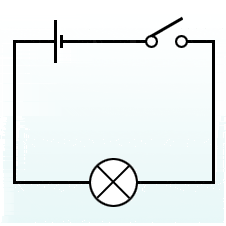
76.
What kind of circuit is this?
a)
series
b)
parallel
77.
What type of circuit is show in the image?
a)
Series Circuit
b)
Parallel Circuit
78.
this circuit is .....?
a)
open
b)
parallel
c)
closed
d)
The cutest little circuit evah!
79.
When all parts of the circuit are connected it is a ______ circuit. 
a)
open
b)
closed
80.
When you flip a light switch on and off you are closing and opening a circuit.
a)
true
b)
false
81.
In a parallel circuit if one light bulb goes OUT; then they ALL go out. TRUE OR FALSE?
a)
TRUE
b)
FALSE
82.
What is a switch's function in a circuit?
a)
to make the current hotter or colder
b)
turn on and off the flow of current
c)
the pathway that current flows
d)
to add more power to the circuit
83.

What process occurs when tiny water droplets cling together in the atmosphere?

a)

clouds

b)

evaporation

c)

condensation

d)

accumulation

84.

What is the role of the sun in the water cycle?

a)

provide heat energy for evaporation

b)

provide heat energy for condensation

c)

dry out the soil for runoff to occur

d)

provide thermal energy for accumulation

85.

Which of the following is an example of precipitation?

a)

sleet

b)

hail

c)

snow

d)

all of the above

86.

Which of the following is NOT a way water moves from the land to the air?

a)

transpiration

b)

respiration

c)

evaporation

d)

precipitation

87.

What is it called when plants release water vapor through their leaves?

a)

sublimation

b)

respiration

c)

transpiration

d)

precipitation

88.

What is the process called when water vapor turns to liquid water?

a)

evaporation

b)

condensation

c)

precipitation

d)

transpiration

89.

If groundwater reaches earth's surface, how does it reenter the water cycle?

a)

by transpiration

b)

by evaporation

c)

by accumulation

d)

it can't

90.

Water falls to Earth as rain after water vapor ________ into clouds.

a)

evaporates

b)

accumulates

c)

condenses

d)

freezes

91.

During evaporation, water changes from a _________ to a __________.

a)

solid, liquid

b)

gas, liquid

c)

liquid, gas

d)

liquid, solid

92.

Part of the plant that absorbs water.

a)

Roots

b)

Flowers

c)

Petals

d)

Leaves

93.

Part of the plant that has chlorophyll

a)

Roots

b)

Flowers

c)

Petals

d)

Leaves

94.

Part of the plant that is long, transport nutrients, water and keep the plant stable in the ground.

a)

Roots

b)

Stem

c)

Petals

d)

Leaves

95.

Green substance that turn the leaves green

a)

Chlorophyll

b)

Roots

c)

Green Paint

d)

Spore

96.

What does it mean to brainstorm solutions to a problem?

a)

Think of ways to make the problem worse

b)

Think of ways to make similar kinds of problems

c)

Think of ways to solve the problem

d)

Think of ways to observe the problem

97.

A barometer measures air pressure.

a)

True

b)

False

98.

A circuit will be broken if all particles are in direct contact.

a)

True

b)

False

99.

Different solids have different masses.

a)

True

b)

False

100.

Clouds are formed when water vapor condenses around dust specks in the air.

a)

True

b)

False

101.

Which statement is an example of mimicry?

a)

A giraffe has a long neck to reach high leaves.

b)

An insect’s body is shaped like a thorn

c)

A lizard changes color to blend in with its environment.

d)

A skunk uses a strong odor to scare away predators.

102.

What happens to water when it is heated?

a)

It boils

b)

It changes color.

c)

It becomes thicker.

d)

It becomes a solid.

103.

Choose the example that does not represent an advantage of animals living in a group.

a)

A colony of ants builds a network of underground tunnels.

b)

Owls hunt at night to surprise their prey.

c)

A pack of wolves works together to hunt for food.

d)

Prairie dogs alert each other using calls when a predator is near.

104.

One solid that is hard is _______________.

a)

cotton

b)

rubber

c)

steel

d)

cloth

105.

To stop a drum from producing sound, you would _____.

a)

hit it harder

b)

hit it softer

c)

stop it from vibrating

d)

place it in water

106.

The light in your bedroom will not turn on. Which is not a possible cause?

a)

The power plant is not producing enough electricity

b)

A power line is broken

c)

A wire in your home is broken.

d)

The wires are made of too many conductors.

107.

Batteries are a way to store ____________.

a)

magnetic energy

b)

kinetic energy

c)

electric energy

d)

thermal energy

108.

______________ travel through space to collect data on the planets of our solar system.

a)

Operators

b)

Planetariums

c)

Moons

d)

Satellites

109.

An area with similar patterns of temperature, humidity, precipitation, and wind is a _____.

a)

climate region

b)

hemisphere

c)

continent

d)

state

110.

An electric charge ___________________.

a)

is only negative

b)

can always be seen

c)

can be positive or negative

d)

cannot move in a wire

111.

An organism that imitates another uses __________ to stay safe.

a)

community

b)

climate

c)

camouflage

d)

mimicry

112.

A bear that sleeps through the winter so it does not have to find food is an example of _____.

a)

mimicry

b)

hibenation

c)

camouflage

d)

migration

113.

Electrical charges can be either positive or _____.

a)

closed

b)

balanced

c)

negative

d)

absorbed

114.

Which is true about the circuit pictured?

a)

Electrical energy is converted into light and heat

b)

No energy transfer will occur.

c)

The light bulb is the source of energy.

d)

Light energy is converted into electrical energy

115.

magnetic field

a)

a material that is often affected by the push and pull of magnets

b)

. ​a region of magnetic force around a magnet

c)

the ability of an object to push or pull on another object that has the magnetic property

d)

an object with a force that can attract or repel certain materials

e)

one of two ends of a magnet

116.

pole

a)

. ​a material that is often affected by the push and pull of magnets

b)

​a region of magnetic force around a magnet

c)

the ability of an object to push or pull on another object that has the magnetic property

d)

an object with a force that can attract or repel certain materials

e)

one of two ends of a magnet

117.

magnet

a)

​a material that is often affected by the push and pull of magnets

b)

a region of magnetic force around a magnet

c)

the ability of an object to push or pull on another object that has the magnetic property

d)

an object with a force that can attract or repel certain materials

e)

one of two ends of a magnet

118.

magnetism

a)

a material that is often affected by the push and pull of magnets

b)

​a region of magnetic force around a magnet

c)

the ability of an object to push or pull on another object that has the magnetic property

d)

​an object with a force that can attract or repel certain materials

e)

one of two ends of a magnet

119.

metal

a)

a material that is often affected by the push and pull of magnets

b)

a region of magnetic force around a magnet

c)

​the ability of an object to push or pull on another object that has the magnetic property

d)

an object with a force that can attract or repel certain materials

e)

one of two ends of a magnet

120.

Which liquid has more volume?

a)

A

b)

B

121.

Which liquid has more volume?

a)

A

b)

B

122.

Dissolving salt and water is a physical change.

a)

True

b)

False

123.

All seeds are the same size.

a)

True

b)

False

124.

Clouds are formed when water vapor condenses around dust specks in the air.

a)

True

b)

False

125.

Cosmologists study the weather on Earth.

a)

True

b)

False

126.

A stratus cloud that forms near the ground is called _____.

a)

steam

b)

fog

c)

water vapor

d)

a cumulus cloud

127.

Different seasons are caused by the spinning of the Earth on an imaginary line called its ___________.

a)

hemisphere

b)

meriudian

c)

axis

d)

rod

128.

Which property might a chair have?

a)

fuzzy

b)

jagged

c)

hard

d)

shapelesss

129.

Thelma is baking cookies with her mom. Which is a chemical change that cannot be reversed?

a)

mixing sugar and flour

b)

shaping the dough into cookies

c)

baking the cookies

d)

freezing the cookies

130.

Which of the following might a lightning rod prevent?

a)

a flood

b)

an earthquake

c)

a fire

d)

a tornado

131.

Which affects climate the most?

a)

sand and rocks

b)

windsocks and air

c)

weather vanes and balloons

d)

oceans and mountains

132.

When you roll pieces of clay into a ball, what changes?

a)

the total mass of the clay

b)

the shape of the clay

c)

the temperature of the clay

d)

the color of the clay

133.

A stick of butter is cut and melted. It starts to burn. Which is a chemical change that cannot be reversed?

a)

cutting the butter

b)

melting the butter

c)

burning the butter

d)

freezing the butter

134.

Which measures precipitation?

a)
b)
c)
d)
135.
Name this landform.
a)
delta
b)
canyon
c)
sand dune
d)
cave
136.
Name this landform.
a)
sand dune
b)
delta
c)
desert
d)
mountain
137.
What agent is responsible for creating sand dunes?
a)
wind
b)
water
c)
ice
d)
deposition