
 Worksheets
Everything through Ventricular ECG
Total questions: 24
Worksheet time: 12mins

What is the ECG showing
Atrial Fibrillation
Ventricular Fibrillation
Asystole
Premature Ventricular Contraction
Heart Block
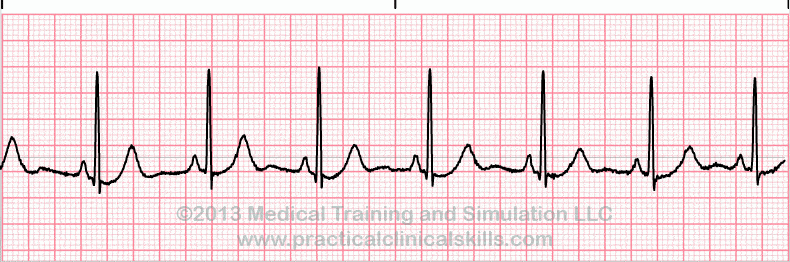
What is the ECG showing
Atrial Fibrillation
Ventricular Fibrillation
normal
Premature Ventricular Contraction
Heart Block

What is the ECG showing
Atrial Fibrillation
Ventricular Fibrillation
normal
Premature Ventricular Contraction
Heart Block

What is the ECG showing (arrow)
Atrial Fibrillation
Ventricular Fibrillation
normal
Premature Ventricular Contraction
Heart Block
Rate: 150 – 250 bpm
Rhythm: regular
Accelerated Junctional Rhythm
ST
Accelerated IVR
SVT
Rate: less than 60 bpm
Rhythm: regular
Sinus Rhythm
Sinus Arrhythmia
Sinus Bradycardia
Sinus Tachycardia
A common cardiac dysrhythmia characterized by premature heartbeats originating in the atria.
A-Fib
A-Flutter
PAC's
SA Block
Lead II is the standard lead in viewing the EKG.
True
False
ST Elevation
NSTEMI
STEMI
Occlusion of this artery is often the most fatal.
Right Posterior Ascending Artery
Left Anterior Descending Artery
Circumflex Artery
Marginal Artery

Use the rule of 300 to determine approximate Heart Rate.
300/6 = 50
300/3.5 = 75
300/1.5 = 200
Not enough information.

Which of the following best describes this strip?
Tachycardia
Normal Sinus Rhythm
Bradycardia
Asystole

The nurse sees the above rhythm on the monitor. What should the nurse do first?
Defibrillate the patient
Initiate chest compressions
Check for the presence of a pulse
Advise the patient not to get out of bed

Name the EKG
Normal Sinus Rhythm
Sinus Tachycardia
Sinus Bradycardia
Atrial fibrillation
The QRS complex is normally __________ seconds in duration
0.06 to 0.10
0.04 to 0.10
0.08 to 0.12
0.10 to 0.12
Every other beat is a PVC
A fib
Atrial Flutter
Asystole
bigeminy
Atria are irritable and quivering, causing fibrillatory waves between QRS complex
asystole
atrial flutter
A fib
V fib
Premature early beat that is wide and bizarre
PAC
PJC
PVC
Premature heart block
Every third beat is a PVC
Bigeminy
Trigeminy
Couplet
Triplet
Ventricles are irritable and no longer contract but quiver, there are no definite complexes
A fib
V fib
V tach
Atrial flutter
Ventricles are contracting but at a very fast rate, only see wide and bizarre complexes
Atrial tachycardia
Ventricular Fib
Atrial Fib
V tach

Name this Rhythm
Torsades
V fib
a fib
agonal

What rhythm is here?
idioventricular
agonal
asystole
sinus bradycardia

What rhythm is here?
idioventricular
agonal
asystole
sinus bradycardia

