wayground logo

Free Printable Worksheets

Font size

S
M
L
XL
Worksheets

BIG REVIEW 2020-2021

Total questions: 94

Worksheet time: 1hrs 16mins

Name
Class
Date
1.
What did the Homestead Act of 1861 allow settlers to do?
a)
Go to war with Native Americans
b)
Own the land that they settled on after 5 years
c)
Establish the sharecropping system
d)
Make peace with the Native Americans
2.
The Industrial Revolution describes a time when
a)
people rejected socialism and began calling for capitalism.
b)
people began to use the scientific method to find answers to their questions.
c)
work done by machines in factories replaced work done by hand.
d)
industrialized nations created overseas colonies.
3.

How did the growth of the railway system during the 19th century affect the U.S. economy?

a)

by helping expand the commercial markets of U.S. businesses

b)

by making it easier for people in rural areas to work in urban factories

c)

by helping strengthen the economic ties between U.S. and British companies

d)

by permitting faster communication between corporate leaders and their employees

4.

Which of the following is the reason people moved to cities?

a)

for the job opportunities

b)

to catch a smelly pole cat

c)

that is where the transcontinental railroad stopped

d)

to get away from the free farmland out west

5.
While industralists made lots of money, their workers often didn't, so the period was not as prosperous as it seemed. For this reason it is often called the....
a)
Great Depression
b)
Gilded Age
c)
Golden Age
d)
Dark Age
6.
The sometimes unethical business practices of some industrialists led them to be given this nickname
a)
Captains of Industry
b)
Tycoons
c)
Fat Cats
d)
Robber Barons
7.
What is a Laissez-Faire economy?
a)
An economy that is completely controlled by the U.S. government
b)
An economy that is partially controlled by the U.S. government
c)
An economy that works best when there is very little involvement by the U.S. government
d)
An economy that is controlled by another country
8.
When was the Progressive Era?
a)
Antebellum
b)
1865-1877
c)
1900-1920
d)
1933-1945
9.
Why did the U.S build the Panama Canal?
a)
to reduce travel time
b)
to speed up trade
c)
to protect from invaders
d)
for fishing
10.
How did many Americans react to the Zimmermann Telegram?
a)
They became concerned about Russian expansion
b)
They wanted to avoid membership in the League of Nations.
c)
They wanted to fire Zimmermann
d)
They were outraged over a possible German-Mexican alliance.
11.
Why did the United States join the Allied Powers?
a)
They had no interest in any of the countries on the Central Powers side.
b)
They were closer to the Allies physically and they could attack them.
c)
They believed in the reasons the Allies were fighting
d)
They were closely tied to Great Britain and the Germans attacked their citizens
12.

The United States entered WWI soon after what event

a)

German submarines sank the Lusitania

b)

German propaganda began attacking President Wilson

c)

Americans learned about trench warfare

d)

When Germany sided with Austria-Hungary

13.

What does "Gilded" mean when we talk about the Gilded Age?

a)

Nice on the outside, ugly on the inside

b)

Ugly on the outside, nice on the inside

14.

The Dawes Severalty Act dealt with which group in America?

a)

Indians (Native Americans)

b)

Immigrants

c)

Chinese

d)

Settlers

15.

The title given to people like Carnegie who invested their money to start businesses, such as his steel monopoly.

a)

Entrepreneurs

b)

Nativists

c)

Philanthropists

d)

Populists

16.
1906- Wrote The Jungle which exposed the conditions in the U.S. meat packing industry. (Helped pass the Pure Food and Drug Act) 
a)
Upton Sinclair 
b)
Lincoln Steffens 
c)
Jacob Riis 
d)
Frank Norris 
17.
Which best describes the working conditions of most immigrants during the Industrial Revolution? 
a)
Most immigrants worked long hours in low-paying industrial jobs
b)
Most immigrants worked as farmers in rural areas
c)
Most immigrants worked as bookkeepers or other professional jobs
d)
Most immigrants worked as tailors or other skilled jobs
18.
Who wrote the first draft of the Declaration?
a)
Ben Franklin
b)
John Hancock
c)
James Madison
d)
Thomas Jefferson
19.
To whom were the signers writing this "break-up letter"?
a)
The world
b)
King George
c)
George Washington
d)
No one
20.
What are unalienable rights?
a)
Rights of this world
b)
Rights granted by the King
c)
Rights you have just because you were born
d)
Rights given in the Constitution
21.
We hold these truths to be self-evident, that all men are created equal, that they are endowed by their Creator with certain ?  , that among these are Life, Liberty and the pursuit of Happiness. — The Declaration of Independence, July 4, 1776
Which of the following best completes this excerpt?
a)
unalienable rights
b)
equalities of opportunity
c)
duties and responsibilities
d)
repeated injuries and abuses
22.
We hold these truths to be self-evident, that all men are created equal, that they are endowed by their Creator with certain unalienable Rights …. That to secure these rights, Governments are instituted among Men, deriving their just powers from the consent of the governed. That whenever any Form of Government becomes destructive of these ends, it is the Right of the People to alter or to abolish it, and to institute new Government…
The excerpt above is taken from the - 
a)
Magna Carta
b)
Bill of Rights
c)
Declaration of Independence
d)
U.S. Constution
23.
How did population change in the late 1800s?
a)
People moved to farms
b)
Many people moved south
c)
Immigrants went west for farms
d)
Immigrants settled in cities
24.
Nativism is:
a)
Embracing diversity
b)
Disliking immigration
c)
Moving out of the U.S.
d)
Liking Native Americans
25.

Between 1890 & 1915, most immigrants to the US were labeled "new immigrants" because they were...

a)

considered mentally & physically superior to earlier immigrants.

b)

from China, Japan, and other Asian nations.

c)

forced to settle in recently established Midwestern cities.

d)

culturally different from most earlier immigrants.

26.

According to Progressives, who should fix society's problems?

a)

big business

b)

social organizations

c)

churches

d)

government

27.
My presidential platform was called the "Square Deal." 
a)
Wilson
b)
Debs
c)
Taft
d)
Roosevelt
28.
The 17th Amendment gave people the right to vote for their ______ directly.
a)
President
b)
Vice President
c)
Senators
d)
House Representatives
29.
What nickname did Roosevelt get after breaking up monopolies with the Sherman Anti-Trust Act?
a)
Trustbuster
b)
Monopolybuster
c)
Tim Roosevelt Destroyer of Trusts
d)
Slayer of trusts and eradicator of monopolies
30.
What happened in the election of 1912?
a)
Roosevelt runs as a third party and wins
b)
Roosevelt runs as a third party which divides Republicans and helps to elect Woodrow Wilson, a Democrat.
c)
Taft runs as a Republican and wins
d)
none of the above
31.
One of the major reasons the United States went to war was over Germany's submarine warfare. The other was friendship with---
a)
France
b)
Great Britain
c)
Italy
d)
Russia
32.
What is the correct chronological order of these events?
a)
2, 1, 4, 3
b)
3, 4, 1, 2
c)
1, 2, 3, 4
d)
4, 3, 2, 1
33.
Why did the United States join the Allied Powers?
a)
They had no interest in any of the countries on the Central Powers side.
b)
They were closer to the Allies physically and they could attack them.
c)
They believed in the reasons the Allies were fighting
d)
They were closely tied to Great Britain and the Germans attacked their citizens
34.
Who was the commander of the American Expeditionary Forces on the Western Front during World War I ?
a)
General Sherman
b)
General MacArthur
c)
General Eisenhower
d)
General Pershing
35.
Woodrow Wilson's purpose in proposing a League of Nations was to --
a)
Prepare for World War II
b)
have countries settle dieputes in nonviolent ways
c)
provide Europe with money to rebuild after the war
d)
create a world army
36.
 During World War I, American soldiers received a new nickname. What was this new  nickname for the arriving soldiers?
a)
doughboys
b)
Grunts
c)
GIs
d)
Leathernecks
37.

Whose assassination caused the beginning point of WWI?

a)

A Serbian

b)

A German

c)

An Austria-Hungarian

d)

An American

38.

Which country was not part of the Central Powers?

a)

Germany

b)

Great Britain

c)

Austria-Hungary

d)

Bulgaria

39.
What is the policy of building up armed forces in aggressive preparedness for war?
a)
Militarism
b)
Nationalism 
c)
Imperialism
d)
Alliances
40.
What caused the U.S. and German relations to deteriorate in 1915?
a)
German invasion of Belgium
b)
German blockade
c)
Sinking of the Lusitania
d)
German embargo on U.S. goods
41.
Which group of countries allied themselves to form the Triple Entente (Allies) in the years before World War I?
a)
Britain, France, and Austria-Hungary
b)
Germany, Austria-Hungary, and the Ottoman Empire
c)
Russia, Germany, and Italy
d)
Britain, France, and Russia
42.

What was the primary way flappers of the 1920s challenged the traditional role of women?

a)

fought for increased job opportunities

b)

pressured colleges and universities to accept female students

c)

displayed fashions and behaviors that shocked mainstream society

d)

helped female politicians win campaigns

43.

Which of these was NOT a characteristic of the Harlem Renaissance?

a)

helped to break stereotypes about Blacks

b)

helped to increase respect for Blacks

c)

decreased support for the civil rights movement

d)

increased appreciation for Black art and literature

44.

The Ku Klux Klan was most closely associated with

a)

nativism

b)

education

c)

helping immigrants

d)

assembly line

45.

What amendment banned alcohol (Prohibition)?

a)

16

b)

18

c)

19

d)

21

46.

What amendment gave women the right to vote?

a)

16

b)

18

c)

19

d)

21

47.

What kind of people were targeted during the Red Scare?

a)

anarchists and socialists

b)

socialist candidates

c)

people with freedom of speech who talk bad about the government

48.

A “return to normalcy” after World War I meant….

a)

Increased US involvement in Europe

b)

No longer selling alcohol in the United States

c)

Going back to life as it had been before the war

d)

Limiting immigration

49.

The Great Migration of African Americans to the North during the 1920s was mainly the result of…

a)

Political corruption

b)

Nativism

c)

Racism and discrimination of African Americans in the South

d)

Success of military desegregation

50.

The __________________________ ended prohibition and was passed in 1933.

a)

18th Amendment

b)

19th Amendment

c)

20th Amendment

d)

21st Amendment

51.

Smugglers who brought alcohol into the United States when it was illegal were called?

a)

Flappers

b)

Bootleggers

c)

Anarchists

d)

Communists

52.

What are speakeasies?

a)

Illegal bars and clubs

b)

Jazz musicians

c)

Communication that reaches many people

d)

Powerful gangsters

53.
The 20s were characterized by
a)
Political Isolationism
b)
World War
c)
Economic Depression
d)
Decreased Nativism
54.
Which author most contributed to the Harlem Renaissance?
a)
Upton Sinclair
b)
Langston Huges
c)
Dorthea Lang
d)
John Steinbeck
55.
Which year marks the Stock Market Crash that began the Great Depression?
a)
1927
b)
1928
c)
1929
d)
1930
56.

What did the 18th amendment to our Constitution state?

a)

Americans had to be 18 years old to purchase alcohol

b)

The making and selling of alcohol was banned

c)

Alcohol could only be sold in government-run stores

d)

Only alcohol from foreign countries could be sold

57.

What did the 19th amendment do?

a)

Freed slaves

b)

Ended Prohibition

c)

Gave women the right to vote

d)

Banned the sale of consumption of alcohol

58.
How were new inventions such as automobiles and appliances "mass produced"?
a)
assembly lines
b)
farms
c)
garages
59.
What was the name of FDR's plans and programs designed to meet the needs and problems of the Great Depression?
a)
New Deal
b)
Great Deal
c)
Social Security
d)
the New Liberalism
60.
This Program helped retirees
a)
Social Security Act
b)
Social Service Act
c)
Stock Market Advice
d)
CCC
61.
Why did Franklin Roosevelt close banks when he became president?
a)
to prevent "runs" on the banks
b)
to consolidate the assets fo several banks
c)
to reduce the number of banks in operation
d)
to allow the banks to receive money from the federal government
62.
In the 1930’s, the enactment of New Deal programs demonstrated a belief that
a)
corporations were best left to operate without government interference
b)
state governments should give up control over commerce inside their states
c)
the government should be more involved in regulating economy
63.
The election of Franklin D. Roosevelt to the Presidency in 1932 reflected the desire of many Americans to
a)
have government take an active role in solving economic problems
b)
return to a policy of laissez-faire capitalism
c)
continue the domestic policies of the Hoover administration
64.

The fear of communism spreading:

a)

Red Scare

b)

Containment

c)

Nativism

d)

Democratic Whiplash

65.

In 1957, the USSR successfully launched this satellite into space:

a)

Hubble Telescope

b)

Gemini 2

c)

Apollo 11

d)

Sputnik

66.

Which presidential election witnessed the first, live television debates between Nixon and Kennedy?

a)

Election of 1956

b)

Election of 1960

c)

Election of 1952

d)

Election of 1964

67.

What kind of society did President Johnson envision when he created the Great Society programs?

a)

one the ensured access to justice, education, decent housing, and health care for all Americans

b)

one that emphasized that all people are equal only in the eyes of God

c)

one that sympathized with the less fortunate but strictly limited government's role in helping them

d)

one that made separate schools for black and white children truly equal

68.
This created the Job Corps, VISTA, and Project Head Start in an effort to fight the “war on poverty”
a)
Civil Rights Act
b)
Economic Opportunity Act 
c)
Pendleton Service Act
d)
Warren Court 
69.

Read the quote.


“On Sunday, June 25th, Communist forces attacked the Republic of Korea.


This attack has made it clear, beyond all doubt, that the international Communist movement is willing to use armed invasion to conquer independent nations. An act of aggression such as this creates a very real danger to the security of all free nations.”


… excerpt from President Harry S. Truman’s speech regarding Korea (July 19, 1950)


What conclusions can you draw about the United States' involvement in the Korean War?

a)

The United States became involved in the Korean War to gain more allies for future world wars.

b)

The United States became involved in the Korean War to protect their trade routes to China.

c)

The United States became involved in the Korean War to prevent the spread of communism around the world.

d)

The United States became involved in the Korean War to stop Emperor Hirohito from conquering Korea.

70.
Which was not an allied Power?
a)
Canada
b)
USSR
c)
United States
d)
Italy
71.
Which event caused the US to enter the war?
a)
Pearl Harbor
b)
Invasion of Poland
c)
Stalingrad
d)
Assassination of Archduke Franz Ferdinand
72.
What event took the Japanese out of the war?
a)
Island hopping
b)
Pearl Harbor
c)
Battle of Britain
d)
Atomic Bombs
73.
Axis Powers:
a)
Italy, France, Britain
b)
U.S., France, Britain
c)
Italy, Japan, Germany
d)
Britain, Japan, Italy
74.
Allied Powers:
a)
Soviet Union, France, Britain
b)
U.S., Britain, Soviet Union
c)
Italy, Japan, U.S.
d)
Britain, Italy, Soviet Union
75.
Which best describes the 1960's?
a)
It was a time of peace and a strong economy
b)
There were many assassinations and war protests
c)
People were pleased with the political leadership, but the economy struggled
d)
There were some protests for civil rights, but everything remained non-violent throughout the decade
76.

The March on Washington was most famous because . . .

a)

it caused race riots in the nation's Capital

b)

200,000 people worked together to help African Americans get the right to vote

c)

the KKK became an illegal organization because of the march

d)

Martin Luther King, Jr. gave his "I have a Dream: speech, which inspired hundreds of thousands to help the Civil Rights Movement

77.

Why were federal troops sent to Little Rock, Arkansas in 1957?

a)

to stop race riots

b)

to enforce voting laws to allow African Americans to vote

c)

to protect African American students who were attending an all-white high school

d)

to arrest black students who were sitting at a whites-only lunch counter

78.

What is segregation ?

a)

When you form a bad opinion about someone without even knowing them. Thinking bad things.

b)

When you treat people differently because of their race.

c)

When you separate people based on their race.

79.

What did the Civil Rights Act of 1964 do?

a)

Ended segregation in schools

b)

Ended discrimination based on race, religion, gender, or national origin.

c)

Gave all African Americans who were born in the United States the right to vote.

d)

Gave all people the right to sit wherever they wanted on the city bus.

80.

What were the laws designed to keep white people and black people apart called?

a)

Segregation Laws

b)

Jim Crow Laws

c)

Seperation Laws

d)

Separate but Equal Laws

81.

In Brown V. BOE, what did the court rule about school segregation?

a)

That it was alright as long as the facilities were equal.

b)

That it was unconstitutional.

c)

That it was wrong, but you could still do it if you wanted.

d)

That it was perfectly fine.

82.
Agent Orange
a)
Nickname of a Soviet agent that would always wear orange while on important missions
b)
Term used to describe the South Vietnamese agents because they 
c)
A chemical herbicide used to clear out forests and tall grasses
d)
An intensely burning explosive used to destroy jungle growth
83.
Napalm
a)
A chemical herbicide used to clear out forests and tall grasses
b)
A type of lotion soldiers would use to get rid of the sent on their clothing
c)
Another name for a flamethrower
d)
An intensely burning explosive used to destroy jungle growth
84.
Hostility between the Soviet Union and the United States but without military action was known as ______.
a)
Marshall Plan
b)
Iron Curtain
c)
Cold War
d)
Brinkmanship
85.
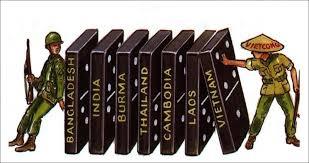
The idea that if South Vietnam fell to communism, other nations would soon follow...
a)
Vietnamization 
b)
Communism
c)
Domino Theory
d)
Imperialism
86.
What were the problems of fighting in Vietnam?
a)
Identifying the enemy 
b)
Jungle/Location provided cover and a place to transport enemy supplies
c)
Weather and climate
d)
all of these
87.
Shifting the burden of actual combat from American troops to S. Vietnamese forces.
a)
Vietminization
b)
Vietcong
c)
Internationalism
d)
Linkage
88.
President Bush and the United Nations sent in troops in January 1991, their goal was the restore peace in Kuwait. What was the name of this conflict, which lasted six weeks?
a)
World War II
b)
Vietnam War
c)
Persian Gulf War
d)
This means war
89.
The Cold War ended in 1991, when which country broke apart?
a)
China
b)
Kuwait
c)
Soviet Union
d)
Cuba
90.
How was the Iran Hostage Crisis resolved?
a)
the hostages were all killed
b)
the hostages were released as part of the agreement ending the Vietnam War
c)
the hostages were freed upon Reagan's inauguration
d)
the Camp David Accords led Israel to release the hostages
91.
Idea to fix stagflation with massive tax cuts
a)
REAGANOMICS
b)
PEACE THROUGH STRENGTH
c)
BIG STICK DIPLOMACY
d)
INFLATION
92.
Which of the following were significant social issues faced during the 1980s (The Reagan Era)?
a)
Alien landings in Roswell
b)
Crack cocaine
c)
Homosexual Marriage
d)
The gum disease gengivitas 
93.
What religious group formed to promote family values and support conservative politicians?
a)
Great Society
b)
New Right
c)
Moral Majority
d)
Social Gospel
94.
Ronald Reagan declared war on what?
a)
Terror
b)
Poverty
c)
Drugs
d)
AIDS