wayground logo

Free Printable Worksheets

Font size

S
M
L
XL
Worksheets

Atmospheric Heating and Air Pressure Review

Total questions: 56

Worksheet time: 1hrs 7mins

Name
Class
Date
1.

The hot regions in the word has (a)   pressures

2.

The cold regions in the world has (a)   pressure

3.

Equatorial regions have (a)   pressure

4.

There is (a)   pressure of air around north pole and south pole.

5.

wind

a)

warm, less dense air rises

b)

movement of air cause by differences in air pressure created by the even heating of the earth's surface

c)

large circular patterns of moving air

d)

movement of air cause by differences in air pressure created by the unequal heating of the earth's surface

6.

convection cells

a)

warm, less dense air rises

b)

cool, dense air sinks

c)

large, circular patterns of moving air

d)

movement of air caused by differences in air pressure

7.

low pressure area

a)

warm, less dense air rises

b)

cool, dense air sinks

c)

large, circular patterns of moving air

d)

movement of air caused by differences in air pressure

8.

pressure belts

a)

winds that blow from east to west between 60 and 90 degrees latitude in both hemispheres

b)

the curving of a path of a moving object from an otherwise straight path due to Earth's rotation

c)

bands of high and low pressure found about every 30 degrees of latitude

d)

narrow belts of strong winds that blow in the upper troposphere

9.

Coriolis Effect

a)

bands of high and low pressure found about every 30 degrees of latitude

b)

the curving of a path of a moving object from an otherwise straight path due to Earths rotation

c)

winds that blow from east to west between 60 and 90 degrees latitude in both hemispheres

d)

narrow belts of strong winds that blow in the upper troposphere

10.

sea breeze

a)

cool air moves down a mountain slope towards a valley

b)

warm air rises up a mountain slope from a valley

c)

cool land air flows to the ocean at night, causing warm ocean air to rise

d)

cool ocean air flows to land during the day, causing warm land air to rise

11.

mountain breeze

a)

cool mountain air moves down a mountain slope towards a valley

b)

warm air rises up a mountain slope from a valley

c)

cool land air flows to the ocean at night, causing warm ocean air to rise

d)

cool ocean air flows to land during the day, causing warm land air to rise

12.

land breeze

a)

cool air moves down a mountain slope toward a valley

b)

warm air rises up a mountain slope from a valley

c)

cool land air flows to the ocean at night, causing warm ocean air to rise

d)

cool ocean air flows to land during the day, causing warm land air to rise

13.

What type of winds blow constantly, predictably, and over long distances?

a)

land breezes

b)

local winds

c)

global winds

d)

sea breezes

14.
Which statement correctly defines wind?
a)
Wind is the movement of air from areas of low pressure to areas of high pressure
b)
Wind is the movement of air to a colder area in the atmosphere.
c)
Wind is the movement of air from areas of high pressure to areas of low pressure.
d)
Wind is the movement of air pushed around and bouncing off Earth's surface.
15.
Where does the initial source of energy come from that creates winds?
a)
the moon
b)
the sun
c)
the Earth's surface
d)
the rotation of the Earth
16.

What is the initial source for global winds and convection in the atmosphere?

a)

continental deflection

b)

the rotation of the Earth

c)

Moon's gravity

d)

unequal heating of the Earth by the sun

17.
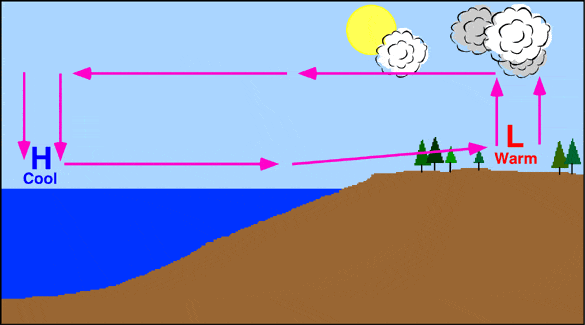
Which diagram shows the formation of a land breeze?
a)
diagram Y
b)
diagram X
c)
neither 
d)
both
18.
Which diagram shows the formation of a sea breeze?
a)
diagram Y
b)
diagram X
c)
neither
d)
both
19.
Why does warm air rise?
a)
Warm air is more dense than cooler air.
b)
Warm air has more pressure than cooler air.
c)
Warm air is less dense than cooler air.
d)
Warm air has a higher dew point than cooler air.
20.
Land and water absorb and release the sun’s heat in different ways. One result of this is a sea breeze. Which statement is true of sea breezes?
a)
They originate in the day and blow toward the land.
b)
They originate in the day and blow toward the water.
c)
They originate in the evening and blow toward the land.
d)
They originate in the evening and blow toward the water.
21.

Local winds blow over:

a)

short distances

b)

long distances

c)

the poles

d)

the equator

22.

Flow of air from land to a body of water is called:

a)

doldrum

b)

chinook

c)

sea breeze

d)

land breeze

23.

Sea breezes occur?

a)

during the day

b)

during the night

c)

high noon

d)

full moon

24.
What kind of air pressure does COLD air have?
a)
High pressure
b)
Low pressure
25.
What kind of air pressure does WARM air have?
a)
High pressure
b)
Low pressure
26.
During the day, warm air rises over the land then cools and falls over water in a continuous cycle.
a)
Land breeze
b)
Sea breeze
27.
What is responsible for warming the Earth’s surface and creating wind?
a)
The Moon
b)
Earth's interior (inside)
c)
Coriolis effect
d)
The Sun
28.
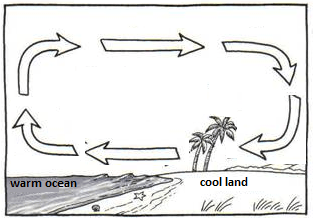
What kind of breeze is this and when would it form?
a)
Land breeze - daytime
b)
Land breeze - nighttime
c)
Sea breeze - daytime
d)
Sea breeze - nighttime
29.
Land and water absorb and release the sun’s heat in different ways. One result of this is a sea breeze. Which statement is true of sea breezes?
a)
They originate in the day and blow toward the land.
b)
They originate in the day and blow toward the water.
c)
They originate in the evening and blow toward the land.
d)
They originate in the evening and blow toward the water.
30.
Is this a land or a sea breeze?
a)
land breeze
b)
sea breeze
31.
The strength of a sea breeze depends on
a)
the heat of the day
b)
the difference between the temperature of the sea and the land
c)
the wind speed
d)
the amount of precipitation that day
32.
Why do land breezes occur at night?
a)
Land cools off slower than water, so the air above water is cooler.
b)
Water cools off faster than land, so the air above land is warmer.
c)
Land heats up slower than water, so the air stays cooler during the day.
d)
Water cools off slower than land, so the air above water is warmer.
33.
Which best describes why winds at the beach change direction between day and night? **
a)
because the temperatures over land and over water change 
b)
because warm air over land sinks and stays in place over land
c)
because cool air rises and is replaced by warm air from the ocean 
d)
because cool air sinks and stays in place over land 
34.
________is the instrument used to measure air pressure.
a)
barometer
b)
thermometer
c)
mercury
d)
watch
35.
Low pressure will usually bring what kind of weather?
a)
Sunny
b)
Calm
c)
Stormy
36.
Pressure is the effect of
a)

the weight of all the air above pressing down on the Earth's surface.

b)
water vapor in the atmosphere
c)
greenhouse gases
d)
solar radiation
37.
High pressure will usually bring what kind of weather?
a)
clear and dry
b)
cloudy and wet
38.
Based on the information in the table, in which city will it most likely rain?
a)
City W
b)
City X
c)
 City Y
d)
City Z
39.
Which weather condition will most likely occur when the atmospheric pressure in an area begins falling?
a)
dry
b)
cold
c)
rainy
d)
sunny
40.
Which kind of weather change will occur with an increase in air pressure?
a)
cooler and dryer
b)
colder and rainier
c)
hotter and stormier
d)
warmer and moister
41.
_______ pressure systems are characterized by fair weather.
a)
High
b)
Low
42.
On a cold, cloudy day, the local weather forecaster predicts that a high-pressure system will be moving into the area in the next 24 hours. Which weather conditions will this system most likely bring to the area?
a)
stormy
b)
sunny
c)
snowy
d)
hot
43.
Michael observes the air pressure daily. Over the last couple of days the air pressure has been dropping. What weather will Michael most likely observe as a result?
a)
increasingly clear skies and more wind
b)
increasingly clear skies and dry weather
c)
increasingly cloudy skies and possible storms
44.
Which is the best indicator that precipitation is on the way?
a)

low pressure, low humidity, higher temperature

b)

low humidity, high pressure, low temperatures

c)

low temperature, high humidity, high pressure

d)

low pressure, high humidity, higher temperature

45.
What type of air pressure is present?
a)
High 
b)
Low
46.
What type of air pressure is present?
a)
High 
b)
Low
47.
What happens to air pressure as you move upward into the atmosphere?
a)
increases
b)
decreases
c)
stays the same
48.
Air pressure is greater _______.
a)
at the top of the mountain
b)
at the bottom of the mountain
c)
at the center of the mountain
49.
Density of air is greater ________.
a)
at the top of the mountain
b)
at the bottom of the mountain
c)
at the center of the mountain
50.
What is altitude?
a)
how much something weighs
b)
the distance above sea level
c)
how big something is
d)
how far away something is
51.
On a cold, cloudy day, the local weather forecaster predicts that a high pressure system will be moving into the area in the next 24 hours. Which weather conditions will this system most likely bring to the area?
a)
stormy
b)
sunny
c)
snowy
d)
hot
52.
In the morning, Carlos noticed that the air pressure reading on the barometer was beginning to drop. What kind of weather can he most likely expect in the evening?
a)
The weather will be cloudy with a chance of rain.
b)
The weather will be warmer with clear skies.
c)
The weather will be clear and windy.
d)
The weather will be sunny and cool.
53.
Which is most associated with a thunderstorm?
a)
low air pressure
b)
high air pressure
c)
winds blowing from the West
d)
winds blowing from the East
54.
Altitude is greater __________.
a)
at the bottom of the mountain
b)
at the top of the mountain
c)
at the center of the mountain
55.
Fewer molecules further apart, means density is:
a)
high
b)
low
56.

The oceans make up 70% of the Earth's surface. They regulate the overall temperature of the Earth by absorbing the majority of the solar energy provided by the sun, and heating up slowly. What is true about the ocean's release of heat?

a)

Oceans release heat rapidly and add to the greenhouse effect

b)

The oceans release heat more slowly than the land

c)

Oceans release heat more rapidly than the land

d)

The oceans release heat at the same rate as the land