wayground logo

Free Printable Worksheets

Font size

S
M
L
XL
Worksheets

Unit Review - Microbiology

Total questions: 55

Worksheet time: 2hrs 35mins

Name
Class
Date
1.

The cell theory applies to all organisms, including the five shown. Which of the following statements describes how these organisms are an example of the cell theory?

a)

The organisms have cells that lack a nucleus.

b)

The organisms are made of one or more cells.

c)

The cells of the organisms undergo photosynthesis.

d)

The cells of the organisms are identical to each other.

2.
Which invention from the 17th century allowed for the development of modern cell theory?
a)

x-rays

b)

computers

c)

the compound light microscope

d)

the scanning electron microscope

3.

A scientific theory explains how or why things happen in nature.

a)

True

b)

False

4.

Was the first person to see cells by looking at cork under a microscope and gave them their name

a)

Hooke

b)

Leeuwenhoek

c)

Virchow

d)

Schleiden

5.

Proposed that all cells come from other cells

a)

Leeuwenhoek

b)

Schleiden

c)

the Janssens

d)

Virchow

6.

Said that all plants are made of cells

a)

Hooke

b)

Virchow

c)

Schleiden

d)

Schwann

7.

Looked at pond water under a microscope and saw living cells (bacteria) and coined the term "animalcules"

a)

Hooke

b)

Leeuwenhoek

c)

Virchow

d)

Schwann

8.

Said that all animals are made of cells

a)

Hooke

b)

Virchow

c)

Schleiden

d)

Schwann

9.

The cell theory developed from the work of many different scientists. Which of the following statements is NOT part of the cell theory?

a)

All cells come from other living cells.

b)

The cell is the basic unit of life an organization.

c)

All cells of living things have the same organelles.

d)

All living things are composed of cells.

10.

The work of many different scientist:, led to the development of the cell theory. Which of the following statements is NOT part of the cell theory?

a)

All cells come from other living cells.

b)

The cell is the basic unit of all living things.

c)

The cell provides everything a living thing needs.

d)

All living things are made up of one or more cells.

11.

Match the cell theory contributor with their correct invention/discovery

a)

Discovered cells and coined the term "cell"

1.

Robert Hooke

b)

Invented the first compound microscope

2.

Hans and Zacharias Janssen

c)

Discovered red blood cells and bacteria

3.

Antoni van Leeuwenhoek

d)

Discovered that all plants are made of cells

4.

Matthias Schleiden

e)

Discovered that all animals are made of cells

5.

Theodor Schwann

12.

Which two cell theory contributors discovered the cell theory components

all living organisms are composed of one or more cells and

cells are the basic unit of life?

a)

Matthias Schleiden

b)

Antonie van Leeuwenhoek

c)

Theodor Schwann

d)

Robert Hooke

13.

Robert Hooke, Anton van Leeuwenhoek, Theodor Schwann, Rudolf Virchow, and Matthias Schliden were all responsible for what theory?

a)

The Theory of Gravity

b)

The Theory of Relativity

c)

The Cell Theory

d)

The Theory of Continental Drift

14.

All living things are made up of...

a)

cells

b)

tissues

c)

organ

d)

organ systems

15.

What is the basic structural and functional unit of all living things?

a)

atom

b)

cell

c)

bacteria

d)

animalcules

16.

All cells -----

a)

come from other dead cells

b)

come from other living cells

c)

crystallize out of the air

17.

Which of these is a function of ALL cells?

a)

to transfer DNA from one generation to the next

b)

to produce oxygen through photosynthesis

c)

to combine with other cells to form tissues

18.

A scientist discovers what he thinks is a cell. Which question about this new discovery should the scientist answer first to determine if it is a cell?

a)

How long does it live?

b)

Can it reproduce itself?

c)

How large can it grow?

19.

What type of cell has a nucleus?

a)

eukaryotic

b)

prokaryotic

c)

neither

d)

both

20.

Plants and animal cells are examples of ___ cells

a)

prokaryotic cells

b)

eukaryotic cells

c)

both eukaryotic and prokaryotic

d)

neither

21.

Prokaryotes do NOT have....

a)

membrane bound organelles

b)

DNA or RNA

c)

Cell membrane

d)

Life

22.

Bacteria are considered what?

a)

Eukaryotes

b)

Prokaryotes

23.
A fossilized cell is discovered, and evidence suggests it reproduced on its own and had DNA, but a membrane did not enclose its DNA. Which type of organism would this most likely be?
a)
prokaryote
b)
eukaryote
c)
plant cell
d)
animal cell
24.
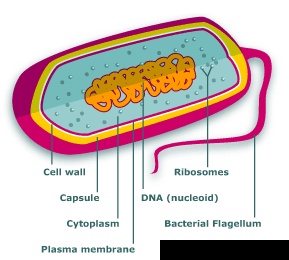
This is a picture of:
a)
Prokaryote
b)
Eukaryote
25.
Which type of cell?
a)
Prokaryote
b)
Eukaryote
26.

True or False: Both Prokaryotes and Eukaryotes have DNA.

a)

True

b)

False

27.

DNA is free floating in the cytoplasm, not in a nucleus

a)
Prokaryote
b)
Eukaryote
28.

Can be multicellular or unicellular.

a)
Eukaryote
b)
Prokaryote
29.
No membrane-bound organelles
a)
Prokaryote
b)
Eukaryote
30.
Made up of one cell
a)
Prokaryote
b)
Eukaryote
31.
DNA is found in the nucleus
a)
Prokaryote
b)
Eukaryote
32.
Which organism performs all life processes in one cell?
a)
grass
b)
bacteria
c)
mushroom
d)
butterfly
33.
Which best explains why humans are multicellular organisms?
a)
Human cells are too small to function alone.
b)
Human cells join together to form one large cell.
c)
Humans need many cells to carry out life processes.
d)
Humans have many systems that perform the same function.
34.
Molly is reading a book in science class. She reads one sentence that says, “This organism is capable of surviving as a single cell.” Which organism is she most likely reading about?
a)
amoeba
b)
flower
c)
mushroom
d)
insect
35.
How are algae able to survive?
a)
The algae get energy from other algae.
b)
The algae do not require energy to survive.
c)
The single cell controls all the algae’s life processes.
d)
Other multi-celled organisms provide food for the algae.
36.
Why do humans require many different types of cells to survive?
a)
Human cells are identical and work together to perform the same function.
b)
Human cells are specialized and work together to perform the same function.
c)
Human cells are identical and work independently to perform different functions.
d)
Human cells are specialized and work independently to perform different functions.
37.
Which statement best describes a bacterial cell?
a)
It contains more than one cell.
b)
It is a complete organism.
c)
It is part of a larger organism.
d)
It contains different kinds of cells.
38.
Which best describes a multi-celled organism?
a)
basic
b)

less complex

c)
uniform
d)

more complex

39.
Which statement would most likely be found in an article about multi-celled organisms like plants?
a)
Plants have a simple structure.
b)
Plants contain only one cell that performs all functions.
c)
Plants do not need to eat, remove waste, or reproduce.
d)
Plants contain many specialized cells that perform different functions.
40.
How are single-celled organisms and multi-celled organisms similar?
a)

Both need nourishment for energy and growth.

b)
Both have a skeletal system for support.
c)
Both require the interaction of many cells to survive.
d)
Both are able to carry out all life functions in only one cell.
41.
How are multi-celled and single-celled organisms different?
a)
Multi-celled organisms need energy to survive, while single-celled organisms need no energy to survive.
b)
Single-celled organisms can be seen without using a microscope, while multi-celled organisms are microscopic.
c)
Multi-celled organisms have large numbers of specialized cells to perform a variety of life functions, while single-celled organisms complete life functions with one cell.
d)
Single-celled organisms have large numbers of identical cells that all perform the same function, while multi-celled organisms have cells that are all different and perform different life functions.
42.
A scientist is trying to decide whether an organism is unicellular or multicellular.  Which information would help the scientist most to make her decision?
a)
size of the cells of the organism
b)
what the organism eats
c)
how many types of cells are in the organism
d)
how fast the organism grows
43.

What do you call organisms that can make their own food?

a)

heterotophs

b)

autotrophs

c)

trophies

44.
What is another name to describe an autotroph?
a)
Consumer
b)
Producer
45.

Organisms that cannot make their own food and must get energy from eating other organisms are called...

a)

autotrophs

b)

heterotrophs

c)

plants

46.
What is another name to describe a heterotroph?
a)
Consumer
b)
Producer
47.

Click all examples of heterotrophs

a)

plants

b)

animals

c)

bacteria

d)

some types of fungi and protists

48.

What is the source of energy for autotrophs?

a)

animals

b)

animal waste

c)

sunlight

d)

other plants

49.

What is the name of the process that autotrophs or producers use to make food?

a)

cellular respiration

b)

photosynthesis

c)

photo respiration

d)

cellularsynthesis

50.
Which terms best describe heterotrophs?
a)
Plants; producers
b)
Animals; producers
c)
Plants; consumers
d)
Animals; consumers
51.
Which terms best describe autotrophs?
a)
Plants; producers
b)
Animals; producers
c)
Plants; consumers
d)
Animals; consumers
52.

Which of the following organism above are considered "Heterotrophic"?

a)

Deer

b)

Fern Plant

c)

Apple Tree

d)

Owl

e)

Skunk

53.

Which of the following organism above are considered "Autotrophic"?

a)

Lemongrass

b)

Fox

c)

Apple Tree

d)

Rose Plant

e)

Sunlight

54.

The Cell Theory:

  1. 1. All living organisms are composed of one or more ​ (a)   .

  2. 2. All cells arise from ​ (b)   cells.

  3. 3. Cells are the structural and functional unit of ​ (c)   .

Choose from the below words
cells
preexisting
life
55.

Developed the first compound light microscope.

a)

the Janssens

b)

Hooke

c)

Schwann

d)

Virchow