
Font size
 Worksheets
Level 4 Review
Total questions: 150
Worksheet time: 8hrs 30mins
Soil is made up of
water, dirt, worms, and banana peels
minerals, air, water, and organic material
air, worms, plants, and headphones
water, worms, walnuts, and watermelons
Soil is necessary to many different things. Which sentence correctly matches a necessity with a living organism?
Soil is food for plants.
Soil is a playground for animals.
Soil is mud for pigs.
Soil is a mess for moms.
One property of soil is it's ___.
worms
temperature
name
texture
What is the first step in soil formation?
rock breaks into tiny pieces
organic matter mixes with inorganic matter
worms dig holes in soil
it begins to rain on soil
What is the second step in soil formation?
rock erodes into tiny pieces
organic matter decays and mixes with inorganic matter
worms move in
it rains on soil
The layers of soil are also known as ____.
horizons
humus
loam
dirt
The O Horizon is also known as _____.
humus
topsoil
subsoil
bedrock
The A Horizon is also know as _____.
humus
topsoil
subsoil
bedrock
The B Horizon is also known as the _____.
humus
topsoil
subsoil
bedrock
The R Horizon is also known as the _____.
humus
topsoil
subsoil
bedrock
Humus is made up of
organic matter
minerals
water
rock
In which layer of soil do plant roots grow?
humus
topsoil
subsoil
bedrock
Minerals are found in which layer of soil?
humus
topsoil
subsoil
bedrock
Which layer of soil consists of solid rock?
humus
topsoil
subsoil
bedrock

Which layer of soil are these roots growing in?
subsoil
topsoil
When plants, animals, and other organisms die, they break down and become part of the soil. What is this part of the soil called?
sand
silt
clay
humus

Which layer is the bottom of the soil profile?
Partially Weathered Parent Material
Separated rock
Bedrock
Topsoil
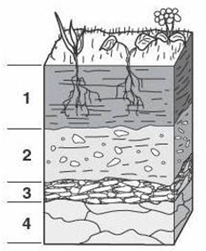
In which layer of the soil profile contains the MOST humus?
Layer 1
Layer 2
Layer 3
Layer 4

In which layer of the soil profile contains a solid layer of rock?
Layer 1
Layer 2
Layer 3
Layer 4

Soil is made of?
weathered rocks and minerals
dead plants and animals
air and water
all of the above
The first layer of soil, called the A horizon is also known as?
Bedrock
Parent Material
Topsoil
Subsoil
Which type of soil drains the slowest?
silt
clay
sand
loam

What happens when water condenses from its vapor state to its liquid state?
rain forms
clouds form
ice melts
rivers and lakes flood

What is one role that the ocean plays in the water cycle?
it provides salt for the environment
evaporated ocean water comes down as rain
wind causes waves on the surface of the ocean
it has a complex food chain
In which states of matter is water found naturally in Earth's water cycle?
solid, liquid and gas
liquid and gas only
solid and gas only
liquid and solid only

You are having a glass of water with ice, and you notice that small water droplets are beginning to form on the outside of the glass. Which part of the water cycle do the droplets represent?
evaporation
transpiration
condensation
precipitation

What is the primary role of the ocean in our water cycle?
primary place where runoff starts
source of most evaporation
location of most condensation
only place for precipitation

What causes evaporation?
water freezing and melting
energy from the sun
precipitation
large bodies of water

Shahan draws a picture to illustrate the water cycle. He needs to add another step in the cycle to
complete his illustration. Which step is missing from the illustration to complete the water
cycle?
evaporation
runoff
precipitation
condensation

Oceans cover over 70% of Earth's surface, and precipitation constantly adds freshwater to the
oceans. Yet, ocean levels remain relatively constant. Which of the following is the best
explanation for why ocean levels remain constant?
Ocean water is continually absorbed underground into the ocean floor.
Ocean water is continually changing from a liquid state into a vapor.
It is very easy to change the ocean levels due to the large size of the oceans.
Humans alter the level of the oceans due to our need for drinking water.
What are clouds made from?
water vapors
water droplets or ice crystals
smoke
large snowflakes
Freshwater makes up how much of the Earth's water supply?
97%
75%
25%
3%
Saltwater makes up how much of the Earth's water supply?
97%
75%
25%
3%
What are the two kinds of water that exist on Earth?
Freshwater
Saltwater
Sugarwater
Bluewater
Where is most of Earth's freshwater found?
in the ground
in the atmosphere
in lakes and rivers
in glaciers and icecaps

Potable water means...
Water which comes straight from a river or reservoir
Water containing bacteria
Water which is safe to drink
Water which contains a high amount of salt
The ___________ is the movement of water between Earth's geosphere and its atmosphere.
air
water cycle
precipitation
ocean
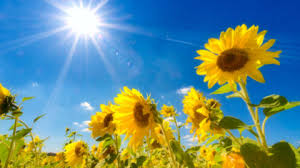
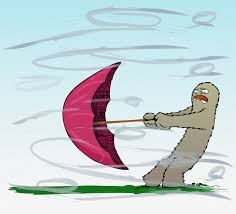
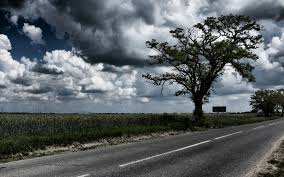


What is a precipitation gauge?
A funnel that holds water
Measures air pressure
Measures Wind
How can you measure wind direction?
By using a barometer
By using a anemometer
By using a ammeter
By using a hygrometer

The layer of the sun’s atmosphere that gives off visible
light
Photosphere
Corona
Solar Flare

the layer of the sun’s atmosphere that looks like a
halo during an eclipse
Photosphere
Solar Flare
Corona

the joining of hydrogen atoms to form helium
Nuclear Fusion
Nuclear Fission

the layer of the sun’s interior where energy is
transferred mainly by electromagnetic radiation
Convection Zone
Radiation Zone
Corona

the layer of the sun’s atmosphere that has a reddish
glow
Corona
Photosphere
Chromosphere

a stream of charged particles produced by the corona
Solar Wind
Corona
Particles

areas of gas on the sun’s surface that are cooler than
the gases around them
Freckles
Corona
Sun spot

What is the light show caused by collisions between electrically charged particles from the sun that enter the earth's atmosphere called?
Aurora borealis
Sunspots
Solar Wind
The Sun is made of...
Water and Ice
Hydrogen
Magnesium
Hydrogen and Helium
The Sun takes up 99.8% of the Solar System
True
False
Different parts of the Sun rotate at different rates because
The sun is solid and heavy
The sun is made of water and is unstable
The sun is made of gas
The Sun core....
The region of the sun where energy is produced.
The region of the sun where solar flare happen.
The sun spots are generated at core
The carry particles of ligh
Solar Prominence
Quick burst of gas into the solar system
Loop of gas that connects sun spots
Hot gas moving into Earth's atmosphere
Breaks power lines
Solar Flare
The crown of the sun
Cooler spots on the sun
A loop of energy
Brief eruption of intense high energy of gas
Rippled sheets of light in the sky because of electrical charged particles.
Denver
Stars
Galaxies
Auroras
The layer of the sun that makes light
Photosphere
Solar flare
Core
Chromosphere
Chromosphere
The layer of sun that creates the suns color
The layer that makes light
The layer that creates energy
Coronal Mass Ejections "CME's"
massive emissions of electrically charged material
Explosions that occur when multiple loops suddenly connect
hydrogen and nitrogen together
Sun spots
Sun Spots
Throw particles into Earth's Atmosphere
Create donuts
Help the space probes send information
The cooler darker parts of the Sun
When the sun gets higher in the sky, shadows get ______.
longer
gone
shorter
darker
When the sun gets lower in the sky, shadows get______.
longer
gone
shorter
darker
Shadows are longest during _______.
morning and evening
noon
night
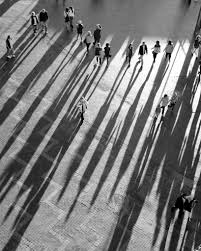
When was this picture most likely taken?
(Hint: think about the shadow's length)
morning or evening
night
noon
afternoon
When an object blocks the path of light, what is formed?
A problem
A fog
A reflection
A shadow
When an object moves closer to a light source, its shadow...
Gets smaller
Gets bigger
Changes shape
Stays the same size
When the Sun is behind you, your shadow is ...
behind you
in front of you
at the side of you
not there
The moon's surface is covered with what?
water
craters or holes
salt
plants
The moon orbits the Sun.
True
False
Why does the moon shine?
it has its own light
it reflects Earth's light
it reflects the Sun's light
How long does it take for the moon to orbit Earth?
24 hours
365 days
28 days
The moon has 4 phases.
true
false
We can't see the moon when it is in which phase?
waning crescent
new moon
waxing gibbous
When does a lunar eclipse happen?
when the sun is hidden by the moon
when the Earth is hidden by the sun
when the full moon passes through Earth's shadow
The moon is a burning ball of gas.
true
false
The moon is made of what material?
water
gas
rock


As our sun continues through its life cycle, it will _________ and turn into a _______________.
gradually get smaller and smaller until it dies out/ black hole
Gradually get larger until its outer layers drift off/ white dwarf
become denser and denser/ protostar
become hotter and hotter blue/ hypergiant.

All stars begin their life in a
Main Sequence
Nebula
Protostar
Black Dwarf


Average size stars will turn into a _____ star next.
protostar
red giant
supergiant
black hole

The Sun is the biggest star in the sky.


Constellations are stars that appear to be in a pattern.

What is the name of the explosion at the death of a massive star?
Supergiant
Supernova
Black Hole
Nebula
Which statement best describes stars?
large planets that are composed mostly of gases
celestial bodies made of gas that give off light
faint dots of light that can be seen from Earth's surface
objects that form in the outer parts of the solar system
Felix examined several photos of stars. To compare their temperatures, he looked at the colors of the stars. He organized the photos in order from coolest to hottest. Which of these answers shows the correct order?
red, yellow, white, blue
white, blue, yellow, red
yellow, white, blue, red
blue, yellow, white, red
What is the biggest kind of star in a galaxy called?
blue giant star
the sun
super giant star
red dwarf star
How many stars are there in the universe?
thousands
millions
hundreds
ten
What are stars made of?
hot gases
ice
hydraulic gas
dust and clouds
Why does the sun look so big to us?
It is the closest star to Earth.
It is the biggest star.
It is farthest star from Earth.
It is the hottest.
Why do most stars look so small in the sky?
They are close to us.
They are far away from us.
They are running out of gas.
They are new stars.
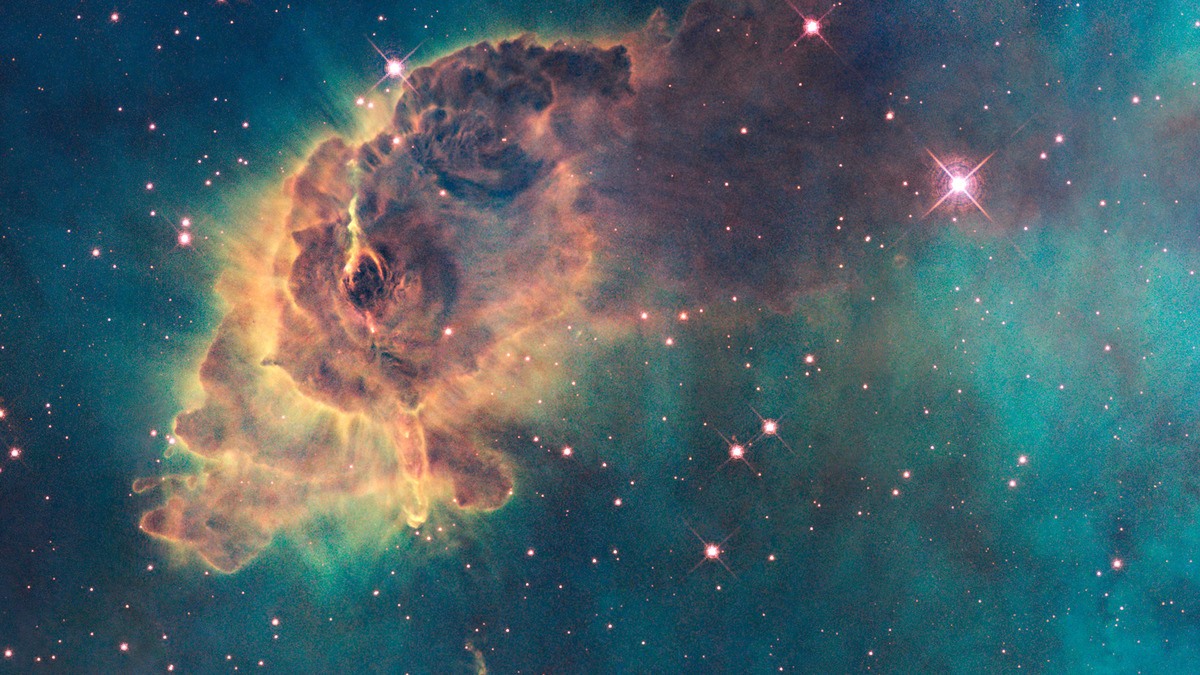
The Sun is the biggest star in the sky.

What is the name of the weather instrument pictured here?
Wind Vane
Rain Gauge
Anemometer
Which instrument measures the amount of rain that occurs over a specific period of time?
weather vane
anemometer
rain gauge
barometer
Regions closest to ________________ tend to have warmer year-round climates.
Forest Fires
South Pole
North Pole
the Equator

Identify this intrument
Thermometer
Rain Gauge
Barometer

this instrument is used to measure the speed of the wind
Wind Vane
Anemometer
none of these

What is this instrument used for?
it used to measured wind direction
it is used to measure air pressure
it used to measure rainfall


