wayground logo

Free Printable Worksheets

Font size

S
M
L
XL
Worksheets

Radioactivity Review

Total questions: 40

Worksheet time: 1hrs 5mins
Name
Class
Date
1.
What is Half-life?
a)
The amount of time it takes for some of the nuclei in a sample of the isotope to decay
b)
The amount of time it takes for half the electrons in a sample of the isotope to decay
c)
The amount of time it takes for half the nuclei in a sample of the isotope to decay
d)
the amount of time it takes to double the nuclei in a sample of the isotope to decay
2.
The half-life of strontium-90 is 25 years. How much strontium-90 will remain after 100 years if the initial amount is 4.0 g?
a)
3.0g
b)
0.25mg
c)
0.3g
d)
0.25g
3.
Two or more nuclei combine to form one larger nucleus in the process of nuclear _____.
a)
Fusion
b)
Fission
c)
Tracing
d)
Decay
4.
Two or more nuclei combine to form one larger nucleus in the process of nuclear _____.
a)
Fusion
b)
Fission
c)
Tracing
d)
Decay
5.

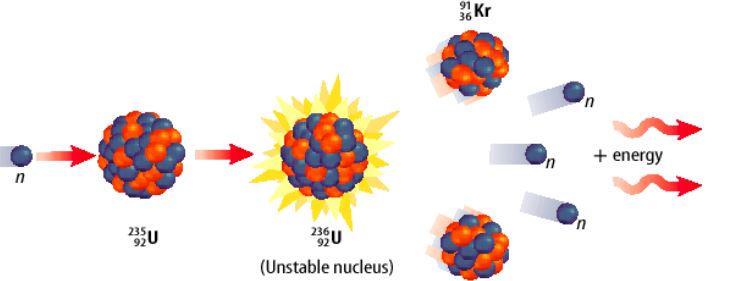
This is an example of a...

a)

Fission reaction

b)

Fusion reaction

c)

Decomposition reaction

d)

Decay

6.
This is an example of ---
a)
Radioactive Decay
b)
Nuclear Fission
c)
Nuclear Fusion
d)
Fossil fuel reaction
7.

After one half life, a sample will begin to have more of the parent isotope than the daughter isotope.

a)

TRUE

b)

FALSE

8.
What makes something radioactive?
a)
elements with an atomic number above 81
b)
an unstable nucleus
c)
contaminated sewage
d)
It decays over time
9.

What is an isotope?

a)

forms of the same element that contain equal numbers of electrons but different numbers of protons

b)

forms of the same element

c)

forms of the same element that contain equal numbers of protons but different numbers of neutrons

d)

An atom with no nucleus

10.
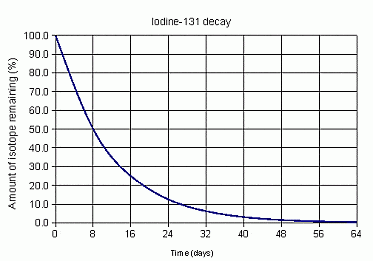
What is the half-life of iodine-131?
a)
32 days
b)
8 days
c)
16 days
d)
24 days
11.

A nucleus that breaks up because there are too many neutrons or protons is known as ________________.

a)

dangerous

b)

fragile

c)

stable

d)

unstable

12.

An unstable nuclei will break up in a process called radioactive _______________.

a)

decay

b)

decomposition

c)

emission

d)

reduction

13.

An unstable nuclei will decay ______________.

a)

forever

b)

until it becomes a stable isotope

c)

until there are no neutrons left

14.

Background radiation comes from the following sources (choose all the correct answers):

a)

Buildings and rocks

b)

Cosmic rays from space

c)

Food and drink

d)

Medical sources

e)

Radon gas from the ground

15.
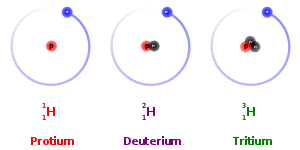
Different isotopes have...
a)
different masses
b)
different atomic numbers
c)
different electrons
d)
different protons
16.
If 10 mg of iodine 131 is given to a patient, how much is left after 24 days? The half-life of iodine-131 is 8 days.
a)
1.25mg
b)
1.25g
c)
10g
d)
10mg
17.
If the half-life of uranium-232 is 70 years, how many half-lives will it take for 10 g of it to be reduced to 1.25 g?
a)
1 half-life
b)
2 half-lives
c)
3 half-lives
d)
4 half-lives
18.
Process occuring on sun
a)
Nuclear fission
b)
Nuclear fusion
c)
Fossil fuel combustion
d)
Natural gas combustion
19.
If you start with 100 grams of iodine-131 and the half life is 2 days, how many grams is left after 6 days?
a)
25 grams
b)
12.5 grams
c)
50 grams
d)
200 grams
20.
a)
Nuclear fusion
b)
Beta decay
c)
Alpha decay
d)
Nuclear chain reaction
21.
Half-life of iodine-131
a)
32 days
b)
8 days
c)
16 days
d)
24 days
22.
Disadvantage of nuclear fission
a)
Toxic waste 
b)
Large amounts of energy produced
c)
Frequent meltdowns
d)
Air pollution
23.
Advantage of nuclear energy
a)
Nuclear energy is renewable
b)
Can use any element to produce power
c)
Converts a small mass into a lot of energy
d)
Produces no waste
24.
How do nuclear power-plants work?
a)
Fusion
b)
Half-life
c)
Fission
d)
Fusion or fission
25.
Splitting a uranium atom is called - 
a)
fission
b)
fusion
26.
All of the following are problems of nuclear energy except ---
a)
storage of radioactive fuel
b)
air pollution
c)
security concerns
d)
natural disasters (tsunamis, earthquakes, etc.)
27.
What is an advantage  of nuclear energy?
a)
radioactive waste
b)
no air pollution
c)
we will never run out
d)
it is the safest way to make energy
28.
Nuclear Power is - 
a)
Renewable
b)
Non-renewable
29.
Nuclear power uses ____ for fuel.
a)
steel
b)
coal
c)
uranium
d)
hydrogen
30.
Nuclear energy uses _____ to turn turbines to power a generator.
a)
wind
b)
water
c)
steam
d)
solar
31.
Energy is stored in the ___ of an atom.
a)
proton
b)
neutron
c)
electron cloud
d)
nucleus
32.
What is an advantage  of nuclear energy?
a)
radioactive waste
b)
no pollution
c)
we will never run out
d)
it is the safest way to make energy
33.
This is an example of...
a)
Fission  reaction
b)
Fusion reaction
c)
Decomposition reaction
d)
Combustion
34.
Which of the following best describes the process of nuclear fission? 
a)
Splitting an atom's nucleus apart 
b)
Separating an atom's electrons from its nucleus 
c)
Fusing two atomic nuclei together 
d)
Splitting an atom's electrons in half 
35.
The time needed for half of a radioactive sample to decay is called its __________.
a)
decay period
b)
period
c)
transmutation time
d)
half-life
36.

This is an example of

a)

Nuclear Fission

b)

Nuclear Fusion

c)

No reaction

37.

A major scientific concern over nuclear energy is how to--

a)

store the waste products safely

b)

reduce the high levels of carbon dioxide emitted into the air

c)

deal with the large amounts of fossil fuels required

d)

prevent the depletion of the ozone layer

38.

What might be a concern raised by community members if they were told that a nuclear power plant was going to be built in their neighborhood?

a)

Excessive use of petroleum would leak into the water under the ground

b)

Coal could be used to produce more energy per gram of fuel

c)

The air pollution generated by the plant

d)

The threat of a nuclear accident or spill

39.

Which process is best described in the graphic?

a)

nuclear fission

b)

nuclear mitosis

c)

nuclear fusion

d)

nuclear meltdown

40.

Which process is best described in the graphic?

a)

nuclear fission

b)

nuclear meiosis

c)

nuclear fusion

d)

nuclear meltdown