wayground logo

Free Printable Worksheets

NEW

Font size

S
M
L
XL
Worksheets

Erosion

Total questions: 29

Worksheet time: 35mins

Name
Class
Date
1.

What is the process of moving sediments from location to another?

a)

Deposition

b)

Erosion

c)

Weathering

d)

Compaction

2.
What is sediment?
a)
the process of rocks being broken down and carried away
b)
bits of rock, sand, and silt caused by the weathering of rocks
c)
the top layer of the soil
d)
decaying plant or animal material 
3.

Which of these is an example of erosion?

a)

Light shinning onto a mountain

b)

Rain breaking down rock

c)

Wind blowing away sediment

d)

All of the above

4.
How does freezing water cause the weathering of rocks?  The freezing water—
a)
keeps the rocks in place
b)
makes the rocks last longer
c)
expands cracks and breaks rocks
d)
causes rocks to fall in landslides
5.
Which agents  break down earth materials?
a)
wind only
b)
earthquakes and gravity
c)
ice and 007
d)
wind, water, and ice
6.
What is an enormous mass of ice moving over land?
a)
Ice wedging
b)
Glacier
c)
Iceberg
d)
Dune
7.

Rain washing away soil from a hillside

a)

Weathering

b)

Erosion

c)

Deposition

8.
Wind blowing sand from one location to another
a)
Weathering
b)
Erosion
c)
Deposition
9.
How do plants weather rocks?
a)
during photosynthesis
b)
when roots grow into cracks of rocks and expand the rock
c)
when the plant moves water from the roots to the leaves
d)
Plants don't weather rocks
10.

How do plants in the soil affect how fast erosion happens?

a)

It doesn't affect erosion.

b)

It slows down erosion.

c)

It speeds up erosion.

11.
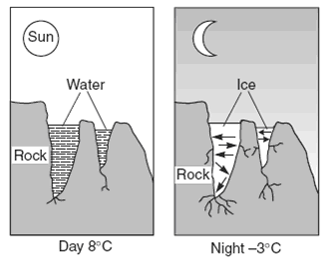
The diagrams  shows a natural process that weathers rock.
 Which statement best explains why this process results in weathering?
a)
frozen water acts as a solute
b)
water expands when it freezes
c)
the mass of water increases when it freezes
d)
frozen water dissolves most types of rock
12.

Which of the following was formed through erosion?

a)

Eiffel Tower

b)

The Grand Canyon

c)

Mt. Rushmore

d)

The Pyramids of Giza

13.
Which way do sand dunes move?
a)
up & down
b)
to the west
c)
toward the sea
d)
in the direction of the wind
14.
What is the force that moves glaciers?
a)
ice
b)
wind
c)
gravity
d)
energy
15.

What are two kinds of glaciers?

a)

moraine and continental

b)

continental and valley

c)

valley and mountain

d)

till and stratified drft

16.
Mounds of sand left by the wind
a)
desert pavement
b)
loess
c)
dunes
d)
deflations
17.
Rocks left behind when wind blows all the dirt away 
a)
desert pavement
b)
dunes
c)
loess
d)
deflations
18.
The process in which wind blows away soil
a)
desert pavement
b)
loess
c)
dune
d)
deflation
19.

What is a floodplain?

a)

The area near a river that floods when water levels get to be too high.

b)

The area near a river that looks boring or dull.

c)

The process of water levels going over a river or stream bank.

d)

Water gathering on the surface of the Earth because it doesn't seep into the ground.

20.

With a steeper slope, we would expect to see...

a)

less erosion

b)

more erosion

c)

the same amount of erosion

d)

no erosion at all

21.
Which of the following statements is not true?
a)
Water causes more erosion on slopes without plants
b)
Water flows from higher to lower ground
c)
Faster water erodes more sediment
d)
As water slows, smaller particles are deposited first
22.
When a stream or river starts to slow down, it:
a)
Picks up more sediment
b)
Erodes more rapidly
c)
Deposits fine sediments, but continues carrying larger rocks
d)
Deposits larger rocks, but continues carrying finer sediment
23.
The steeper the slope, the ________ the stream.
a)
Slower
b)
Broader
c)
Faster
d)
Curvier
24.
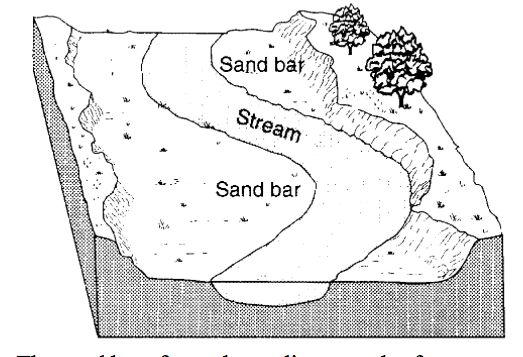
The diagram below shows a portion of a stream. The sand bar formed as a direct result of 
a)
erosion due to a decrease in stream velocity 
b)
erosion due to an increase in stream velocity
c)
deposition due to a decrease in stream velocity
d)
deposition due to an increase in stream velocity 
25.
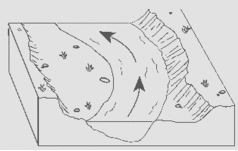
The diagram below shows a section of a meander in a stream. The arrow shows the direction of stream flow. The stream bank on the outside of this meander is steeper than than the stream bank on the inside of this meander because the water on the outside of the meander is moving
a)
Slower, causing deposition
b)
Faster, causing deposition
c)
Slower, causing erosion
d)
Faster, causing erosion
26.
A wide, sloping deposit of sediment formed where a stream leaves a mountain range.
a)
flood plain
b)
delta
c)
alluvial fan
d)
gully
27.
A landform made of sediment that is deposited where a river flows into an ocean or lake.
a)
delta
b)
alluvial fan
c)
flood plain
d)
oxbow lake
28.
A tiny groove in soil made by flowing water.
a)
stream
b)
gully
c)
tributary
d)
rill
29.
A large channel in soil formed by erosion.
a)
gully
b)
rill
c)
stream
d)
tributary