
 Worksheets
AIR Biology Review #1
Total questions: 44
Worksheet time: 33mins
Name
Class
Date
1.
Which biomolecule is made of nucleotides and contain you DNA?
a)
Carbohydrate
b)
Lipids
c)
Protein
d)
Nucleic Acid
2.
Which biomolecule has sugars and starches?
a)
Lipids
b)
Proteins
c)
Carbohydrates
d)
Nucleic Acid
3.
Which biomolecule functions include enzymes which speeds the rate of chemical reactions, structural components in cells, mechanical functions in muscles and cytoskeleton, cell signaling, and immune response; provides structure and helps with chemical reactions
a)
Protein
b)
Lipids
c)
Carbohydrate
d)
Nucleic Acid
4.
Which biomolecule is important source of energy for humans; glucose for human cells, tissues, and organs; provides fiber, sugar, and starches; provides structural support, cell wall, and cell membrane maker?
a)
Nucleic Acid
b)
Lipid
c)
Carbohydrate
d)
Protein
5.
Which biomolecule includes fats, such as triglycerides, oils, waxes, and steroids (cholesterol); insoluble in water; provides energy storage, insulation, part of cell membrane, and hormones
a)
Nucleic Acid
b)
Lipids
c)
Carbohydrate
d)
Protein
6.
What is the monomer for a protein?
a)
Monosaccharide
b)
Triglyceride
c)
Amino Acid
d)
Nucleotide
7.
Lipids are made up of which of the following?
a)
glycerol and fatty acids tails
b)
glycerol and monolipids
c)
fatty acids and phosolipids
d)
amino acids and nucleotides
8.
What is the monomer of nucleic acids?
a)
Glycerol
b)
Monosaccharides
c)
Amino Acids
d)
Nucleotides
9.
The waxy, organic substances used by aquatic birds to coat their feathers, when analyzed consists mostly of
a)
lipids
b)
proteins
c)
carbohydrates
d)
nucleic acids
10.
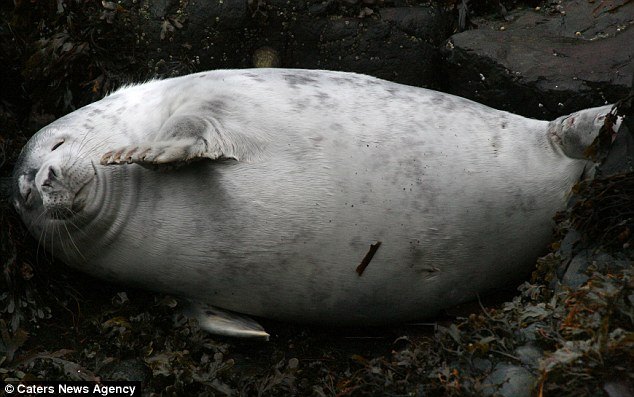
Which biomolecule is responsible for insulation and LONG term energy storage?
a)
Proteins
b)
Nucleic Acids
c)
Lipids
d)
Carbohydrates
11.
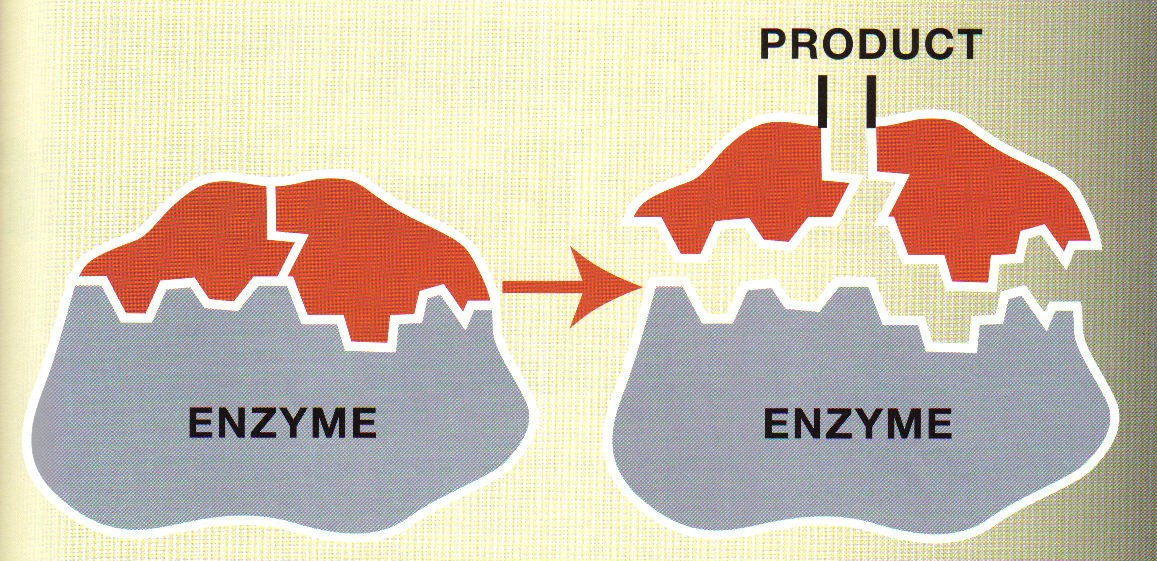
The area that the substrate fits into on the enzyme is called the:
a)
Active Site
b)
Allosteric Site
c)
DiSulphide Bridge
d)
β-Pleated Sheet
12.
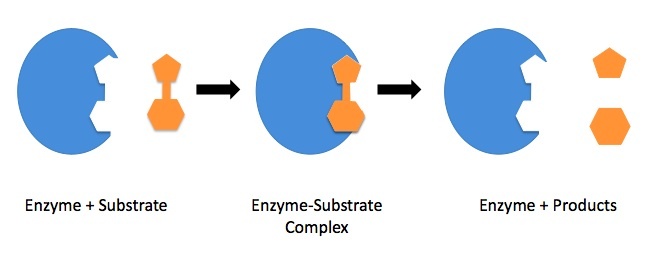
The current model of enzyme action is referred to as the:
a)
Induced Fit Model
b)
Lock & Key Model
c)
Singer-Nicolson Model
d)
Davson-Danielli Model
13.
Enzymes catalyze reactions by ___________ Activation Energy.
a)
Increasing
b)
Decreasing
14.
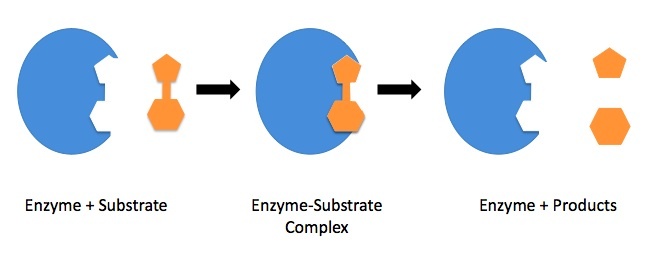
Most enzymes have the ending:
a)
-ase
b)
-ose
c)
-ic acid
d)
-ate
15.
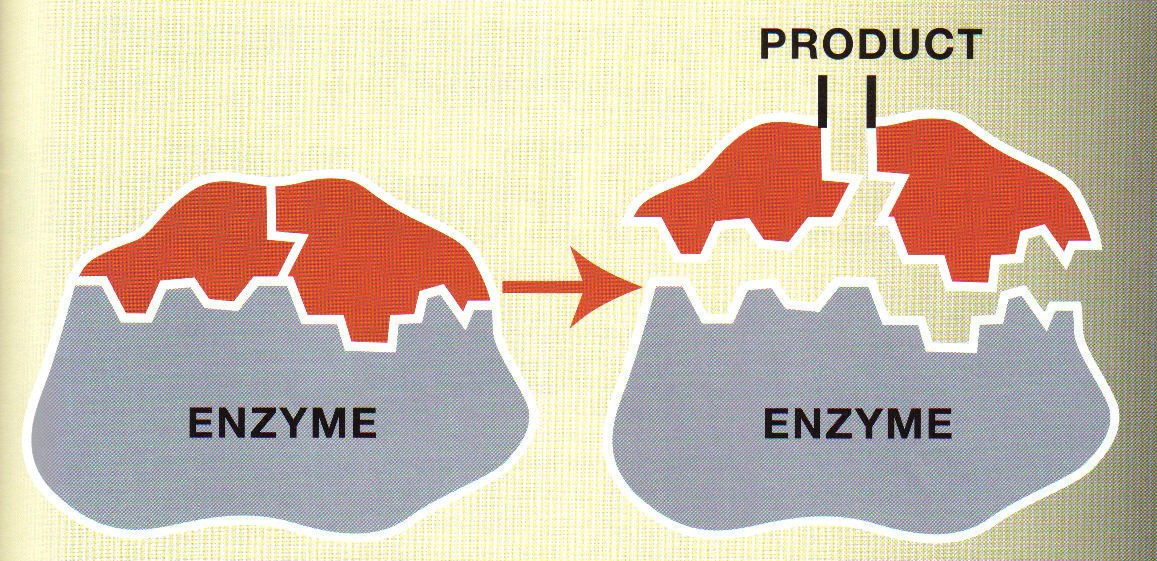
The molecule an enzyme is working on is called the:
a)
Substrate
b)
Solvent
c)
Allosteric Inhibitor
d)
CoEnzyme
16.
Enzymes are an example of
a)
Lipids
b)
Carbohydrate
c)
Protein
d)
Nucleic Acid
17.
What is the purpose of an enzyme?
a)
give permission for the reaction
b)
raise activation energy
c)
speed up reactions
d)
control how many reactions occur
18.
After the enzyme and substrate bind together and perform the reaction, what does the substrate become?
a)
a substrate
b)
an enzyme
c)
a product
d)
an active site
19.
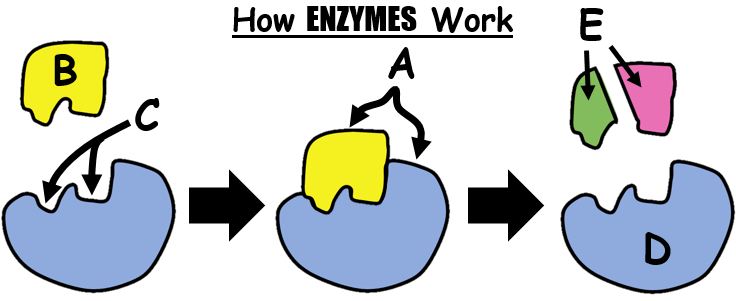
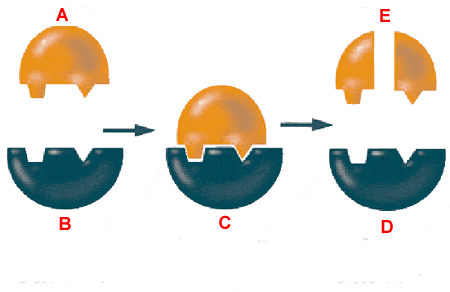
In the diagram, what is letter A?
a)
product
b)
substrate
c)
enzyme-substrate complex
d)
active site
20.
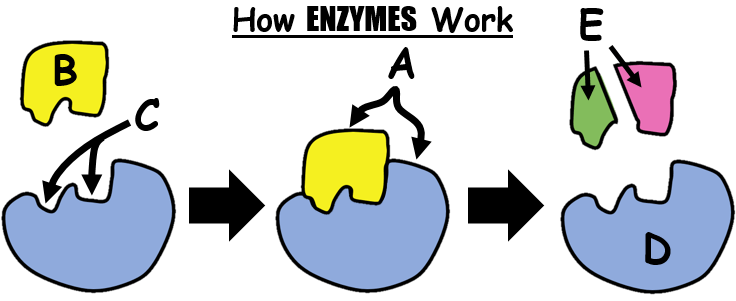
Letter B...
a)
active site
b)
enzyme
c)
substrate
d)
products
21.
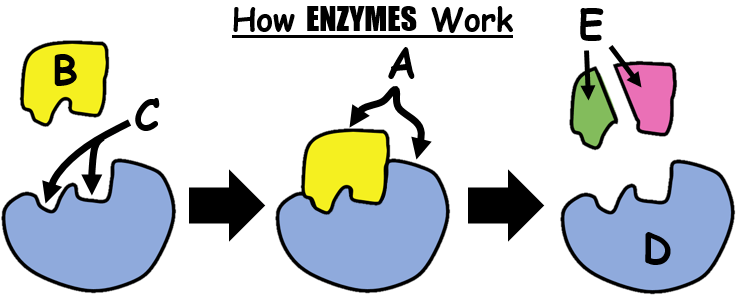
Letter D...
a)
active site
b)
enzyme
c)
substrate
d)
products
22.
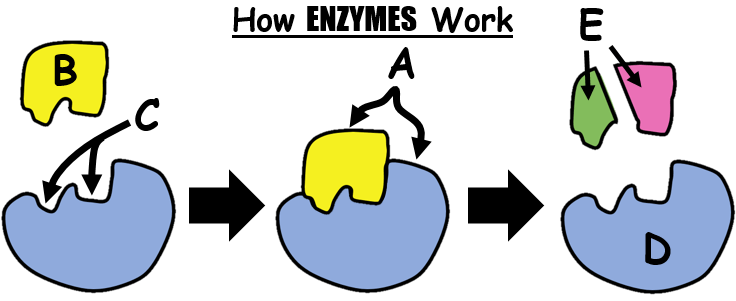
Letter E...
a)
active site
b)
enzyme
c)
substrate
d)
products
23.
In a chemical reaction, bonds are broken and new bonds are formed that create new substances. The bonds that are broken are called what?
a)
Reactants
b)
Products
c)
Atoms
d)
Catalysts
24.
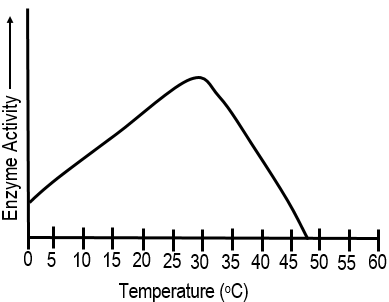
Based on the graph, what is the optimal temperature for this enzyme?
a)
15oC
b)
40oC
c)
30oC
d)
35oC
25.
An enzyme speeds up a chemical reaction in the cell but can only be used once. True or False?
a)
true
b)
false
26.
Which of the following is the correct equation for PHOTOSYNTHESIS?
a)
CO2 + light + H2O --> O2 + Sugar
b)
CO2 + sugar + H2O --> O2 + light
c)
O2 + light + H2O --> CO2 + Sugar
d)
CO2 + O2 + H2O --> Light+ Sugar
27.
What is the pigment in chloroplasts that performs photosynthesis?
a)
Chlorosynthesis
b)
Chlorophyll
c)
ADP
d)
Electron Transport
28.
What gas is being released during photosynthesis
a)
sulfur
b)
carbon dioxide
c)
oxygen
d)
hydrogen
29.

What are the products of photosynthesis?
a)
Glucose and Chlorophyll
b)
Glucose and Oxygen
c)
Water and Light energy
d)
Carbon Dioxide and Light energy
30.
Which of the following is the correct equation for PHOTOSYNTHESIS?
a)
CO2 + light + H2O --> O2 + Sugar
b)
CO2 + sugar + H2O --> O2 + light
c)
O2 + light + H2O --> CO2 + Sugar
d)
CO2 + O2 + H2O --> Light+ Sugar
31.
The process that converts food (glucose) into energy is called
a)
Cellular Respiration
b)
Photosynthesis
c)
Chloroplast
d)
Carbon dioxide
32.
The process of converting sunlight energy into chemical energy stored in a molecule is called
a)
Cellular respiration
b)
Photosynthesis
c)
Mitochondria
d)
Carbon dioxide
33.
Cellular respiration happens in a cell's
a)
Mitochondria
b)
Chloroplast
c)
Nucleus
d)
Cell wall
34.
Photosythesis happens in a cell's
a)
Mitochondria
b)
Chloroplast
c)
Nucleus
d)
Cell Wall
35.
Photosythesis happens in a cell's
a)
Mitochondria
b)
Chloroplast
c)
Nucleus
d)
Cell Wall
36.

Which bond of the ATP molecule is broken in order to release energy?
a)
A
b)
B
c)
C
d)
D
37.

Which structure in the figure above represents a single thylakoid?
a)
Structure A
b)
Structure B
c)
Structure C
d)
Structure D
38.
The ______ the temperature, the more photosynthesis can occur.
a)
higher
b)
lower
39.
Increasing the intensity of light had what effect on photosynthesis?
a)
It slowed it down
b)
It sped up
c)
It stayed the same
40.
This happens in the muscles of your arm when you squeeze a tennis ball for 100 seconds.
a)
alcoholic fermentation
b)
lactic acid fermentation
c)
glycolysis fermentation
d)
chloroplast fermentation
41.
This process is usually performed by yeast.
a)
kreb's cycle
b)
lactic acid fermentation
c)
glycolysis fermentation
d)
alcoholic fermentation
42.
Which of the following is anaerobic?
a)
ETC
b)
Kreb's Cycle
c)
Fermentation
d)
Calvin Cycle
43.
If oxygen is not present what process will occur in yeast cells?
a)
Alcoholic fermentation
b)
Respiration
c)
Photosynthesis
d)
Lactic acid fermentation
44.
Which process produces the most ATP per molecule of glucose?
a)
lactic acid fermentation
b)
aerobic respiration
c)
alcoholic fermentation
d)
all are about the same
100 %

