
 Worksheets
Evolution, Viruses, Natural Selection
Total questions: 44
Worksheet time: 29mins
Name
Class
Date
1.
Structural adaptations help organisms survive in various environments. Which of these is not an example of a structural adaptation?
a)
The harmless syrphid fly resembles the yellow jacket in coloring and body shape.
b)
The leaf frog’s coloring and shape make camouflage on the forest floor possible.
c)
Mole-rats have large teeth and claws which help them dig tunnels and escape predators.
d)
A lizard finds a shady spot to escape the sun’s heat.
2.
Penicillin is widely used to kill bacteria which cause disease. However, this drug does not affect as many species of bacteria today as it did when it was first discovered. Which statement describing this situation is false?
a)
Thousands of years were required for bacteria to become resistant to penicillin.
b)
The ability of bacteria to resist penicillin varies within a population.
c)
Bacteria which are resistant to penicillin will survive exposure to the drug.
d)
. Bacteria which are resistant to penicillin will produce penicillin-resistant offspring.
3.
Which of the following statements about mutations is false?
a)
Environmental factors including radiation and chemicals can cause mutations to occur.
b)
Enzymes in cells can fix mutations by replacing incorrect nucleotides with correct ones.
c)
All mutations are harmful to both the organism and the species to which it belongs.
d)
Cancer is one result of DNA mutation.
4.
Within a fish species, variations exist in color, size, and the speed at which individuals can swim. Which variation would be least likely to be passed on to future generations of the species?
a)
. swimming speed which is less than that of predators
b)
color of markings which aid camouflage
c)
size which enables hiding among small rocks and in rock crevices
d)
reproduction by laying extremely large numbers of eggs
5.
A bear produces two offspring. One of the cubs is smaller than normal and has difficulty digesting food. Which statement comparing the two cubs is false?
a)
The larger bear cub is more likely to survive to reproductive age.
b)
The smaller bear cub is less likely to pass its genes on to another generation.
c)
The larger bear is better adapted for survival in its environment.
d)
d. Both bear cubs are equally likely to pass their genes on to the next generation.
6.
Which of these statements about natural selection is true?
a)
a. Organisms which survive to reproduce can pass favorable variations on to offspring.
b)
Natural selection works on individuals, rather than a population of organisms.
c)
All organisms within a species are genetically identical.
d)
. Offspring can inherit traits of an organism which that organism develops during its life.
7.
What is one reason that pumpkins are more closely related to corn plants than to edible mushrooms?
a)
Pumpkins and corn grow more slowly than mushrooms
b)
. Pumpkins and corn need less moisture than mushrooms.
c)
Pumpkins and corn taste different than mushrooms.
d)
Pumpkins and corn both make their own food
8.
Heidi Takashi is a farmer who grows corn. About 10 years ago, Ms. Takashi began spraying her fields with herbicide, a chemical that kills plants, to kill weeds in the corn field. For a few years the herbicide killed nearly all of the weeds in Ms. Takashi’s corn field. One year, Ms. Takashi noticed that some weeds were growing even after being sprayed with herbicide. The next year, even more weeds were still alive after herbicide-spraying. Based on what you know about how organisms adapt to their environment, what is the most likely reason to explain the results of Ms. Takashi’s use of herbicide?
a)
The weeds underwent a mutation which led to a resistance to herbicide.
b)
The weeds were new species of weeds.
c)
The herbicide was still effective on Ms. Takashi’s weeds.
d)
The herbicide underwent a chemical change.
9.
. Which kind of evidence led scientists to suspect that species may change over time?
a)
fossils of marine organisms that were found buried in the sides of mountains
b)
a recent theory stating that new organisms can only come from older organisms
c)
experiments in which plants were crossbred to produce offspring with traits from each parent
d)
sequential layers of fossils that have the remains of the most modern-looking organisms in the top layers
10.

During a severe drought a dry lake was explored for fossils. The diagram below represents the fossils uncovered and the layers they were in. According to this information, this area was once a—
a)
forest that was replaced by a freshwater lake
b)
freshwater lake that was replaced by a desert
c)
saltwater sea that was replaced by a forest
d)
freshwater lake that was replaced by a forest
11.
Many scientists classify viruses as non-living things. Which of these best describes why a virus might be classified as non-living?
a)
It has no genetic material of its own.
b)
It reproduces only when it is inside a cell.
c)
It can take control of a cell and change its normal activities.
d)
Its effects on an organism are always harmful.
12.

The photograph shows a virus attacking a human T cell (immune cell). Which disease could result if many T cells are destroyed in this manner?
a)
AIDS
b)
. Tuberculosis
c)
Chicken pox
d)
Multiple sclerosis
13.
A virus has been approved for use as a food additive because it attacks and kills bacteria harmful to humans. The virus kills the bacteria by doing which of the following?
a)
ingesting the bacteria
b)
injecting its own genetic material into the bacteria
c)
absorbing the oxygen that the bacteria need for respiration
d)
producing toxins that prevent the bacteria from reproducing
14.
Viruses that contain RNA as their genetic information are
a)
prophages
b)
bacteriophages
c)
retroviruses
d)
capsids
15.
If a flu virus infects a person, which of the following will MOST likely occur inside the person?
a)
Deformed bone and skin cells will appear
b)
The pH of the bloodstream will change slightly
c)
The number of viruses will increase dramatically
d)
Body cells will temporarily stop undergoing mitosis
16.
How does a virus differ from a cell?
a)
. Viruses are much larger than the largest cells
b)
A virus cannot copy itself unless it is inside a living cell
c)
. Cells make people sick, but viruses heal them
d)
A virus can make copies of itself before invading a body
17.
What is the basic structure of a virus?
a)
DNA or RNA surrounded by a protein coat
b)
a capsid surrounded by a protein coat
c)
a tail sheath surrounded by tail fibers
d)
a tiny cell surrounded by a cell wall
18.
The structure labeled C in the figure is—
a)
DNA
b)
an organelle
c)
the nucleus
d)
a high-energy sugar
19.
The structure labeled D in the figure above is—
a)
DNA
b)
pilus
c)
flagella
d)
cilia
20.

Who is more closely related to rodents and rabbits?
a)
Crocodiles
b)
Sharks
c)
Amphibians
d)
Ray finned fishes
21.
How does a virus cause a person to develop the common cold?
a)
invades the host cell to reproduce
b)
removes energy from the host cell
c)
produces toxins in the host cell
d)
protects the host cell from bacteria
22.
Antibiotics kill viruses
a)
True
b)
False
23.

A(n) _____ is a virus that enters a bacterial cell.
a)
endospore
b)
decomposer
c)
plasmid
d)
bacteriophage
24.
Which viral life cycle allows viral genetic material to lay dormant while the host cell reproduces?
a)
lytic
b)
mitosis
c)
lysogenic
d)
S phase
25.
Which viral life cycle kills its host cell by lysing?
a)
lytic
b)
mitosis
c)
lysogenic
d)
S phase
26.
What happens in the lysogenic cycle?
a)
Virus goes in and leaves the host cell
b)
Virus quickly kills the host cell
c)
Virus inject the nucleic acid into the host cell, and the nucleic acid integrates into the host cell DNA, and stay dormant for a long time
d)
Bacteria injects DNA into a host cell
27.

What process is this?
a)
phagocytosis
b)
lytic cycle
c)
lysogenic cycle
d)
formation of antibodies
28.
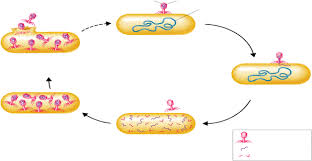
What is shown here?
a)
Lysogenic Cycle
b)
Lytic Cycle
c)
Binary Fission
d)
Conjugation
29.
What is the 1st step of virus infection?
a)
Entry
b)
Attachment
c)
Replication
d)
Assembly
30.
Which virus reproduction cycle causes the cell to immediately rupture and die?
a)
Lytic Cycle
b)
Lysogenic Cycle
c)
Mitosis
d)
Meiosis
31.

Which labels the virus correctly
a)
R: Capsid a protein that protects genetic material
S: Genetic Material
Q: Surface markers used to attch to host
S: Genetic Material
Q: Surface markers used to attch to host
b)
R: Capsid a protein that protects genetic material
S: Genetic Material
Q: Surface markers glycoproteins used to attach to host
S: Genetic Material
Q: Surface markers glycoproteins used to attach to host
32.
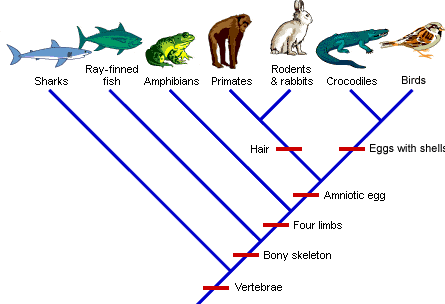
According to this cladogram, birds are LEAST related to:
a)
Amphibians
b)
Sharks
c)
Ray Finned Fish
d)
Crocodiles
33.
You look at two species and see very similar DNA. What does this likely tell you?
a)
These are the same animal.
b)
These animals have a common ancestor.
c)
These animals are not likely related.
d)
These animals are likely becoming one species.
34.
Individuals that are well adapted to their environment will survive and produce:
a)
Fewer mutations
b)
Stronger genes
c)
More offspring
d)
Better traits
35.
The finches on the Galapagos island were similar in form except for variations of their beaks. Darwin observed that these variations were useful for:
a)
attracting a mate
b)
defending territory
c)
building nests
d)
gathering food
36.
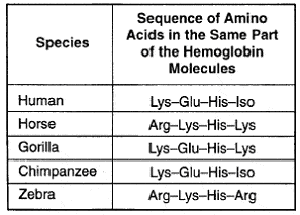
You look at two species and see very similar amino acid sequences. What does this likely tell you?
a)
These are the same animal.
b)
These animals have a common ancestor.
c)
These animals are not likely related.
d)
These animals are likely becoming one species.
37.

What genus does Bird X belong to?
a)
Certhidea
b)
Geospiza
c)
Camarhynchus
d)
Platyspiza
38.
What day is today?
a)
Saturday
b)
Wednesday
c)
March 5
d)
Friday
39.

The structures shown are_________
a)
homologous
b)
heterologous
c)
analogous
d)
vestigial
40.

The hind leg bones in a whale are examples of
a)
homologous structures
b)
analogous structures
c)
fossils
d)
vestigal structures
41.
Which of the following pieces of evolution evidence deals with aged and identified fossils?
a)
fossil record
b)
comparative embryology
c)
comparative biochemistry
d)
comparative anatomy
42.
Bird wings and butterfly wings are an example of
a)
Homologous structure
b)
Analogous structure
c)
Mimicry
d)
Camoflague
43.
HOMOLOGOUS structures?
a)
same function/different structure no common ancestors
b)
same structure/ same function
c)
same structure/ function and a possible common ancestor.
d)
common ancestors
44.
What is survival of the fittest?
a)
It is where the fittest die out and therefore reproduce and pass on their genes
b)
It is where the fittest die out and therefore can't reproduce and pass on their genes
c)
It is where the fittest don't die out and therefore can't reproduce and pass on their genes
d)
It is where the fittest don't die out and therefore reproduce and pass on their genes
100 %

