
NEW
Font size
 Worksheets
Sed. Rock and Fossil Fuels Review
Total questions: 33
Worksheet time: 28mins
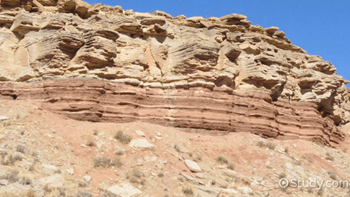
What factors can lead to the formation of a sedimentary rock?
melting and solidification
extreme heat and pressure
compaction and cementation


The diagram below shows the sequence of the processes that turn solid rock into sandstone. Which two processes best complete this diagram?
Melting and cooling
Erosion and compaction
Compaction and cementation
Evaporation and dissolving

Which of the following correctly completes the Sedimentary Rock Cycle?
A = Compaction, B = Erosion, C = Cementation
A = Erosion, B = Compaction, C = Cementation
A = Cementation, B = Compaction, C = Erosion
A = Erosion, B = Cementation, C = Compaction
Which diagram models the process of compaction leading to the formation of sedimentary rock? (5.7A)


Sediments are falling into the layers. What is NOT needed to make sedimentary rocks?
millions of years
organic matter
layers of sediment
compaction and cementation

Which layer is the oldest?
siltstone
conglomerate
limestone
mudstone
Sedimentary rocks are formed because of
compaction and cementation
compaction and compression
compression and pressure
heat and cementation
Most fossils form from
the muscles and organs of the animals body
the bones, horns and teeth of an animal
the skin of an animal
the fur of an animal
Sedimentary rocks form in
crystal shapes
a large mixture of different sediments
layers of sediments stacked on top of each other
Sedimentary rocks take _______________ to form
millions of years
hundreds of years
a few years
a few months
Fossils are an important source of
fuel for making electricity
fuel for our cars
information about life on Earth a long time ago
information about life on Earth now


Look closely at answer choices- TRICKY!

Trees are renewable resources.
True
False
Fossil Fuels are
pieces of rock that have been compacted many times
rock that contains 50% plant and animal remains
metamorphic rock
fuels that form from the remains of plant and other organisms that were buried and altered over million of years
The liquid form of fossil fuels is ___.
coal
petroleum
natural gas
gasoline
The gas form of fossil fuels is ____.
petroleum
natural gas
coal
heat
The solid form of fossil fuels is _______.
petroleum
crude oil
natural gas
coal
Which of the following is NOT TRUE of fossil fuels?
They are non-renewable.
They produce harmful pollution.
They can easily be replaced as they are used.
They are inexpensive.
Fossil fuels were formed from ____.
the remains of once living organisms.
the earth.
solids, liquids, and gases, made millions of years ago.
sun and water.
Natural gas and petroleum were both formed _____.
in swamp lands.
under ancient seas.
on the surface of the oceans.
underground.
Coal was formed ______.
under ancient seas.
in swamps and marshes.
in caves.
under oceans.
Are fossil fuels renewable or non renewable?
renewable
non renewable

