wayground logo

Free Printable Worksheets

Font size

S
M
L
XL
Worksheets

Unit 4 & 5 Review

Total questions: 65

Worksheet time: 11hrs 50mins
Name
Class
Date
1.
What type of function is f(x)=2(1/7)x ?
a)
Exponential Growth
b)
Linear
c)
Exponential Decay
d)
None of the Abovee
2.
What type of function is y = 7(5/4)x?
a)
Exponential Growth
b)
Exponential Decay
c)
Linear
d)
None of the above
3.
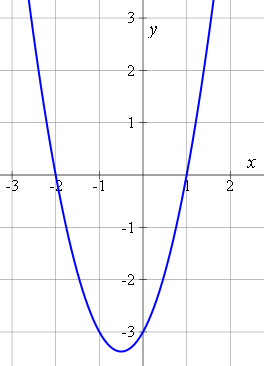
Is the graph linear, exponential or neither?
a)
Linear
b)
Exponential
c)
Neither
4.
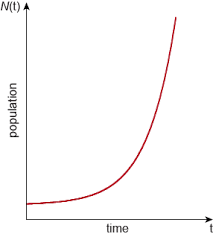
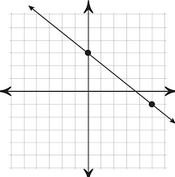
Is the pictured graph growth, decay, or linear or none?  
a)
Exponential Growth
b)
Exponential Decay
c)
Linear
d)
None
5.
A new savings account is opened with $400 and gains 3% every year. What is the exponential function?
a)
f(x)=400(1+3)x
b)
f(x)=400(1-0.03)x
c)
f(x)=400(1+0.03)x
d)
f(x)=400(0.03)x
6.
What does the y-intercept of the graph represent?
a)
The amount of grams the material is gaining.
b)
The amount of grams the material is losing.
c)
The amount of grams remaining after so many years.
d)
The initial amount of grams.
7.
Which of the following is an increasing exponential function whose y-intercept is 50?
a)
y = 50(.05)x
b)
y = 50x - 4
c)
y = (2)x + 50
d)
y = 50(1.4)x
8.
The amount of ants in a colony, f, that is decaying can be modeled by                      f(x) = 800(.87)x, where x is the number of days since the decay started. By what percentage is the colony decaying?
a)
87%
b)
13%
c)
800%
d)
8.7%
9.
The amount of ants in a colony, f, that is decaying can be modeled by                         f(x) = 800(.87)x, where x is the number of days since the decay started. Suppose           f(20) = 49. Which of the following is true?
a)
After 20 days, there are 49 ants in the colony.
b)
After 49 days there are 20 ants in the colony.
c)
The amount of ants times 20 is 49.
d)
After 20 days the amount of ants remaining decreases by 49.
10.
A collectible car has been going up in price by 10% each year. If the car is already worth $29,000, how much will the car be worth in 5 years?
a)
$0.29
b)
$2,900,000,000
c)
$46,704.79
d)
$145,000
11.
The expression 12(1.015)t models the population of elephants in a wildlife refuge after t years since 1975.
What does the value 12 represent?
a)
The predicted increase in number of elephants in the refuge each year.
b)
The predicted decrease in number of elephants in the refuge each year.
c)
The number of years it will take for the elephant population to stop increasing.
d)
The initial amount of elephants in the park.
12.
The amount of ibuprofen (medicine for headaches) breaks down by 30% each hour. If a person took a 200 milligram ibuprofen, how much will be left after 3 hours?
a)
5.4 mg
b)
68.6 mg
c)
.0054 mg
d)
2,400,000 mg
13.

What type of pattern do exponential functions have?

a)

Adds by the same number every time

b)

Multiplies by the same number every time

c)

Square roots all the inputs

d)

Squares all the inputs

14.

What type of pattern do linear functions have?

a)

Adds by the same number every time

b)

Multiplies by the same number every time

c)

Square roots all the inputs

d)

Squares all the inputs

15.

Is the table linear, exponential, or neither?

a)

Linear

b)

Exponential

c)

Neither

16.

Is the table linear, exponential, or neither?

a)

Linear

b)

Exponential

c)

Neither

17.

Is the table linear, exponential, or neither?

a)

Linear

b)

Exponential

c)

Nether

18.

Is the table linear, exponential, or neither?

a)

Linear

b)

Exponential

c)

Neither

19.

What is the rate of change for the table below between x=4 and x=7?

a)

1/3

b)

3/7

c)

7/3

d)

3

20.
What is the rate of change for the following graph?
a)
80
b)
20
c)
40
d)
160
21.
What is Mrs. Gordon's rate from 0 to 2 seconds?
a)
2.5 feet per second
b)
.4 feet per second
c)
5 feet per second
d)
.2 feet per second
22.

Calculate the average rate of change from 20 to 40 minutes.

a)

-2 minutes per gallon

b)

-20 minutes per gallon

c)

-2 gallons per minute

d)

-20 gallons per minute

23.
Find the average rate of change over the given interval. 
a)
4
b)
7
c)
7/3
d)
3/7
24.
What is the average rate of change of [1, 5]?
a)
-0.65
b)
-0.75
c)
3.75
d)
4
25.
What is the average rate of change from x=0 to x=1
a)
-3
b)
3
c)
0
d)
2
26.
f(x) = 2x2 + 12x + 16
What is the average rate of change of f(x) on the interval [-3, -2].
a)
2
b)
1/2
c)
-2
d)
-1/2
27.
What is the average rate of change of y = 2(3)x at [2, 4]?
a)
72
b)
3
c)
36.8
d)
630
28.

Use the given function or the graph to find the average rate of change

a)

5

b)

-1/5

c)

-5

d)

15

29.

Which of the following is not an arithmetic sequence?

a)

1/2, 1, 3/2, 2

b)

11, 14, 17, 20

c)

2, 4, 8, 16

d)

5, 2, -1, -4

30.

Identify the common difference of the sequence below:

-2.3, -1.1, 0.1, 1.3,...

a)

-1.2

b)

1.3

c)

1.2

d)

-1.3

31.

Write the explicit formula for the sequence shown below.

3, -3, -9, -15

a)

an=3+6(n-1)

b)

an=3−6(n-1)

c)

an=6−3(n-1)

d)

an=6+3(n-1)

32.

What is the 20th term of the arithmetic sequence shown below.

7, 4, 1,...

a)

-49

b)

50

c)

-50

d)

-51

33.

An arithmetic sequence is described by the function f(n)=−3n+7. What are the first 5 terms of the sequence?

a)

7, 10, 13, 16, 19

b)

4, 1, -2, -5, -8

c)

-4, -1, 2, 5, 8

d)

-7, -10, -13, -16, -19

34.
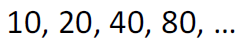
What kind of sequence is the pattern 15, 17, 20, 24, 29, ...?
a)
Arithmetic
b)
Geometric
c)
Neither
35.
What kind of sequence is the pattern 400, 200, 100, 50, 25, ...?
a)
Arithmetic
b)
Geometric
c)
Neither
36.
Find the common ratio for the geometric sequence.
a)
10
b)
1/2
c)
2
d)
4
37.
Determine whether the sequence is arithmetic, geometric, or neither.
a)
arithmetic
b)
geometric
c)
neither
38.
Determine whether the sequence is arithmetic, geometric, or neither.
a)
arithmetic
b)
geometric
c)
neither
39.
Find the common ratio for the geometric sequence.
a)
1
b)
-1
c)
7
d)
-7
40.
Write the explicit formula for the geometric sequence.
a)
an = 4(3)n-1
b)
an = 3(4)n-1
c)
an = -4(3)n-1
d)
an = 3(-4)n-1
41.
Write the explicit formula for the geometric sequence.
a)
an = 162(2/3)n-1
b)
an = (2/3)(162)n-1
c)
an = 162(3/2)n-1
d)
an = 162 + (n-1)(-54)
42.
Write the explicit formula for the geometric sequence.
a)
an = 2(100)n-1
b)
an = 100(2)n-1
c)
an = 100(1/2)n-1
d)
an = (1/2)(100)n-1
43.
Write the recursive formula for 6, 17, 28, 39, 50....
a)
an=an-1+11
a1=6
b)
an=an-1-4
a1=6
c)
an=an-1+9
a1=6
d)
an=an-1+6
a1=6
44.
Given the recursive formula, find the first four terms:
an = an-1 + 5
a1 = -16
a)
-16, -21, -26, -31
b)
5, -11, -27, -43
c)
-16, -80, -500, -200
d)
-16, -11, -6, -1
45.
Write a recursive rule for the sequence 17, 1, -15, -31 . . .
a)
an = an-1 + 16
a1=17
b)
an = an-1 - 17
a1=17
c)
an = an-1 - 15
a1=17
d)
an = an-1 - 16
a1=17
46.

Write the recursive formula for 4, 8, 12....

a)

an=an-1-7

b)

an=an-1-4

c)

an=an-1+3

d)

an=an-1+4

47.

A formula that requires the computation of all previous terms to find the value of an.

a)

Explicit Formula

b)

Recursive Formula

c)

Arithmetic Formula

d)

Geometric Formula

48.
What is the 15th term of the sequence an = -3n+50
a)
95
b)
-5
c)
5
d)
-95
49.

Determine the first 3 terms of the following sequence.

a1= -3

an=an-1(3)

a)

-3, 9, 27

b)

-3, -9, -27

c)

-3, -6, -9

d)

-3, 6,9

50.

Create the explicit formula for the sequence:

2, 8, 14, ...

a)

an=2+6n

b)

an=-6+6n

c)

an=6n-4

d)

an=4-6n

51.

Write the explicit formula for the sequence given by 3, 6, 12, 24, …

a)

an= 3(2)n-1

b)

an= 3+(2)n

c)

an= 3(2)n

d)

an= 3+(2)n-1

52.

Write a recursive formula for the following sequence:

16,8, 4, 2,...

a)

a1=16

an=an-1 (2)

b)

a1=16

an=an-1 (1/2)

c)

a1=16

an=an-1 + (1/2)

d)

a1=16

an=an-1 + (2)

53.

What is the common ratio of the sequence: 16, -8 , 4, -2...

a)

 12\frac{1}{2}  

b)

 22  

c)

 12-\frac{1}{2}  

d)

 2-2  

54.

 f(n)=  24 (12)(n1)f\left(n\right)=\ \ 24\ \left(\frac{1}{2}\right)^{\left(n-1\right)}  Given the explicit formula, find the 3rd term

a)

6

b)

12

c)

3

d)

1.5

55.

Who has the greater rate of change (slope)?

a)

Smith has the greater rate of change with 5/4

b)

Harmon has the greater rate of change with 7/2

c)

Smith has the greater rate of change with 4/5

d)

They have the same rate of change.

56.

Who has the greater rate of change (slope)?

a)

Troy has the greater rate of change.

b)

Lucy has the greater rate of change

c)

They have the same rate of change

57.

Which kitten grows fastest? What is it's rate of change (slope)?

a)

Kitten A with a rate of change of 3

b)

Kitten B with a rate of change of 4

c)

Kitten A with a rate of change of 4

d)

Kitten B with a rate of change of 3

58.

What type of function does this equation represent? 
y=5x+10y=5x+10

a)

Linear Function

b)

Quadratic Function

c)

Exponential Function

d)

Not a Function

59.

What type of function does this equation represent?
 Y=4(12)xY=4\left(\frac{1}{2}\right)^x  

a)

Linear Function

b)

Quadratic Function 

c)

Exponential Function

d)

Not a Function

60.

What type of function does this equation represent?
Y=x2+6x+5Y=x^2+6x+5

a)

Linear Function

b)

Quadratic Function

c)

Exponential function

d)

Not a Function

61.

What type of function does this situation represent?

The sales of smart phones have increased 15% every year since the year 2000.

a)

Not a function

b)

Linear Function

c)

Exponential Function

d)

Quadratic Function

62.

What type of function does this situation represent?

Macy puts $100 into her savings account each month.

a)

Exponential Function

b)

Quadratic Function

c)

Linear Function

d)

Not a Function

63.

What type of function does this situation represent?

Todd tosses a basketball upwards into the air from the top of a 10 ft ladder with a velocity of 14 ft/sec.

a)

Quadratic Function

b)

Exponential Function

c)

Linear Function

d)

Not a function

64.

In the table, function 3 is

a)

Linear

b)

Quadratic

c)

Exponential

65.

What type of function does this situation represent?

Joy is redoing the carpet in her rectangular living room. The length of the room is 3 feet longer than the width.

a)

Quadratic Function

b)

Exponential Function

c)

Linear Function

d)

Not a function