
 Worksheets
Newton's Laws Unit Review
Total questions: 61
Worksheet time: 31mins
What is a force?
a pull exerted on an object
a measure of how heavy an object is
a push or a pull exerted on an object
a change in the direction of motion of an object
Sasha pulls a block across the floor at a constant speed. Why doesn’t the motion of the block change even though Sasha is pulling on it?
Sasha’s force on the block is balanced by the friction force.
Sasha’s force on the block is balanced by the gravitational force.
If Sasha was not pulling on the block, there would be no forces on the block, and it would speed up.
If Sasha was not pulling on the block, there would be no forces on the block, and it would stop moving.
When a comet enters the solar system, it curves toward the sun. Which statement describes why the sun does not move when a comet is nearby?
There is no force exerted on the sun from the comet.
There is no force exerted on the sun unless the sun and comet collide.
The force on the sun from the comet is smaller than the force on the comet from the sun because the comet’s speed is too great.
The force on the sun from the comet is equal to the force on the comet from the sun but does not cause the sun to move because the sun is too massive.

The weights of four objects with different masses have been calculated to show how much each object would weigh on four different planets. Based on the table, _____ would have the largest mass and greatest weight on Earth, and _______ would have the smallest mass and least weight on Earth?
Object A, Object C
Object A, Object B
Object C, Object A
Object C, Object D
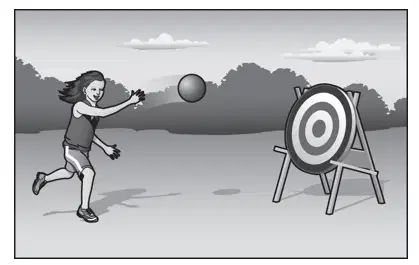
Rebecca is practicing her aim by throwing a ball at a target. The ball exerts a force on the target, causing the target to fall over. But when this happens, the ball bounces backward. Why does the ball bounce backward?
The target exerts a larger force on the ball because the ball is very bouncy.
The ball exerts a larger force on the target, causing the target to have a larger change of motion than the ball.
The target exerts the same size force on the ball, so when the target moves in one direction, the ball moves in the opposite direction.
The ball exerts a smaller force on the target because the ball is smaller than the target, so the target causes the ball to bounce backward.

The diagram shows four blocks suspended on identical dynamometers, a tool that is used for measuring the weights of objects. Which object has the greatest weight?
A
B
C
D
Two cars travel on a straight road from point A to point B. Both cars accelerate to their maximum speed and then continue at that speed for the rest of the distance. Car 1 accelerates from rest to 20 m/s over 30 s. It reaches point B in 35 s. Car 2 accelerates from rest to 20 m/s over 20 s. It reaches point B in 30 s. Which car uses a larger acceleration to reach its maximum speed, and which car has a larger average speed?
Car 1 has both a larger acceleration and a larger average speed.
Car 2 has both a larger acceleration and a larger average speed.
Car 1 has a larger acceleration, but Car 2 has a larger average speed.
Car 2 has a larger acceleration, but Car 1 has a larger average speed.
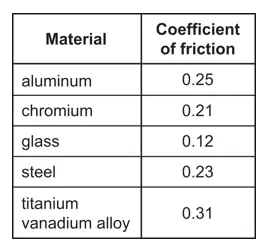
A student is sliding blocks of different materials down a steel ramp. All of the blocks have similar sizes and masses. The table shows the coefficient of friction for several materials when sliding on steel. The larger the coefficient of friction, the greater the force of friction. ______ will slide down the ramp the fastest and _____ will slide down the ramp the slowest.
aluminum, chromium
glass, titanium vanadium alloy
glass, aluminum
titanium vanadium alloy, glass

Box ____ will move to the right and box ____ will move to the left.
C, D
D, C
A, B
B, A
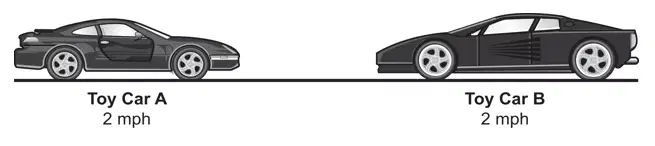
The two toy cars are headed for each other at the same ______. The force of car A as it hits car B will be _____ the force of car B as it hits car A.
speed, less than
speed, greater than
speed, equal to
velocity, less than
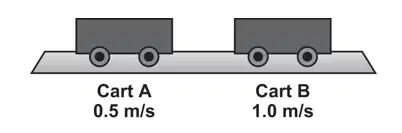
The diagram shows two identical carts rolling toward each other, about to collide. Which statement describes the direction and speed that cart A is moving before and after the collision?
Cart A moves left 0.5 m/s before the collision and to the left at a speed greater than 1.0 m/s after the collision.
Cart A moves left 0.5 m/s before the collision and to the right at a speed less than 0.5 m/s after the collision.
Cart A moves right 0.5 m/s before the collision and to the left at a speed greater than 0.5 m/s after the collision.
Cart A moves right 0.5 m/s before the collision and to the right at a speed less than 1.0 m/s after the collision.
A boy pushes against the trunk of a tree with his hands. Which two of the following statements is true?
The tree does not exert any force on the boy.
The ground exerts an upward force against the tree.
The boy exerts more force on the tree than the tree exerts on the boy.
The forces exerted by the boy and the tree are exerted in the same direction.
Any object that touches the tree in the same way as the boy’s hands will exert a force on the tree.
Daniel uses a force of 5 N to push a ball with a mass of 12 kg. He puts a piece of tape on the floor to show how far the ball rolled in 1 second. Daniel wants to make a ball roll a shorter distance in 1 second than the distance the first ball rolled. Which two of the following action can Daniel take to achieve this result?
use a 20 kg ball with the same amount of force as in the first investigation
mark the distance after 2 seconds
use a 1 N force on a ball of the same mass as in the first investigation
use a 20 N force on a ball of the same mass as in the first investigation
Toni needs to set up a demonstration to prove that Newton’s third law applies during the collision of two objects. She has a toy car, a toy truck, and two identical billiard balls. She chooses to demonstrate the action-reaction force pairs by rolling the billiard balls toward each other. Why did Toni choose billiard balls instead of the other objects to illustrate her point?
The billiard balls have the same mass, making the result of equal forces easier to see.
The toy truck would exert more force on the toy car, showing unequal forces instead of equal ones.
The billiard balls are the same diameter, showing equal forces during a collision and proving Newton’s third law.
A collision between any of the other objects would not demonstrate Newton’s third law, making the demonstration invalid.
The same force is applied separately to two object, A and B. B has twice the mass of A. What happens?
B's acceleration is half that of A.
B's acceleration is twice that of A.
B's acceleration is one-fourth that of A.
B's acceleration is four times that of A.
A metal ball sits motionless on a flat surface. Which of these would make the ball move?
The force of gravity becomes less.
The force of gravity becomes greater.
Two equal horizontal opposing forces act upon the ball.
Two unequal horizontal opposing forces act upon the ball.
Two equal forces act in opposite directions on object A. Two unequal forces act in opposite directions on object B. If these are the only forces acting on objects A and B, which of these conclusions is true?
Only object A will accelerate.
Only object B will accelerate.
Both object A and object B will accelerate.
Neither object A nor object B will accelerate.
Two ice skaters on ice push away from each other. What will be the effect of the forces of their pushing each other if their masses are different?
The skater with the greater mass will have the lesser acceleration.
The skater with the less mass will have the lesser acceleration.
The forces applied to an object are 8 N to the left and 5 N to the right. What is the net force on the object?
3 N to the right
3 N to the left
13 N to the right
13 N to the left
A person who weighs 500 N on Earth would weigh about 80 N on the Moon. The force of gravity is less on the Moon because ____.
a person loses mass when traveling to the Moon.
the Moon is far away.
the Moon has less mass than Earth.
scales don't work on the Moon.
An object at rest or moving at a constant speed and in a constant direction is being acted on by _______________________force/s and an _______ force always causes a change in position, speed, or direction of an object.
unbalanced, unbalanced
unbalanced, balanced
balanced, unbalanced
balanced, balanced
A 1 kg object accelerates at a rate of 5 m/s2. Calculate the net force on the object. Tell how its motion is changing.
5 N, The object is accelerating.
1 N, The object is accelerating.
15 N, The object is not accelerating.
0 N, The object is not accelerating.
Melanie watched the path a baseball followed after a pitcher threw it. She noticed that the ball traveled horizontally away from the pitcher as well as downward toward the ground. What force caused the ball to accelerate in the downward direction when it was thrown?
applied force
air resistance
electrical force
gravitational force
______ is an example of a contact force, while _____ is an example of a noncontact force.
frictional force, magnetic force
magnetic force, frictional force
frictional force, air resistance
magnetic force, air resistance
Sean is moving heavy furniture by sliding it across the floor. He puts a blanket underneath the furniture. Why did this help him?
The blanket protects the side of the furniture from bumping against the wall.
The blanket reduces the gravitational force between the furniture and the floor.
The friction is larger between the blanket and the floor than between the furniture and the floor.
The friction is smaller between the blanket and the floor than between the furniture and the floor.
How would the absence of friction affect a marble traveling on a long, straight path?
the marble's speed would decrease
the marble would stop immediately
the marble's speed would increase
the marble would remain at a constant speed
During a baseball game, a hitter strikes the ball with a bat. When this happens, the ball and the bat exert a force on each other. Why does the ball accelerate away from the bat more than the bat accelerates away from the ball?
The ball has less mass, so it exerts less force on the bat.
The ball has greater velocity before the collision, so the force affects the ball more than it affects the bat.
The ball has less mass, so the equal force on the ball and the bat causes greater acceleration of the ball.
The bat exerts more force than the ball because the batter is exerting a force on the bat as it hits the ball.
The front of a car is designed to crumple during a crash. What is the purpose of this?
to decrease the mass of the car, decreasing the force of the collision
to increase the amount of time it takes for the collision to occur, decreasing the force of the collision
to increase the amount of time it takes for the collision to occur, decreasing the acceleration of the car
to decrease the amount of time it takes for the collision to occur, increasing the acceleration of the car
A fisherman steps off of a boat, which is in the water, onto a dock. What happens?
The boat and dock do not move.
The boat moves toward the dock.
The boat moves away from the dock.
The dock moves away from the boat.
An airplane is traveling at a speed of 200 m/s relative to Earth. A person walks toward the front of the plane at a speed of 1 m/s. How fast is that person traveling in reference to the other people on the airplane?
0 m/s
1 m/s
200 m/s
201 m/s

The table below shows the acceleration of a 10 kg mass resulting from different forces. What will be the acceleration when a force of 400 N is applied to this object?
25 m/s2
30 m/s2
35 m/s2
40 m/s2
Which law best describes a satellite orbiting the earth?
Law of Inertia
Law of Mass and Acceleration
Law of Action and Reaction
Initially, a rubber ball sits on a level table. An upward force acts on the ball as well as the force of gravity. In order for the rubber ball to roll on the level table, a _________ is required. This quantity is measured in __________ .
sideways unbalanced force, newtons
sideways balanced force, newtons
sideways unbalanced force, pounds
sideways balanced force, pounds
Which of the following scenarios demonstrates Newton's third law of motion?
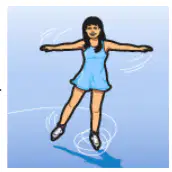
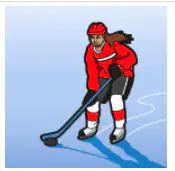
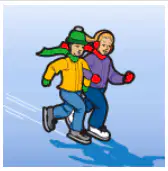
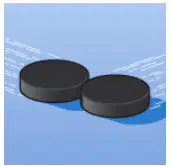
Rene notices a leaf that has fallen onto the grass. Although a light breeze is blowing, the leaf is not moving. How can this be explained in terms of the forces that are acting on the leaf?
The forces on the leaf are balanced.
The normal force on the leaf is stronger than gravity.
The elastic force is stronger than the tension force.
The leaf has a small mass.
An index card is placed across the top of a drinking glass. A coin is then placed on top of the index card. A student quickly flicks the card sideways off the glass. Which of these explains why the coin falls into the glass rather than moving to the side with the index card?
Newton's first law of motion
Newton's second law of motion
Newton's third law of motion
Newton's laws of universal gravitation
A tennis ball hits a wall. Which of these statements is true?
The tennis ball’s force is unopposed by the wall.
The tennis ball’s speed doubles when it hits the wall.
The wall exerts a force in the same direction as the tennis ball’s force.
The wall exerts a force in the opposite direction to the tennis ball’s force.
Which of the following has more inertia?
Bowling Ball
Tennis Ball
Feather
After stepping into a mud puddle, Susan stomps her shoes on the ground to remove some of the mud from them. Which explains why the mud comes off her shoes?
The mud has less mass than her shoes.
The mud continues in motion even after the shoes stops.
Mud tends to travel farther.
The mud has more momentum.
When a boy pushed down on a diving board, what is the reaction force?
the boy pushing down
gravity pulling him down
the diving board pushing upward
Earth pushing upward
A 20 kg bike accelerates at 10 m/s2. what was the force?
25 N
200 N
20 N
10 N
Young soccer players usually use a small-sized soccer ball. Which explains why the smaller ball needs less force to accelerate it?
It can remain in motion longer in one direction.
It has more friction from the ground.
It can reach higher velocities.
It has less mass.
Which of Newton's laws are illustrated with a rocket launch?
Newton's first law of motion
Newton's second law of motion
Newton's third law of motion
Newton's laws of universal gravitation
A magician pulls a tablecloth out from under dishes and glasses on a table without disturbing them. Which law is demonstrated?
Newton's first law of motion
Newton's second law of motion
Newton's third law of motion
Newton's laws of universal gravitation
Jessica is comparing two balls. One ball has a mass of 1 kg, and the other has a mass of 2 kg. She pushes each with a force of 100 N. How do the accelerations of the two balls compare?
The 1 kg ball accelerates the same as the 2 kg ball.
The 1 kg ball accelerates half as much as the 2 kg ball.
The 1 kg ball accelerates twice as much as the 2 kg ball.
The 1 kg ball accelerates four times as much as the 2 kg ball.
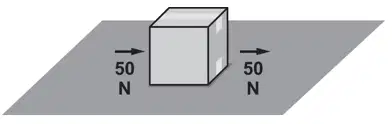
Look at the diagram of forces acting on an object. The picture shows a push and a pull acting on a box of books sitting on the floor. What is the net force toward the right on the box?
0 N
50 N
100 N
2,500 N
When two objects having different masses collide, they move away from each other at different speeds. Which is true of the forces exerted at the moment of impact?
The forces exerted when they collide are equal and opposing.
The forces exerted when they collide are unequal and opposing.
The forces exerted when they collide are equal and in the same direction.
The forces exerted when they collide are unequal and in the same direction.
The same force is applied separately to two objects, A and B. B is twice the mass of A. What happens?
B's acceleration is half that of A.
B's acceleration is twice that of A.
B's acceleration is one-fourth that of A.
B's acceleration is four times that of A.
You are sitting in a crowded movie theater waiting for friends. The following are ways that you could describe your location within the theater using reference points. Which description may be unreliable because of the reference point?
I am sitting near a theater worker, fifth seat from the side.
I am in the fifth row from the back, tenth seat from the right side.
I am in the sixth row from the front, tenth seat from the right side.
Which law states that the acceleration of an object depends on the mass of the object and the amount of force applied?
1
2
3
Which law states that when one object applies a force to a second object, the second object applies an equal and opposite force on the first object?
1
2
3
Which law states that unless acted on by an unbalanced force, an object at rest stays at rest and an object in motion stays in motion at a constant velocity?
1
2
3
Objects with _____ mass have _____ inertia than objects with less mass.
less, more
more, less
more, more
One marble is moving and collides with a stationary marble. Which of these statements is true?
Each marble exerts a force on the other, and the two forces are equal and in opposite directions.
Each marble exerts a force on the other, and the two forces are the same in magnitude and direction.
Each marble exerts a force on the other, and the two forces are proportional to the masses of the marbles.
The moving marble exerts a force on the stationary marble, but the stationary marble does not exert a force on the moving marble.
A soccer player kicks a ball. The player’s foot exerts a force on the ball. The ball exerts a force on the foot. Why don’t the forces cancel out to result in a net force of zero?
The ball moves before the forces can cancel out.
The forces become unbalanced due to air resistance.
The force on the ball is greater than the force on the foot.
The forces are exerted on different objects, and neither force is zero.
A golfer has a choice of several golf clubs with different masses that he can use to hit a golf ball. He can swing all the clubs at the same speed. If he wants to hit the golf ball as far as possible, which club should he choose?
the club with the greatest mass because it will have a greater acceleration
the club with the smallest mass because it will have a greater acceleration
the club with the greatest mass because it will provide the largest force to the golf ball
the club with the smallest mass because it will provide the largest force to the golf ball
Which two of these statements are true about the collision of two objects with different masses based on Newton's laws of motion?
Each object experiences an equal and opposite force.
The more massive object will exert a greater force on the less massive object.
Each object will accelerate in an opposite direction from the other but at a different rate.
The less massive object will accelerate due to the force of the collision, but the more massive object will not.
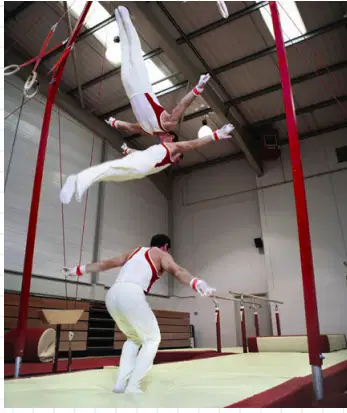
The mat in the photo helps protect the gymnast by ______ the duration of the collision between the gymnast and the floor.
increasing
decreasing
In a simple collision between two objects, Newton's laws of motion can be used to describe the motion of which of the objects?
Both objects
Only objects that are moving before the collision
Neither object
When the masses of two colliding objects are very different, the effect on the _______ object is greater than the effect on the ________ one.
larger, smaller
smaller, larger
A moving car backs into a parked car in a parking lot. Why would the bumpers on both cars be dented?
The parked car was made of weaker material than the car that was not moving.
The car that was moving was made of weaker material than the parked car.
When one car bumps into the other car, they collide with equal and opposite force.
The bumpers of both cars would not have become dented as a result of this minor collision.

