wayground logo

Free Printable Worksheets

NEW

Font size

S
M
L
XL
Worksheets

Unit 6 Review

Total questions: 64

Worksheet time: 5hrs 43mins

Name
Class
Date
1.
Simplify
a)
9
b)
√9
c)
3√9
d)
can't simplify
2.
Simplify:
√96
a)
16√6
b)
6√16
c)
9√6
d)
4√6
3.
Simplify the following radical: √32
a)
3√2
b)
4√8
c)
16√2
d)
4√2
4.
√48
a)
4√2
b)
6√3
c)
4√3
d)
4√2
5.
√125
a)
5√5
b)
25√5
c)
5√25
d)
5√2
6.
Simplify √60
a)
2√15
b)
12
c)
4√15
d)
3√5
7.
a)
11√5
b)
11√10
c)
5√5
d)
12√10
8.
a)
-5√1
b)
8√2 + 13√3
c)
21√5
d)
20√5
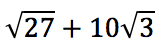
9.
a)
13√3
b)
10√30
c)
13√6
d)
11√3
10.
a)
√18 + 11√2
b)
22√5
c)
11√20
d)
14√2
11.
a)
0
b)
√5
c)
1
d)
-2√15
12.

 227+83+582\sqrt{27}+8\sqrt{3}+5\sqrt{8}  

a)

 24324\sqrt{3}  

b)

 243+5824\sqrt{3}+5\sqrt{8}  

c)

 143+10214\sqrt{3}+10\sqrt{2}  

13.
Add:  4√7 - 10 √7 + 7√7
a)
-6√7
b)
14√7
c)
-3√14
d)
√7
14.
√5 × √10
a)
50
b)
2√5
c)
5√2
d)
5√10
15.
√3 × √15 =
a)
3√5
b)
5√3
c)
2√7
d)
√17
16.
Simplify:
√6 ⋅√6
a)
√36
b)
2√3
c)
12
d)
6
17.
Simplify:
√10 ⋅ √45
a)
3√50
b)
8√2
c)
√450
d)
15√2
18.
Simplify  -2√10 ⋅ 3√20
a)
-60√2
b)
10√2
c)
√30
d)
-6√200
19.
(-2√7)(3√28)
a)
-6√14
b)
6√13
c)
-84
d)
-78
20.

 5(36)\sqrt{5}\left(3-\sqrt{6}\right)  

a)

 1530\sqrt{15}-\sqrt{30}  

b)

 35303\sqrt{5}-\sqrt{30}  

c)

 15-\sqrt{15}  

d)

 1518\sqrt{15}-\sqrt{18}  

21.

 2(41066)\sqrt{2}\left(4\sqrt{10}-6\sqrt{6}\right)  

a)

 8106128\sqrt{10}-6\sqrt{12}  

b)

 412684\sqrt{12}-6\sqrt{8}  

c)

 4206124\sqrt{20}-6\sqrt{12}  

d)

 851238\sqrt{5}-12\sqrt{3}  

22.

 (3410)(5+23)\left(3-4\sqrt{10}\right)\left(\sqrt{5}+2\sqrt{3}\right)  

a)

 35+632028303\sqrt{5}+6\sqrt{3}-20\sqrt{2}-8\sqrt{30}  

b)

 15+18450830\sqrt{15}+18-4\sqrt{50}-8\sqrt{30}  

c)

 388-3\sqrt{88}  

d)

 35+634508303\sqrt{5}+6\sqrt{3}-4\sqrt{50}-8\sqrt{30}  

23.

 (1032)(10+32)\left(10-3\sqrt{2}\right)\left(10+3\sqrt{2}\right)  

a)

 82282-\sqrt{2}  

b)

 206220-6\sqrt{2}  

c)

 100602100-60\sqrt{2}  

d)

82

24.

Find the area of the rectangle

a)

11

b)

22 3622\ -3\sqrt{6}

c)

22+422622+\sqrt{42}-2\sqrt{6}

d)

34+11634+11\sqrt{6}

25.
Which of the following equations matches standard form of a quadratic?
a)
ax + by = c
b)
y = a(x - h)2 + k
c)
y = ax2 + bx + c
d)
y = mx + b
26.
If we have the equation y=ax2+bx+c, how can we can find the x-coordinate of the vertex?
a)
-a
b)
-b/a
c)
b/2a
d)
-b/2a
27.
What is the vertex of y=x2+4x+3?
a)
(2,1)
b)
(-2,1)
c)
(0,0)
d)
(-2,-1)
28.
The axis of symmetry line passes through which point?
a)
y-intercept
b)
any random point
c)
vertex
d)
symmetrical point for the vertex
29.
A parabola has a vertex at (-3,2).
Where is the axis of symmetry?
a)
y = -2
b)
x = 3
c)
x = -3
d)
y = 2
30.
The graph of a quadratic function is called a
a)
Parabola
b)
Vertex
c)
Axis of Symmetry 
d)
Vertex Form
31.
What is the y-intercept of the following equation?
y=x2-3x-4
a)
y=1
b)
y=-4
c)
y=3
d)
y=-3
32.
Does the equation open up or down? 
Y = -3x2 +7x - 2
a)
up
b)
down
33.
What is the green dashed line called?
a)
roots or x-intercepts
b)
parabola
c)
axis of symmetry
d)
y intercept
34.
Which of the following parabolas will have a minimum?
a)
y = -x2 + 4
b)
y = -x2 + x - 3
c)
y = -x2 - 2
d)
y = x2 + 2x - 8
35.
Does the equation open up or down? 
Y = -3x2 +7x - 2
a)
up
b)
down
c)
Neither; it opens to the right.
d)
Neither; it opens to the left.
36.

How can you tell whether a parabola opens up or opens down by looking at the equation?

a)

The vertex tells you the direction of the opening

b)

The value of "a" tells you the direction of the opening.

c)

All parabolas open upward

d)

All parabolas open downward

37.

Identify A, B, and C if y=3x2-8+5x

a)

A=3, B=5, C=-8

b)

A=3, B=-8, C=5

c)

A=3x2, B=5x, C=-8

d)

A=3x2 , B=-8, C=5x

38.
Which of the following equations shows the vertex form of a quadratic?
a)
x = -b/2a
b)
x = (-b ±√b2 - 4ac)/2a
c)
y = ax2 + bx + c
d)
y = a(x - h)2 + k
39.
Determine the vertex of the parabola y=5(x-2)2–7
a)
(5, -7)
b)
(-2, -7)
c)
(2, -7)
d)
(-7, -2)
40.
Use the graph to determine the solutions.
a)
-1 and -3
b)
1 and -3
c)
1 and 3
d)
-1 and 3
41.
What is the vertex of the graph?
a)
(2, 4)
b)
(3, -1)
c)
(0, 8)
d)
(4, 2)
42.
What is the first step in solving 
(x + 2)(x - 3) = 0      ?
a)
Plug in zero for x
b)
Solve for x
c)
FOIL
d)
Set each binomial factor equal to zero
43.
Solve using Zero-Product Property.
(x+4)(x-3) = 0
a)
x = 4 and x = -3
b)
x = 2 and x = 1
c)
x = -4 and x = 3
d)
x = -2 and x = 1
44.
Solve by factoring: x2 + 3x - 18 = 0
a)
x = -3 and x = 6
b)
x = 3 and x = -6
c)
x = -9 and x = 2
d)
x = 9 and x = -2
45.
Solve:
x2 - 49 = 0
a)
x = -7, x = 7
b)
x = -7
c)
x = 7
d)
x = -7, x = 1
46.

How many solutions does this function have?

a)

two

b)

one

c)

all real numbers

d)

no real solutions

47.

How many solutions does this function have?

a)

two

b)

one

c)

all real numbers

d)

no real solutions

48.

How many solutions does this function have?

a)

two

b)

one

c)

all real numbers

d)

no real solutions

49.

What are the solutions to this function?

a)

x={-2,-1}

b)

x={-3,-1}

c)

x={-1,3}

d)

x={-1,-2}

50.

Which graph has the function  f(x)=(x+2)2f(x)=-(x+2)^2 ?

a)
b)
c)
d)
51.

Which graph has the function equation  f(x)=(x2)2+2f\left(x\right)=-\left(x-2\right)^2+2  

a)
b)
c)
d)
52.

 f(x)=(x+2)21f\left(x\right)=\left(x+2\right)^2-1  Which graph has the function equation

a)
b)
c)
d)
53.
"What is the maximum height the ball reaches?"
a)
vertex
b)
x-intercept
c)
y-intercept
d)
point on the graph
54.
"When does the ball hit the ground?"
a)
vertex
b)
x-intercept
c)
y-intercept
d)
point on the graph
55.
"How high off the ground was the stone when it started?"
a)
vertex
b)
x-intercept
c)
y-intercept
d)
point on the graph
56.
A soccer ball is kicked from the ground with an initial upward velocity of 90 feet per second. The equation h=-16t+ 90t gives the height h of the ball after t seconds.
What is the maximum height of the ball?
a)
126.56 ft
b)
5.625 sec
c)
2.81 sec
d)
90 ft
57.
A soccer ball is kicked from the ground with an initial upward velocity of 90 feet per second. The equation h=-16t+ 90t gives the height h of the ball after t seconds.
How many seconds will it take the ball to hit the ground?
a)
126.56 ft
b)
5.625 sec
c)
2.81 sec
d)
0 ft
58.
An object in launched directly upward at 64 feet per second (ft/s) from a platform 80 feet high. Its height is represented by the equation 
s(t) = –16t2 + 64t + 80.
What will be the object's maximum height? 
a)
2 ft
b)
80 ft
c)
144 ft
d)
64 ft
59.

The function f(t) = -5t2+20t + 60 models the approximate height of an object t seconds after it is launched. How many seconds does it take the object to hit the ground?

a)

4 seconds

b)

-2 seconds

c)

6 seconds

d)

9 seconds

60.
If each mark on the x-axis represents one second, when did the object reach the ground?
a)
2.5 seconds
b)
6 seconds
c)
5.5 seconds
d)
5 seconds
61.
A ball is thrown into the air with an upward velocity of 100 ft/s. Its height, h, after t seconds is given by the function
 h = -16t2 + 64t + 960.
How many seconds did it take for the ball to reach its maximum height?

a)
10 seconds
b)
64 seconds
c)
960 seconds
d)
2 seconds
62.
When I want to find the maximum or minimum height of an object, I should_____.
a)
Set the equation = 0 and solve.
b)
Use x = (-b/2a) as my answer.
c)
Substitute x = 0 into the equation.
d)
Find the y-coordinate for the vertex.
63.
If I want to find out when an object hits the ground, I should _________.
a)
Use x = (-b/2a) as my answer.
b)
Set my equation = 0 and solve.
c)
Replace x with 0 and evaluate.
d)
Find the y-coordinate of the vertex.
64.
If I want to see the initial height of an object, I should _____________.
a)
Substitute x = 0 into the equation and evaluate.
b)
Use x = (-b /2a) as my answer.
c)
Find the y-coordinate of the vertex. 
d)
Set my equation = 0 and solve.