wayground logo

Free Printable Worksheets

NEW

Font size

S
M
L
XL
Worksheets

Evolution via Natural Selection

Total questions: 40

Worksheet time: 2hrs 0mins

Name
Class
Date
1.
What is the advantage of having different shaped beaks?
a)
To look different from other species.
b)
To be able to eat the food readily available in the environment.
c)
To protect itself against predators.
d)
To protect itself against prey.
2.
Why are advantageous traits more likely to be passed onto offspring?
a)
Because they are more likely to survive and reproduce.
b)
Because they come from dominant alleles.
c)
Because they come from recessive alleles.
d)
Because the trait is an acquired phenotype.
3.
Why would a population with a large amount of genetic variation be more likely to survive a severe climate change in its environment?
a)
Individuals will only create offspring well-suited to the climate change
b)
The individuals would produce more offspring
c)
Individuals better suited to the new climate will help less-suited individuals survive
d)
Some individuals will posses traits better suited to the new climate and be more likely to pass them on
4.
Which of the following is a fossil?
a)
a plant that has recently died
b)
a group of organisms that can reproduce
c)
a structure or organ that no longer functions
d)
a trace of an organisms that existed in the past
5.
In natural selection, the selective agent is the
a)
humans
b)
mutations
c)
breeders
d)
environment
6.
Mutations are important because they bring about
a)
death of the organism in which they develop
b)
genetic variation needed for a population to evolve
c)
benefits for the individual, not for the population
d)
Hardey-Weinberg equilibrium within a population
7.
The Physical remains of a plant or animal preserved in rock or Earth's crust. 
a)
Adapt
b)
Fossil
8.
Charles Darwin came up with this theory 
a)
Natural Selection
b)
Mutation
9.
Darwin wrote that organisms with traits that are best suited to the environment will ________________
a)
increase in number
b)
become extinct
10.
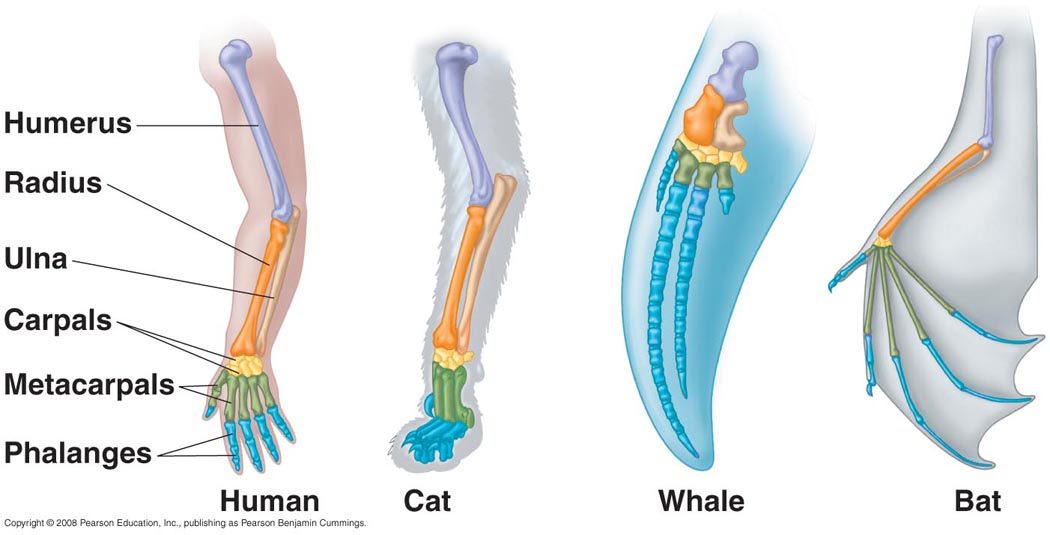
Some organisms that share a common ancestor have features that have different functions, but similar structures.  These are known as
a)
vestigial structures
b)
analogous structures
c)
homologous structures
d)
fossil structures
11.
Survival of the Fittest and Evolution were proposed by what scientist?
a)
Charles Darwin
b)
Albert Einstein
c)
Steven Hawking
d)
Isaac Newton
12.
The differences among a species, like different bird beaks, are called
a)
genes.
b)
variations.
c)
traits.
d)
theories.
13.
A change in DNA.
a)
Competition
b)
Mutation
c)
Species
d)
Fitness
14.

What characteristic did Darwin observe about the finches on the Galapagos Islands?

a)

Their feathers

b)

Genotypes

c)

Their beaks

d)

Their body sizes

15.

The environment around Manchester, England, changed during the Industrial Revolution. How did this change affect peppered moths living in the area?

a)

Natural selection favored moths with dark wings because predators could not see them on the soot-colored trees.

b)

Natural selection favored moths with white wings that were easy for predators to see.

c)

Natural selection favored moths with white wings because predators could not see them on the soot-colored trees.

d)

Natural selection caused moths with white wings to become extinct.

16.

What is this an example of?

a)

diversity of species

b)

variation

c)

vestigial structures

d)

DNA studies

17.

What is a change in an organism that allows for it to survive in its environment?

a)

homologous

b)

vestigial

c)

variation

d)

adaptation

18.
Do organisms "decide" to evolve and change?
a)
Yes, they know they need to change to survive 
b)
No, they change because of natural selection
19.

Why did the number of white peppered moths decrease so much by 1895?

a)

they did not blend in with the trees and birds ate them

b)

they tasted better to the birds than the black moths

c)

they were easier to reach on the trees

d)

white moths flew away to find better trees to blend in with

20.
Why did the population of moths change
a)
Predators were able to easily see their prey.
b)
People hunted lighter colored moths
c)
White moths were killed by the smoke from the factories
d)
Moths mood changed to sad, causing them to become dark
21.
When every organism of a species has died.
a)
Evolution
b)
Natural Selection
c)
Extinction
d)
Artificial Selection
22.

Why do moths and other organism reproduce so many eggs or offspring?

a)

so that their babies can have friends to play with

b)

the more offspring the more likely the offspring will survive

c)

the more offspring the less likely offspring will survive

d)

the more offspring the less competition

23.
The theory of evolution by natural selection means that what is changing over time?
a)
The inherited traits of a population.
b)
The acquired traits of a population.
c)
Hair color and eye color
d)
Attractive features.
24.
Natural selection is the process by which
a)
change occurs in the genetic characteristics of individuals that live together in an environment from one generation to another
b)
organisms with traits well-suited to their environment reproduce at a greater rate than less well-adapted organisms in the same environment
c)
use and disuse of a characteristic leads to evolutionary change
d)
baseball players pass on the trait for strong arm muscles to children
25.

What is "survival of the fittest"?

a)

Being the strongest

b)

Being able to survive and produce offspring

c)

Being the smartest

d)

Being able to collect as much resources as possible

26.
A relative who lived in the past.
a)
Charles Darwin
b)
Speciation
c)
Ancestor
d)
Descendant
27.
An original species from which all other species evolved.
a)
Fossil
b)
Natural Selection
c)
Descendant
d)
Common Ancestor
28.
The information provided by fossils about the Earth's history.
a)
Fossil Record
b)
Extinction
c)
Evolution
d)
Genetic Variation
29.

Which of the following is a factor in natural selection?

a)

Individuals of species compete with one another to survive.

b)

All species are genetically diverse.

c)

Individuals better able to adapt to changes leave more offspring.

d)

All of the above.

30.

Structures with the same parts but have different functions, suggesting that organisms with a backbone share common ancestry is called…

a)

Not related

b)

Not homologous

c)

Homologous

d)

Young in origin

31.

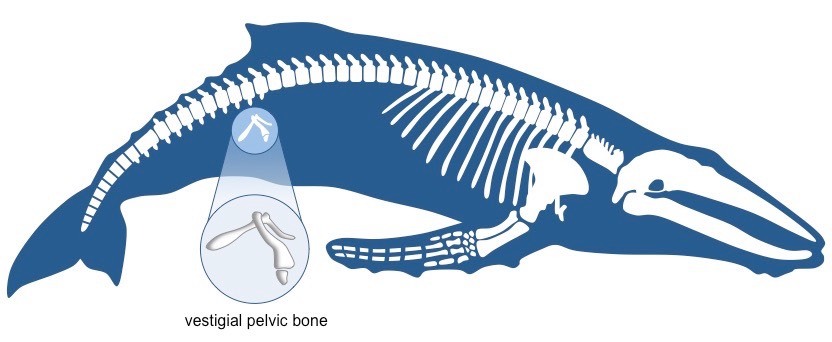
The presence of pelvic bones in the baleen whale is evidence of which of the following?

a)

Whales can travel on land when necessary.

b)

Whales are developing into animals with four functioning limbs.

c)

Whales have functional legs that are hidden by fat and skin.

d)

Whales evolved from four-legged animals.
32.
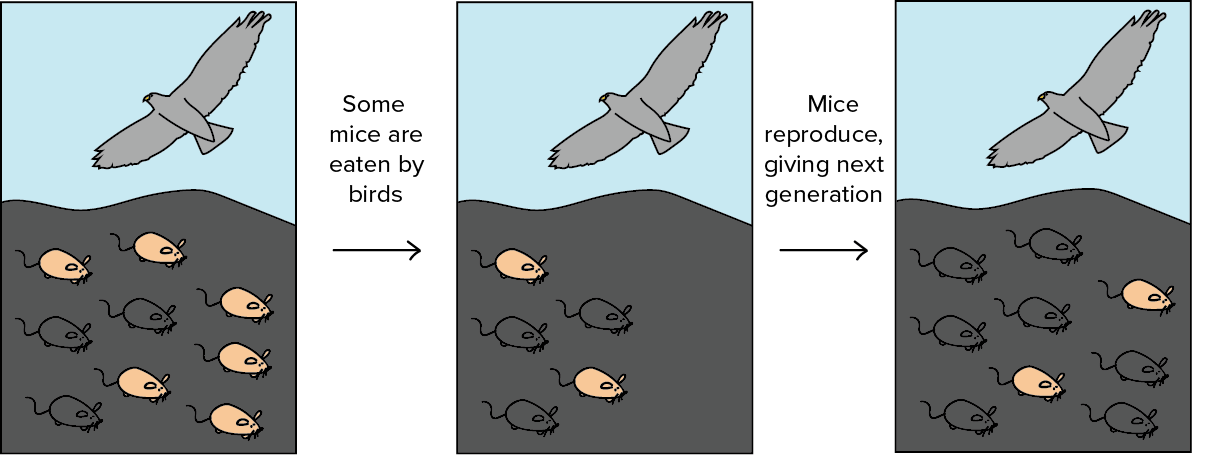
Why is the mouse population changing over time?
a)
The light mice can reproduce more successfully than the dark mice
b)
The hawks eat more dark mice than light mice because the dark mice taste better
c)
The hawks eat more light mice than dark mice because they can see the light mice more easily
d)
The hawks eat more dark mice than light mice because they can see the dark mice more easily
33.

organs or skeletal elements of animals and organisms that, by virtue of their similarity, suggest their connection to a common ancestor. These structures do not have to look exactly the same, or have the same function.

a)

Analogous Structure

b)

Homologous Structure

c)

Vestigial Structure

d)

Molecular Homology

34.

Similar embryological development in different organisms indicating a common ancestry or evolutionary origin.

a)

Molecular Homology

b)

Morphology

c)

Adaptation

d)

Embryology

35.

If you know the age of a rock, you know the relative age of the _________________ that was found inside.

a)

sticky tar

b)

fossil

c)

amber

d)

ice

36.

Which of the following can be learned by using the fossil record?

a)

When organisms changed or evolved

b)

when organisms appeared on Earth

c)

when organisms became extinct

d)

All the above

37.

What are the oldest fossils and why?

a)

B, C- because they are closest to the top

b)

A, B- because they are closest to the bottom

c)

They are all the same age- because they are all found on layer 2

d)

A, B- because they are found closest to the top

38.

Geologists use radioactive dating to..

a)

determine the "actual" ages of rock layers.

b)

tell the difference between molds and casts.

c)

tell where one soil horizon ends and the next one begins.

d)

determine the absolute ages of rocks.

39.

In which kind of rock do we usually find a fossil?

a)

sedimentary rock

b)

metamorphic rock

c)

igneous rock

40.

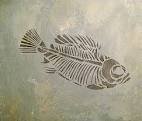
If scientists found this fossil, what could they infer?

a)

what fish are like today

b)

that this fish lacked oxygen

c)

that water once covered the area where this fossil was found