wayground logo

Free Printable Worksheets

NEW

Font size

S
M
L
XL
Worksheets

The Cardiovascular System

Total questions: 68

Worksheet time: 40mins

Name
Class
Date
1.

The heart has _____ atria.

a)

1

b)

2

c)

3

d)

4

2.

The heart has _____ ventricles.

a)

1

b)

2

c)

3

d)

4

3.

The atria are the _________ chambers in the heart.

a)

upper

b)

bottom

c)

right-sided

d)

left-sided

4.

The ventricles are the ___________ chambers of the heart.

a)

upper

b)

bottom

c)

right-sided

d)

left-sided

5.

The largest ventricle in the heart is the ______ ventricle.

a)

left

b)

right

6.

Choose the answer that best explains WHY the left ventricle is the largest ventricle.

a)

The left ventricle pumps blood out to the entire body and because of this, the muscle is larger; the right ventricle only has to pump blood out to the lungs.

b)

The right ventricle is compressed by lung tissue during fetal development and therefore, it is smaller.

7.
Which of the following delivers oxygen to cells?
a)
Red Blood cells
b)
White blood cells
c)
Platelets
d)
Plasma
8.
Which of the following are the blood vessels that helps blood flow to the heart?
a)
Veins
b)
Arteries
c)
Cappillaries
9.
Which of the following are the blood vessels that have a wall that is 1 cell thick?
a)
Veins
b)
Arteries
c)
Cappillaries
10.
Which of the following are the blood vessels that have the thickest walls?
a)
Veins
b)
Arteries
c)
Cappillaries
11.
Blood enters the heart at the ....
a)
Right Atrium
b)
Left Atrium
c)
Right Ventricle
d)
Left Ventricle
12.
What is the name of the part labelled 3?
a)
Right Atrium
b)
Left Atrium
c)
Right Ventricle
d)
Left Ventricle
13.
What is the name of the part labelled 2?
a)
Right Atrium
b)
Left Atrium
c)
Right Ventricle
d)
Left Ventricle
14.
What is the name of the part labelled 4?
a)
Right Atrium
b)
Left Atrium
c)
Right Ventricle
d)
Left Ventricle
15.
What is the function of a valve?
a)
Helps blood to clot
b)
Keeps blood flowing in all directions
c)
Keeps blood flowing in one direction
d)
Stops blood from flowing
16.
Which vessels carry blood away from the heart?
a)
arteries
b)
veins
c)
capillaries
17.
Which part of the heart pumps deoxygenated (oxygen-poor) blood?
a)
Left side
b)
Right side
c)
Top side
d)
Bottom side
18.
Which is the muscular wall that separates the heart into right and left sides?
a)
valves
b)
ventricles
c)
atria
d)
septum
19.
Oxygen-poor blood arrives to the heart from the the body via the _____.
a)
aorta
b)
pulmonary arteries
c)
superior and inferior vena cava
d)
pulmonary veins
20.
A hollow, muscular organ that pumps blood throughout the body.
a)
Skeleton
b)
Heart
c)
Vein
d)
Artery
21.
Another name for the circulatory system is __________________________________________ because they describe the system that consists of the heart, blood vessels, and blood.
a)
Cardiovascular System
b)
Heart
c)
Vein
d)
Artery
22.
Pulmonary vein
a)
carries oxygenated blood to left atrium
b)
carries deoxygenated blood to left ventricle
c)
carries oxygenated blood to left ventricle
d)
carries deoxygenated blood to left atrium
23.
Which part of the heart is this?
a)
Aorta
b)
Pumonary Vein
c)
Pulmonary Artery
d)
Left Atrium
24.
Which part of the heart is this?
a)
Pulmonary Vein
b)
Pulmonary Artery
c)
Right Atrium
d)
Tricuspid Valve
25.
The heart is
a)
A double pump
b)
Myogenic
c)
Generates its own electrical pulse
d)
All of the above
26.
During the Cardiac Cycle, Ventricular systole is when what happens?
a)
The Left Ventricle contracts
b)
When the Right Ventricle contracts
c)
When the Atria contract
d)
When both Ventricles contract
27.
During the Cardiac Cycle the diastole phase is when?
a)
The heart is fully contracted
b)
The heart is fully relaxed
c)
When the atria are relaxed and Ventricles contracted
d)
All of the above
28.
The number of times the heart Ventricles beat in one minute is known as?
a)
Heart Rate
b)
Stroke Volume
c)
Cardiac Output
29.

Which of the following is NOT a function of the cardiovascular system?

a)

Transport Oxygen and Carbon Dioxide to and from the respiratory system

b)

Transport nutrients and waste to and from the digestive system

c)

Break down food into nutrients for the body

d)

Maintain homeostasis by regulating body temperature

30.

The double walled sac that surrounds the heart is called the:

a)

Arteries

b)

Valves

c)

Pericardium

d)

Chambers

31.

What type of blood do the Vena Cava carry?

a)

Oxygenated

b)

Deoxygenated

32.

What type of blood travels through the aorta?

a)

Oxygenated

b)

Deoxygenated

33.

What does the root word "pulmo" mean?

a)

Heart

b)

Lungs

c)

Aorta

d)

Blood

34.

What part of the heart acts like doors to prevent the blood from traveling backwards?

a)

Veins

b)

Arteries

c)

Aorta

d)

Valves

35.

After leaving the heart through the pulmonary artery the blood travels to this organ to pick up oxygen

a)

Stomach

b)

Lungs

c)

Liver

d)

Atrium

36.

These blood cells protect from infections:

a)

Red Blood Cells

b)

White Blood Cells

c)

Plasma

d)

Platelets

37.

What is in blood that are cell fragments that help in the process of clotting?

a)

Red blood cells

b)

White blood cells

c)

Plasma

d)

Platelets

38.
True Or False : Blood That Has Carbon Dioxide Goes Back To The Heart And Then To The Lungs 
a)
False
b)
True
c)
Fasle
d)
Ture
39.
the movement of blood through the heart and body is called?
a)
Ventricular
b)
Locomotion
c)
Heart Pump
d)
Circulation
40.

The fluid in which other parts of the blood are suspended

a)

Platelets

b)

Blood

c)

Plasma

d)

Hemoglobin

e)

White Blood Cells

41.

The fluid that delivers oxygen, hormones, and nutrients to the cells and carries away wastes

a)

Platelets

b)

Blood

c)

Plasma

d)

Hemoglobin

e)

White Blood Cells

42.

The oxygen-carrying protein in blood

a)

Platelets

b)

Blood

c)

Plasma

d)

Hemoglobin

e)

White Blood Cells

43.

Small vessels that carry blood from arterioles and to small vessels called venules which then empty into veins

a)

Arterioles

b)

Arteries

c)

Veins

d)

Venules

e)

Capillaries

44.

The primary cardiac pacemaker

a)

SA Node

b)

AV Node

c)

Bundle of His

d)

Thorel pathways

45.
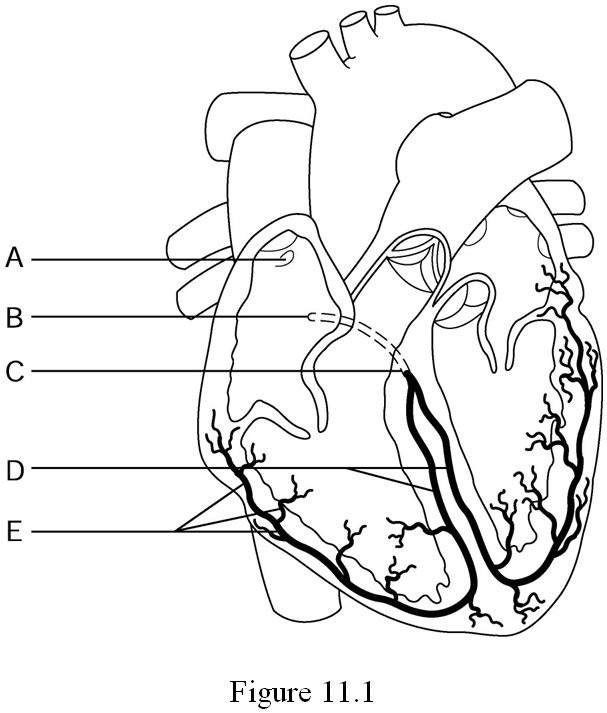
The AV node is located at...
a)
A
b)
B
c)
C
d)
D
46.
An EKG is actually
a)
A ratio
b)
An equation
c)
A time frame
d)
A graph 
47.
An electrocardiogram measures what?
a)
The amount of pressure exerted on blood vessels.
b)
The electrical activity of the heart.
c)
How many times the heart contracts over time.
d)
The body's temperature caused by friction of blood in vessel.
48.
Which of the following is not a direct indicator of a person's cardiac health?
a)
Heart Rate
b)
Blood Pressure
c)
EKG
d)
Temperature 
49.
Which contract in unison??
a)
Top chambers, then bottom chambers.
b)
Right Chambers, then the Left Chambers
c)
All four chambers beat in unison.
50.

#1

a)

superior vena cava

b)

inferior vena cava

c)

aorta

d)

pulmonary artery

51.

#14

a)

superior vena cava

b)

inferior vena cava

c)

pulmonary veins

d)

apex

52.

#2

a)

pulmonary artery

b)

pulmonary veins

c)

aorta

d)

superior vena cava

53.

#12

a)

tricuspid valve

b)

mitral/bicuspid valve

c)

aortic valve

d)

pulmonary valve

54.

#7

a)

mitral/bicuspid valve

b)

tricuspid valve

c)

aortic valve

d)

pulmonary valve

55.

#4

a)

pulmonary valve

b)

aortic valve

c)

mitral/bicuspid valve

d)

tricuspid valve

56.

#15

a)

superior vena cava

b)

inferior vena cava

c)

aorta

d)

septum

57.

#6

a)

pulmonary valve

b)

aortic valve

c)

mitral/bicuspid valve

d)

tricuspid valve

58.
Order the phases an action potential travels in the conduction system
a)
SA node--> AV bundle branches--> AV node--> Purkinje fibers
b)
SA node--> AV node--> AV bundle branches-->  Purkinje fibers
c)
Av bundle branches--> AV node--> SA node--> Purkinje fibers
d)
Purkinje fibers--> SA node--> AV node--> AV bundle branches
59.
What is wrong with this strip?
a)
Tachycardia
b)
Elevated ST segment
c)
No P wave
d)
Wide QRS complex
60.
Abnormal or unusual heart sounds.
a)
Congestive heart failure (CHF)
b)
Heart murmurs
c)
Bradycardia
d)
Tachycardia
61.

Which label is representing the Purkinje fibers?

a)

A

b)

C

c)

D

d)

E

e)

B

62.

What area of the heart's electrical conduction is known as the "pacemaker" of the heart?

a)

Purknife fibers

b)

SA node

c)

Bundle of his

d)

Interventricular Septum

63.

True or False: The AV node is located in the left atrium.

a)

True

b)

False

64.

True and False: The SA node is located in the left atrium.

a)

True

b)

False

65.
 This triggers contraction in the atria
a)
SA node
b)
AV node
c)
QT node
d)
AV Bundles
66.
The pointed, inferior portion of the heart, known as the ________ rests on the diaphragm and is oriented towards the left hip.
a)
base
b)
mediastinum
c)
apex
d)
pericardium
67.

Which of the following is the correct definition of Ischemia?

a)

lack of adequate blood supply to the heart muscle

b)

a rapid uncoordinated quivering of the ventricles

c)

rapid heart rate over 100 beats per minute (bpm)

d)

heart rate that is substantially slower than normal, less than 60 beats per minute (bpm)

68.

What is the final destination of the electrical impulse in the heart?

a)

Purkinje Fibers

b)

SA & AV Nodes

c)

Bundle Branches

d)

Superior Vena Cava