
 Worksheets
ENVIRONMENTAL SCIENCE MID TERM EXAMINATION
Total questions: 100
Worksheet time: 2hrs 44mins
Fossil fuels are nonrenewable because...
they are used to produce heat
they take a long time to form
they can be found underground
none of the above
What does conserving resources mean?
Use as much of the resources as you can
Only use the resources at school
Protecting the resource so it does not run out
none of the above
Any useful material that is found in nature:
Natural Resource
Human Resource
Plants
all of the above
Diamonds and other minerals
Nonrenewable
Renewable
both renewable and nonrenewable
none of the above
We dig metal out of the Earth to make steel for buildings, cars, and buses. Metal is a nonrenewable resource.
True
False
neither true nor false
always true or false
What is a natural resource?
Resources we get from our house
Resources we get from people
Resources we get from nature
all of the above
The three R's stand for:
rebuild, reconstruct, reuse
red, reduce, rainbows
reduce, reuse, recycle
redo, recall, remove

Resources that are not able to be reproduced as quickly as they are used are called _____.
renewable resources
replaceable resources
non renewable resources
non replaceable resources
Geothermal energy uses heat from ____ to produce electricity.
the earth
the coal
the oil
the natural gas
Renewable resources ...
are not replaceable
are used more frequently than non renewables
are never going to run out
going to run out
What type of power plant uses the potential energy of water trapped behind a dam?
nuclear power plant
hydroelectric power plant
solar station
tidal harness
What are fossil fuels?
coal, oil, uranium
oil, natural gas, uranium
coal, oil, natural gas
geothemals, coal, natural gas
What type of power plant uses scraps from farming and waste products to generate electricity?
Hydroelectric Power Plant
Geothermal Power Plant
Biomass Power Plant
Nuclear Power Plant
Why do we tend to use non-renewable resources instead of renewable resources?
Less Expensive
More Energy
All of these
readily available
What is the disadvantage of using non-renewable resources?
They have a large carbon footprint.
They can all be used up over time.
They can lead to global warming.
All of these.
Which of the following has the greatest efficiency out of all of the natural resources?
hydroelectric
fossil fuels
solar
geothermal
Which of the following can be a disadvantage of renewable resources?
They can be intermittent (only available at certain times or in certain places).
They release a lot of CO2 and have a large carbon footprint.
They are renewable and will always be available.
Renewable resources have no disadvantages.

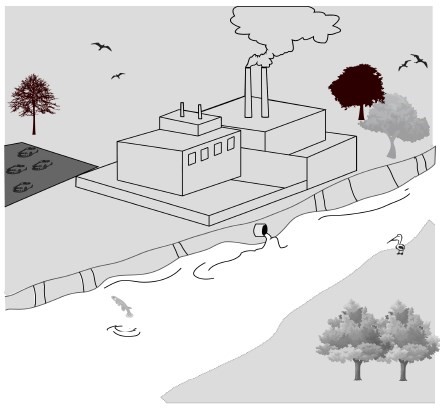
If the factory in this diagram was NOT practicing good environmental conservation, what effect would be produced?
air and water pollution
good fishing for recreation
plentiful animals in the river
purified drinking water
What does conserving resources mean?
Use as much of the resources as you can
Only use the resources at school
Protecting the resource so it does not run out
none of the above

Claim: the consumption of natural resources by humans has a negative impact on the environment. What data would provide evidence for this claim?
Increased human lifespan and increased ice cap size
Increased human population and decreased habitats for plants and animals
Increased consumption of resources by humans and increased biodiversity (variety) in nature
Increased of fossil fuel burning by humans and decreased use of other resources

Some factories that burn coal produce smoke with harmful chemicals, such as sulfur. Scrubbers are devices that are attached to the smokestacks to reduce the amount of sulfur put into the atmosphere. To evaluate the effectiveness of these devices, what data would need to be collected?
The average amount of sulfur in a certain amount of coal
The amount of coal a factory burns each year and how much sulfur it emits (produces)
The increase in the use of scrubbers by factories that burn coal
The amount of sulfur emitted (produced) by a smokestack before and after the scrubber is attached

Ths graph presents data from a city showing the amount of land used to bury solid waste each year. From 1990 to 1999, the amount of space needed to bury waste increased by 1 to 2 square kilometers per year. In the year 2000, the city started a recycling program to slow the increase of land needed for this burying this solid waste. The city claims that since this recycling program started, the amount of land needed for burying solid waste has decreased.
Which evidence would support this claim?
Data showing that by the year 2010, more than 40% of the citizens were participating in the recycling program
Data showing that the land used for burying solid waste in 2010 was less than 22 square kilometers
Data showing that by the year 2010, there was five times more solid waste being buried than being recycled
Data showing that the land used to build a recycling facility is greater than the amount of land used to bury solid waste
As the human population increases, so does the consumption of natural resources. What are some ways this impacts natural ecosystems and environments?
negative impact
positive impact
neutral impact
none of the above
What type of data would be required to show that the
amount of carbon dioxide emissions from the burning of fossil fuels for energy can be reduced by using
renewable resources?
the number of emissions from the burning of fossil fuels
the number of scrubbers on a smokestack
the number of emissions from nonrenewable sources
the amount of renewable resources in a landfill
The people or animals living in a particular area.
population
species
community
consumer
The _____________ the human population, the ______________ the amount of resources being used.
greater, greater
greater, least
least, greater
least, least
How forests increase the atmosphere’s humidity?
By Transpiration
By photosynthesis
By nitrogen fixation
By evaporation
Which one of the following is not considered a consequence of deforestation?
Desertification
Food Shortage
Displacement of local communities
Biodiversity enrichment
forest have _____ vegetation
scattered
man made
natural
none of the above
roots of trees prevent ______ erosion
water
soil
air
rain
The kind of trees that grow in a forest depend on the
climate of the area
soil of the area
All of the above
none of the above
Which of these is not true about forests?
Provide home to animals
help in causing rainfall
prevent soil erosion
purify air by absorbing oxygen and releasing carbon dioxide
The removal of soil by wind or water is known as
Soil Conservation
Soil Protection
Soil Erosion
Soil Processing
which one of the following is not a form of abiotic resource ?
forests
land
minerals
none of the above
What is the variety of ecosystems that are present in the biosphere?
species diversity
genetic diversity
ecosystem diversity
biodiversity

the breaking of habitats into smaller pieces is called...
habitat division
habitat pollution
habitat corruption
habitat fragmentation

have the ability to interbreed.
The Island of Cebu is part of what faunal region of the Philippines?
Greater Luzon
Palawan
Greater Negros-Panay
Bohol
Cebu tamaraw (Bubalus cebuensis) is considered as:
rare species
endangered species
extinct species
vulnerable species
Cebu warty pig (Sus cebifrons cebifrons) "baboy ihalas" is considered as:
rare species
vulnerable species
extinct species
endangered species
Lepeostegeres cebuensis is described as a new species from Cebu Island is a/an
mistletoe
tree
herb
grass
Cynometra cebuensis a new species of Caesalpiniaceae described by Franz Siedensharz in 2013. It is only found in _________________________.
Mt. Lantoy, Argao, Cebu
Tabunan Forest, Cebu City
Mt. Lanaya, Carmen, Cebu
Mt. Mayana, Barili, Cebu
Cebu Cinnamon Cinnamomum cebuense (Kost.1986) locally called Kaningag/Kalingag, is an ________ tree species on the island of Cebu
declared as a __________________ plant species by the International Union for the Conservation of Nature (IUCN) and Department of Environment and Natural Resources (DENR) under DAO 2007-1 (Paguntalan, et al., 2015)
exotic, endangered
exotic, critically extinct
exotic, extinct
endemic, critically endangered
Bicknell’s Hoya is discovered by David Bicknell in June 1998 in __________________.
Carmen, Ceu
Argao, Cebu
Badian Cebu
Cebu City
Anayoto or Dicaeum quadricolor is one of the most CRITICALLY Endangered bird species in the world can only be found on the island of?
Mindanao
Bohol
Siquijor
Cebu
Cebu Hawk Owl-Kuwago Ninux rumseyi, ____________ Endangered bird species and considered distinct species of hawk owl in 2013.
critically
threatened
all of the above
none of the above
Cebu black shama Copsychus cebuensis also known as ______________. Endangered endemic bird with a recent recorded large population in Nug-as Forest. This bird species preferred understory thickets of remaining forest patches.
kuwago
siloy
tagmaya
bali-ala
Cebu Brown-dove Phapitreron frontalis is declared as a distinct of brown dove species and endemic to Cebu Island in 2014. CRITICALLY endangered endemic bird. It is locally called?
alimukon
tagmaya
siloy
korokotok
Philippine Bare-backed fruit bat Dobsonia chapmani
was recorded in Cebu and Negros only and thought to be extinct in Cebu when it was rediscovered in Mt. Kapayas Carmen, Cebu in 2001 and is currently declared as _____________ endangered bat species.
endemic
rare
critically
vulnerable
Golden crowned- flying fox Acedoron jubatos
is one of the heaviest bat in the world, declared as CRITICALLY endangered bat species. Recently recorded in Malones, Dalaguete roosting in a tree together
with 3 other species of fruit bat. It is locally called?
kwaknit
kabog
galansiyang
tagmaya
Philippine tube-nosed fruit bat Nyctemine rabori
is declared as ______________ endemic bat species found only in Cebu, Negros and Sibuyan Islands. Recently recorded in Mt. Kapayas, Tabunan Forest, Nug-as Forest, Mt. Lanaya, Mag-alambak, Dalaguete, Kawasan, Badian and Canbantug and Cansuje, Argao.
critically
locally
all of the above
none of the above
Sicyopus cebuensis is declared as extinct by DENR (2015), was first documented in Naga, River in 1998 by Chen and Shao. Type of Goby fish that is considered to be one of the smallest in the world. The fish thrive in?
salt water
fresh water
none of the above
all of the above
Cebu Small Worm Skink Brachymeles cebuensis
Endemic skink species found in Cebu collected by Brown and Rabor (1997) in the localities of Tapal, Mantalongon, Barili, and in Buhisan Forest in Cebu City. Skink species are?
mammals
fish
reptiles
amphibians
Tabunan Risiocnemis - Alisoysuy Risiocnemis seidenschwarzi A new species of damselfly endemic in Cebu discovered along a small creek flowing out in Tabunan Forest. It was scientifically described by Dr. Matti Hamalainen and was named in honor of Dr. Franz Seidenschwarz. It is a/an?
mammal
insect
reptiles
bird
Kawasan Paper Kite Butterfly - Kaba-kaba
Idea leuconoe jumaloni Sub specie of Idea leoconoe specie of butterfly A new specie of butterfly endemic in Cebu discovered along Kawasan River inMatutinao, Badian. It was scientifically described by Collin G. Treadaway and was named in honor of the late Julian Jumalon, Cebu’s known lepidopterist. Does a lepidopterist collect?
insects
mammals
all of the above
none of the above

