wayground logo

Free Printable Worksheets

Font size

S
M
L
XL
Worksheets

Biodiversity Grade 6 FI

Total questions: 30

Worksheet time: 17mins

Name
Class
Date
1.

Classification is the process of grouping living things, based on:

a)

what they look like (colour, height, weight)

b)

their agespan

c)

shared ancestry (think of it as their family - WAY back)

d)

if they have vertebrae or not

e)

none of the above

2.

The Greek philosopher Aristotle for example, attempted to classify living things as either

a)

alive or dead

b)

big or small

c)

living on land or in water

d)

are plants or animals

e)

none of the above

3.

The classification system originally developed by Linnaeus, which is still used today, consists of a system of groups called

a)

categories

b)

taxa

c)

animals

d)

groups

4.

Biodiversity includes diversity of

a)

individuals

b)

species

c)

ecosystems

d)

car names (eg. Mustang, Ram, Beetle, Jaguar, Viper..)

5.

Humans make choices that can have an impact on biodiversity.

a)

True

b)

False

6.

Invertebrates have

a)

backbones (vertebrae)

b)

fun when they're out with their friends

c)

five syllables in their name

d)

no spinal column

7.

The prefix Bio- means

a)

biology

b)

alive

c)

life

d)

the study of something

8.

An animal's qualities are listed below:

ANIMAL'S QUALITIES

● Moist skin

● Has four legs

● Lays eggs

● Breathes with lungs and gills

● Cold blooded


What type of animal is described in the box?

a)

amphibian

b)

fish

c)

mammal

d)

reptile

e)

bird

9.

Which of the following organisms is a vertebrate?

a)

insect

b)

sponge

c)

monkey

d)

earthworm

10.

What trait do all mammals share?

a)

walk upright

b)

have an opposable thumb

c)

have large brains

d)

nurse their young with milk

11.

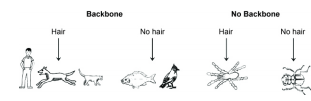
According to the classification key above, which pair of animals could be classified as mammals?

a)

humans and dogs

b)

birds and fish

c)

birds and fish

d)

cats and birds

12.

Fish, amphibians, reptiles, birds and mammals all

belong to which group?

a)

vertebrate

b)

invertebrate

c)

bacteria

d)

vertebrate and invertebrate

13.
Which kingdoms make their own food?
a)
plant, animal, algae
b)
plant, animal, fungi
c)
plant, algae, bacteria
d)
plant, protozoa, bacteria
14.
Which kingdoms eats other living things?
a)
Animales, protozoa, plants, bacteria
b)
Animales, protozoa, fungus, bacteria
c)
Animales, algae, plants, bacteria
15.
Fungus can be unicellular or muliticellular
a)
true
b)
false
16.
Mushrooms are...
a)
fungus
b)
protozoa
c)
bacteria
d)
plant
17.

HOW MANY ORGANISMS EXIST IN THE WORLD?

a)

HUNDRED

b)

THOUSAND

c)

MILLIONS AND MILLIONS

18.

HOW MANY KINGDOMS LIFE-FORMS ARE GROUPED?

a)

THREE

b)

THOUSANDS

c)

MILLIONS

d)

FIVE

19.

ALL ORGANISMS ARE FORMED OF?

a)

CELLS

b)

MICROORGANISMS

c)

FUNGI

20.
Which is a non-living thing?
a)
rock
b)
bush
c)
grass
d)
goldfish
21.
In the food chain, which of the pictures is a PRODUCER?
a)
Sun
b)
Plants
c)
Ladybug
d)
Chicken
22.
__________ make their own food. 
a)
Producers
b)
Consumers
c)
Carnivores
d)
Herbivores
23.
________ get there energy from eating other organisms. 
a)
Producers
b)
Consumers
c)
Carnivores
d)
Herbivores
24.
An animal called a divo lives on an island. This island is the perfect ecosystem for the divo because it has its only food, tree ants. One winter it got very cold and all the tree ants died. What will happen to the divos?
a)
their fur grew longer and thicker
b)
they dug holes and lived underground
c)
they died
d)
they switched to eating seeds
25.
What would happen is rabbits from a warm, southern climate were moved to a cold, northern climate?
a)
ALL of the rabbits will try to adapt to the change
b)
MOST of the rabbits will try to adapt to the change 
c)
FEW OR NONE will adapt to the change
26.
What term describes all living factors in an environment?
a)
abiotic
b)
zoological
c)
biotic
d)
biological
27.
What term describes all nonliving factors in an environment?
a)
abiotic
b)
zoological
c)
biotic
d)
biological
28.
A community of organisms and their abiotic, or nonliving environment is called ---
a)
ecology
b)
ecosystem
c)
population
d)
community
29.
The place where an organism lives that provides it with shelter, food and water.
a)
ecosystem
b)
population
c)
community
d)
habitat
30.
Deserts, mountains, and rivers are all examples of ________.
a)
vacation spots
b)
tundra
c)
ecosystems
d)
wetlands