
 Worksheets
Unit 5: Thermochemistry Review
Total questions: 32
Worksheet time: 39mins
The amount of heat needed to raise the temperature of 1 gram of a substance by 1 C degree is called
heat of fusion
heat of vaporization
specific heat
change in temperature
Exothermic is expressed as
-q meaning heat in
-q meaning heat out
+q meaning heat in
+ q meaning heat out
delta T is calculated by
Ti - Tf
Tf - Ti
Heat flows from ________ temperature areas to ______ temperature areas.
high, low
low, high
Thermal equilibrium occurs when heat flows between hot and cold materials until they reach the same temperature.
True
False
Melting is an __________ process.
exothermic
endothermic
How is heat energy transferred between two objects that are at different temperatures?
The object at a lower temperature pulls heat energy from the warmer object.
Heat flows from the warmer object to the cooler object until they reach the same temperature.
Heat flows from the object that has less thermal energy to the object that has more thermal energy.
Heat flows back and forth equally between the two objects until they reach the same temperature.
Which of these phase changes is an endothermic process?
condensation
freezing
evaporation
All phase changes are endothermic.
Which of the following is NOT a unit of heat?
joules
calories
degrees Celsius
All are units of heat.
What is the amount of heat required to raise the temperature of 200.0 g of aluminum by 10.0 ∘ C?
(specific heat of aluminum = 0.878 J/g ∘ C)
176 J
1 760 J
17 600 J
176 000 J
Which of the following statements is FALSE?
Particles are in constant motion.
Particles slow down when heated.
Particles of matter frequently collide with other particles.
What is the symbol for heat?
Q
t
m
C
What unit do you use to measure heat?
J/Kg ºC
Kg
ºC
J


The melting point of the sample is
-60 ºC
-100 ºC
60 ºC
100 ºC

Given the heating curve of a solid being heated at a constant rate, what is the boiling point of this substance?
20°C
50°C
110°C
170°C

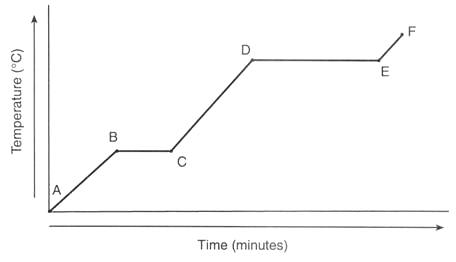
Given the heating curve of water, what is happening to potential and kinetic energy during segment CD?
the potential energy and kinetic energy both increase
the potential energy increases while the kinetic energy decreases
the potential energy is constant while the kinetic energy increases
the potential energy increases while the kinetic energy is constant

Given the heating curve for water, during which line segment could I find water in both the solid and liquid phase at the same time?
AB
BC
CD
DE
EF
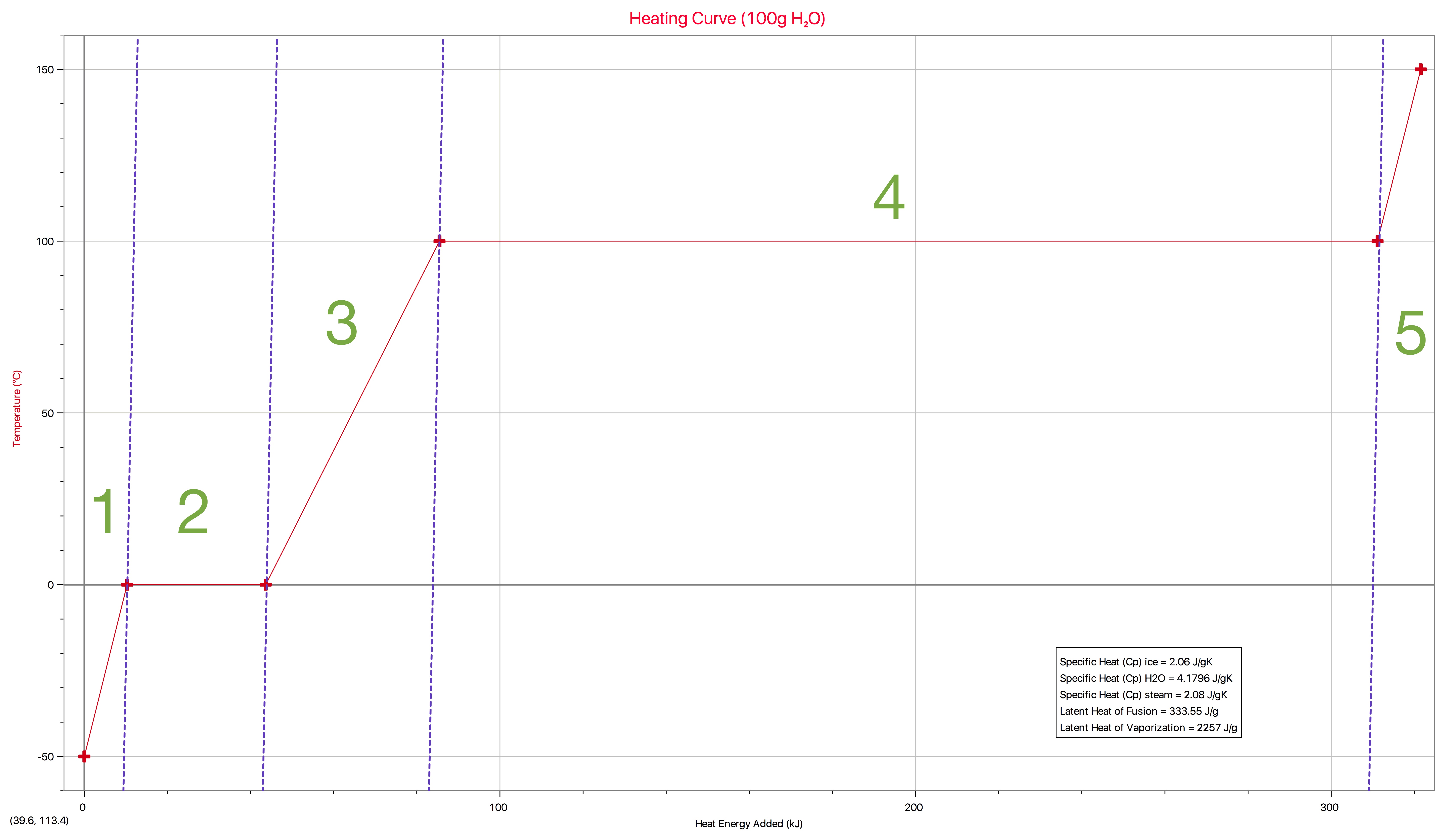

This curve indicates what about the heat energy?
Heat energy is being added or absorbed
Heat energy is being released
the energy required to change phase from liquid to gas
heat of vaporization
heat of fusion
the energy required to change phase from solid to liquid
heat of vaporization
heat of fusion
Temperature does NOT change during a phase change.
True
False
For a skillet, used for cooking, do you want a high or low specific heat
High, so that it will need more energy to heat up
Low, so that it will change temperature quickly

