
 Worksheets
UNIT 8 - QUIZ # 1
Total questions: 18
Worksheet time: 1hrs 7mins
A larger K means there are ______ products at equilibrium
more
less
Ammonia, NH3, behaves as a base when placed in water according to the following equilibrium:
NH3(aq) + H2O(l) ⥨ NH4+(aq) + OH-(aq)
Calculate the pH of a 0.47M NH3 (Kb = 1.8 x 10⁻⁵) solution. (For partial credit - submit your work for this question on Google Classroom - HINT:ICE Table)
2.54
8.93
5.07
11.46
Listed below are weak acids with their Ka values. Which of the following is the strongest acid?
CH3COOH (Ka = 1.8 × 10⁻⁵)
HF (Ka = 6.5 × 10⁻⁴)
HCN (Ka = 6.3 × 10⁻¹⁰)
HClO (Ka = 3.0 × 10⁻⁸)
Listed below are weak acids along with the pKa. Which of the acids is the strongest?
HF (pKa = 3.17)
HCO3– (pKa = 10.32)
H2PO4– (pKa = 7.18)
NH4+ (pKa = 9.20)
A 1.0 molar solution of a very weak monoprotic acid (HA) has a pH of 5. What is the value of Ka for the acid? (Hint- the pH gives you the value of [H+]eq)
1 × 10⁻¹⁰
1 × 10⁻⁷
1 × 10⁻⁵
1 × 10⁻²
A 25.0 mL sample of HCl was titrated to the endpoint with 15.0 mL of 2.0 M NaOH. What is the molarity of HCl?
1.6 M HCl
0.03 M HCl
0.6 M HCl
1.2 M HCl
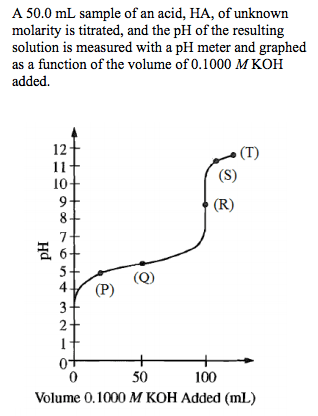
Which point on the titration curve corresponds to the point at which the moles of the added strong base are equal to the moles of the weak acid initially present?
Q
R
S
T
A 5.00 mL sample of household ammonia was analyzed by titration with hydrochloric acid according to the following reaction: HCl + NH3 → NH4 + + Cl −
This titration required 19.5 mL of 0.750 M HCl. What is the molarity of the ammonia sample?
1.97 M
2.19 M
2.44 M
2.92 M

Equal moles of the indicated acids are dissolved in the amounts of water shown in the beakers below. In which solution will the percent ionization of the acid be the lowest?
Beaker A
Beaker B
Beaker C
Impossible to tell from the information given.

Which represents an acid with the smallest Ka value?
HX
HY
HZ
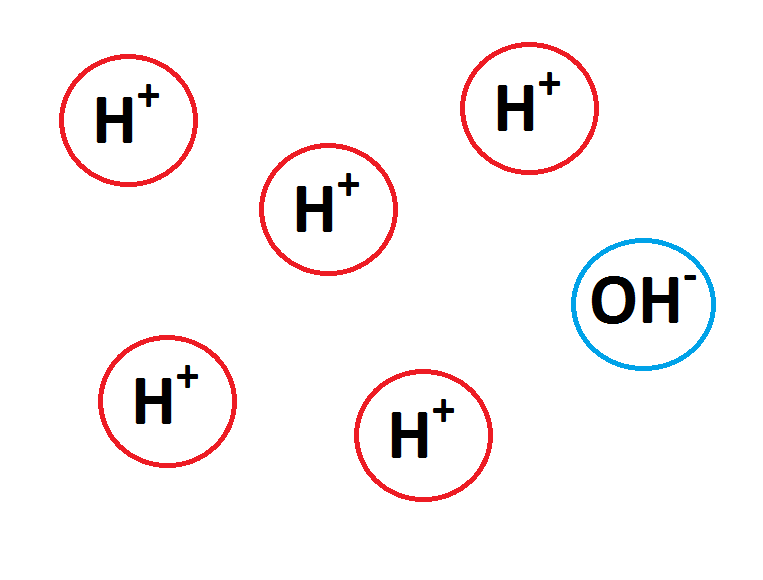
An acid that dissociatels, 100%, completely. Typically 0-4 on the pH scale.
Strong Acid
Weak Acid
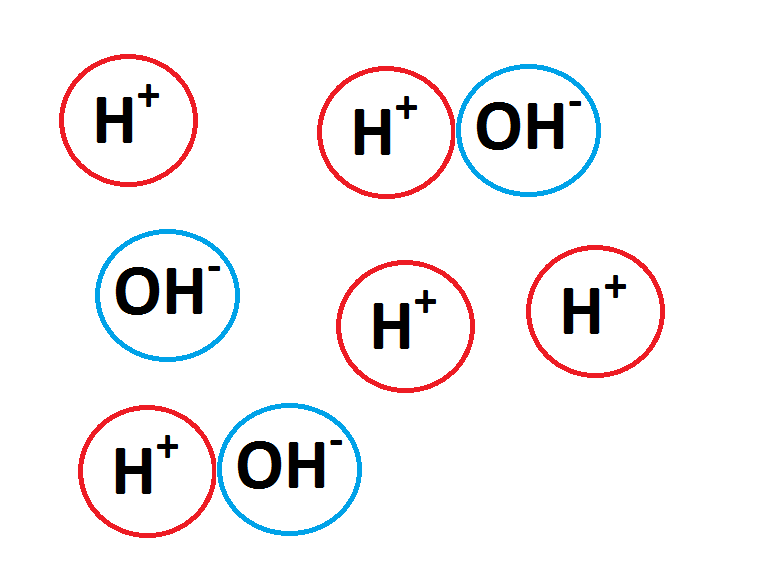
An acid that does not dissociate complete, with less than 100%. Typically pH range is between 4 - 7.
Strong Acid
Weak Acid
HC6H7O7(aq) + OH−(aq) → C6H7O7−(aq) + H2O(l)
A 25.00 mL sample containing 2.5 × 10⁻³ moles of citric acid is titrated to the equivalence point with 0.100 M KOH as shown in the net ionic reaction above. What are the relative amounts of acid and conjugate base at the equivalence point?
[HC6H7O7] ≅ 0.100 M and [C6H7O7− ] << 0.100 M
[HC6H7O7] = [C6H7O7− ]
[HC6H7O7] << 0.050 M and [C6H7O7− ] ≅ 0.0.050 M
[HC6H7O7] << 0.100 M and [C6H7O7− ] ≅ 0.100 M

Each particle diagram shown is a representation of an aqueous solution of one of the acids listed in the table. The molarity of the acids in the solutions is the same. Based on the information, which particle diagram best corresponds to the indicated acid?
Diagram 3 is HClO
Diagram 1 is HIO
Diagram 3 is HBro
Diagram 2 is HClO

