wayground logo

Free Printable Worksheets

Font size

S
M
L
XL
Worksheets

GEO FINAL EXAM REVIEW #1 25-26

Total questions: 60

Worksheet time: 5hrs 0mins

Name
Class
Date
1.
A continuous straight extent of length, without breadth or thickness is called a ________________. It also has arrowheads on both sides.
a)
line
b)
ray
c)
line segment
d)
linear pair
2.
An angle with a measure equal to 90 degrees is called a __________________________.
a)
right angle
b)
obtuse angle
c)
acute angle
d)
congruent angle
3.
Points that lie in the same plane are called ____________________.
a)
coplanar points
b)
collinear points
c)
line segment
d)
defined terms
4.
Points that lie in the same plane are called ____________________.
a)
coplanar points
b)
collinear points
c)
line segment
d)
defined terms
5.
A _______________ is a flat, 2-dimensional surface usually represented by a shape that looks like a floor or a wall.
a)
plane
b)
segment bisector
c)
line
d)
ray
6.
A point that divides, or bisects, a segment into two congruent segments is called a ___________________.
a)
midpoint
b)
congruent segment
c)
angle bisector
d)
endpoint
7.
A __________________ is an object that has no dimension. It is usually represented with a dot that identifies an exact location in space.
a)
point
b)
line
c)
line segment
8.
An angle with a measure equal to 180 degrees is called a _____________________.
a)
straight angle
b)
line
c)
obtuse angle
d)
acute angle
9.
Coplanar lines that do not intersect.
a)
Parallel Lines
b)
Perpendicular Lines
c)
Congruent Segments
d)
Parallel Planes
10.

an angle that measures less than 90*

a)

acute angle

b)

obtuse angle

c)

right angle

d)

straight angle

11.

an angle that measures greater than 90* but less than 180*

a)

acute angle

b)

obtuse angle

c)

straight angle

d)

right angle

12.

part of a line that begins at one endpoint and continues without end in one direction

a)

ray

b)

point

c)

line segment

d)

line

13.

lines that intersect at right angles to form a right angle

a)

parallel lines

b)

perpendicular lines

c)

points

d)

intersecting lines

14.

Two rays joined at a common endpoint

a)

point

b)

line

c)

angle

d)

segment

15.
a quadrilateral with exactly one pair of parallel sides
a)
square
b)
trapezoid
c)
parallelogram
16.
a)
line AB
b)
ray AB
c)
line segment AB
d)
points
17.
a)
segment AB
b)
ray AB
c)
line AB
d)
triangle
18.
a)
ray AB
b)
line AB
c)
segment AB
d)
bisector
19.

Points that lie on the same line are called ___________________________________.

a)

collinear points

b)

noncollinear points

c)

defined terms

d)

endpoints

20.
The set of all points in a plane that are equidistance from a given point.
a)
Circle
b)
Polygon
c)
Concave
d)
Dodecagon
21.

Which one is NOT a way to name this angle?

a)

∠ABC

b)

∠CAB

c)

∠1

d)

∠A

22.

What does this picture represent?

a)

Ray

b)

Line

c)

Segment

d)

Angle

23.
Which quadrilateral has 4 right angles, 2 sets of parallel sides, and all of its' sides are the same length?
a)
Triangle
b)
Rhombus
c)
Rectangle
d)
Square
24.
Figure A is a...
a)
Rectangle
b)
Square
c)
Rhombus
25.
Figure B is a...
a)
Rectangle
b)
Square
c)
Rhombus
26.
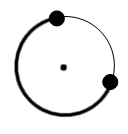
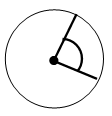
This is a picture of ___________.
a)
Minor Arc
b)
Major Arc
c)
Semi-Circle
d)
Central Angle
27.
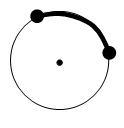
This is a picture of ___________.
a)
Minor Arc
b)
Major Arc
c)
Semi-Circle
d)
Central Angle
28.
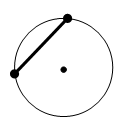
This is a picture of ___________.
a)
Chord
b)
Diameter
c)
Radius
d)
Inscribed Angle
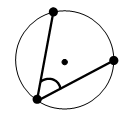
29.
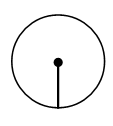
This is a picture of ___________.
a)
Chord
b)
Diameter
c)
Radius
d)
Inscribed Angle
30.
This is a picture of ___________.
a)
Major Arc
b)
Minor Arc
c)
Central Angle
d)
Inscribed Angle
31.
This is a picture of ___________.
a)
Major Arc
b)
Minor Arc
c)
Central Angle
d)
Inscribed Angle
32.

What is this called?

a)

Chord

b)

Minor arc

c)

Secant

d)

Diameter

33.

What is this called?

a)

Tangent Line

b)

Secant

c)

Chord

d)

Diameter

34.

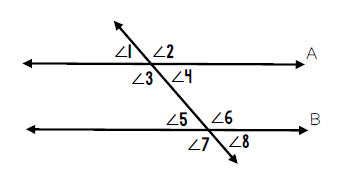
Angle 3 and Angle 6 are examples of which type of angle pair?

a)

Alternate exterior angles

b)

Alternate interior angles

c)

Vertical angles

d)

Corresponding angles

35.

Angle 1 and Angle 5 are examples of which type of angle pair?

a)

Alternate exterior angles

b)

Alternate interior angles

c)

Vertical angles

d)

Corresponding angles

36.
The angle relationship shown is -
a)
complementary angles
b)
supplementary angles
c)
vertical angles
d)
angle bisector
37.
∠1 and ∠3 can best be described as -
a)
complementary angles
b)
supplementary angles
c)
vertical angles
d)
adjacent angles
38.
The angle relationship shown is - 
a)
complementary angles
b)
supplementary angles
c)
vertical angles
d)
adjacent angles
39.
What does collinear mean?
a)
Points on the same plane
b)
Two lines that never intersect
c)
Points on the same line
d)
Lines that cross each other
40.
Are lines j and k skew?
a)
yes
b)
no
41.

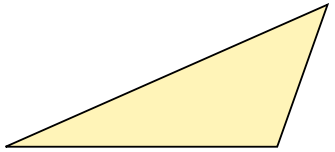
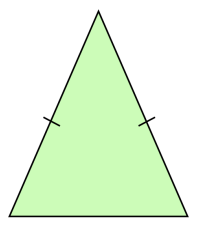
What type of triangle is shown?

a)

Isosceles

b)

Right-angled

c)

Equilateral

d)

Scalene

42.

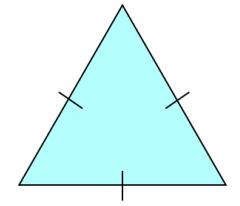
What type of triangle is shown?

a)

Isosceles

b)

Right-angled

c)

Equilateral

d)

Scalene

43.

What type of triangle is shown?

a)

Isosceles

b)

Right-angled

c)

Equilateral

d)

Scalene

44.
Which of the following is NOT true about similar figures?
a)
A) Similar figures always have the same shape.
b)
B) Similar figures always have the same size.
c)
C) Similar figures always have corresponding angles that are equal.
d)
D) Similar figures always have corresponding sides that are proportional.
45.
A ___________ polygon is a polygon that is equiangular (all angles are equal in measure) and equilateral (all sides have the same length). 
a)
plain
b)
perfect
c)
regular
d)
magical
46.
A line from the center of a regular polygon at right angles to any of its sides.
a)
apothem
b)
radius
c)
permimeter
d)
area
47.

Find the area of this hexagon.

a)

54 cm2

b)

54√3 cm2

c)

36√3 cm2

d)

36 cm2

48.

Find the area of a regular hexagon with a perimeter of 60 ft.

a)

150√3 ft2

b)

150 ft2

c)

60√3 ft2

d)

300√3 ft2

49.

What is the PERIMETER of this hexagon?

a)

2√3 in

b)

2 in

c)

16 in

d)

24 in

50.
What is the area of the shaded region?
a)
20 sq cm
b)
4 sq cm
c)
30 sq cm
d)
24 sq cm
51.

Find the area of this composite figure

a)

86 cm2

b)

87 cm2

c)

84 cm2

d)

89 cm2

52.
Find the area.
a)
108 cm sq
b)
60 cm
c)
432 cm sq
d)
216 cm sq
53.

Find the area of the polygon.

a)

45 in2

b)

68 in2

c)

36 in2

d)

24 in2

54.
Find the volume.
a)
151.2
b)
163.7
c)
179.1
d)
186.3
55.

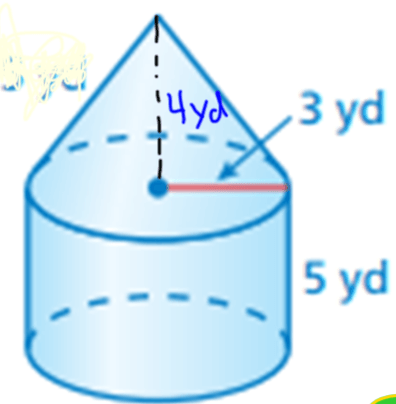
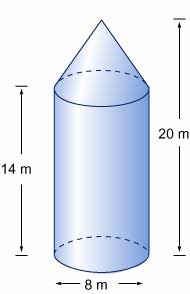
Find the volume of the following shape.

(What two solids are being added together??)

a)

4155.27 m3

b)

1038.82 m3

c)

804.24 m3

d)

1005.31 m3

56.
A cone-shaped hole is cut out of a cube. How much of the cube is left? Round your answer to the nearest cubic centimeter. 
a)
216 cm3
b)
25 cm3
c)
100 cm3
d)
191 cm3
57.

What is the area of this composite shape?

a)

44.14cm2

b)

88.27cm2

c)

143.10cm2

d)

173.10cm2

58.

What is the perimeter of this composite shape?

a)

64.62cm

b)

83.22cm

c)

292.10cm2

d)

427.96cm2

59.

Find the value of m.

a)

10

b)

10√2

c)

20√2

d)

√2

60.

Find the value of x.

a)

9

b)

2√3

c)

1

d)

3