
 Worksheets
Physics: Force and Motion Review
Total questions: 47
Worksheet time: 46mins

A cyclist rode his bike for 4 hours, covering a distance of 40 km. What was his average speed for his ride?
10 km/h
5 km/h
20 km/h
1 km/h

A cross country runner jogged for 2 hours and covered a distance of 14 km. What was the average speed of the runner?
28 km/h
7 km/h
12 km/h
.14 km/h
The energy related to motion is...
potential energy
kinetic energy
electrical energy
chemical energy

When riding a rollercoaster where is the greatest potential energy?
at the top of a hill
at the bottom of a hill
on a straight part of the track
at the bottom of a loop

What is the average speed of a car that made a 60 mile trip in 20 minutes?
3 miles per minute
6 miles per minte
30 miles per minute
60 miles per minute
What is the formula for solving for SPEED
D/T
T/D
S = X
D x T

A jockey was training a horse for a race. He rode the horse for 2 hours and covered a distance of 14 km. What was the average speed the horse ran?
28 km/h
14 km/h
7 km/h
2 km/h
What is the name of Newton's 1st Law of Motion?
Law of Force and Acceleration
Law of Action / Reaction
Law of Inertia
Henry sees a basketball and decides to put in motion. What kind of force does Henry use to move the ball?
small
balanced
equal
unbalanced
Which law states that the acceleration of an object depends on the force exerted on it and its mass?
1st Law
2nd Law
3rd Law
Which law states that for every action there is an equal and opposite reaction?
1st Law
2nd Law
3rd Law
Which law states that an object at rest stays at rest and an object in motion stays in motion unless an unbalanced force acts on it?
1st Law
2nd Law
3rd Law
What is the name of Newton's 1st Law of Motion?
Law of Force and Acceleration
Law of Action / Reaction
Law of Inertia
A force that opposes motion between objects that are touching is called...
motion
friction
velocity
acceleration


When an unbalanced force acts on an object, the force ______________________.
changes the motion of the object
is cancelled by another force
does not change the motion of an object
is equal to the weight of the object
When two equal forces act in opposite directions on an object, they are called ______________________.
frictional force
balanced force
centripetal force
gravitational force


What is potential energy?
The energy an object has due to its atomic structure.
The energy an object has due to its chemical composition.
The energy an object has due to its motion.
The energy an object has due to its position or condition.
What is kinetic energy?
The energy an object has due to its position or condition
The energy an object has due to its motion
The energy an object has due to its chemical composition
The energy an object has due to its atomic structure
When does an object have no kinetic energy?
When it's at rest.
When it's moving very slowly.
When the only force that's acting on it is gravity.
When it has no electrical charge.
Which object has the most potential energy?
A ball resting on the ground.
A ball being thrown at 100 miles per hour.
A ball on top of a refrigerator.
A ball resting on the edge of a cliff.
When does a yo-yo have the most potential energy?
When it's at its highest point.
When it's at its lowest point.
When it's moving between its highest and lowest points.
When it's moving at its top speed.


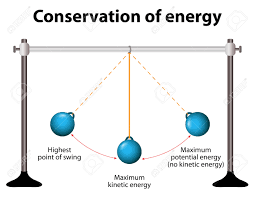


Holding a marble at the top of a ramp
Potential
Kinetic
A marble rolling down a ramp
Kinetic Energy
Potential Energy
Inertia is Newton's _______ Law of Motion.
First
Second
Third


"An object at rest will stay at rest, and an object in motion will stay in motion, unless acted on by an unbalanced force."
Newton's 1st Law
Newton's 2nd Law
Newton's 3rd Law
Newton's 4th Law

