Wayground logo

Free Printable Worksheets

Font size

S
M
L
XL
Worksheets

Waves

Total questions: 48

Worksheet time: 2hrs 55mins

Name
Class
Date
1.
A wave carries...?
a)
energy only
b)
matter only
c)
the matter carries the energy
d)
neither
2.
The highest point of a wave is?
a)
crest
b)
trough
c)
point of origin
d)
comppression point
3.
The lowest part of the wave is?
a)
trough
b)
crest
c)
point of origin
d)
compression point
4.
What is the measure of how many waves pass a point in a certain amount of time?
a)
frequency
b)
wavelength
c)
midpoint
d)
crest and trough
5.
The action of a wave bouncing off a surface is called __________________.
a)
rarefaction
b)
refraction
c)
reflection
d)
diffraction
6.
Amplitude reflects the amount of ____________________ in a wave.
a)
energy
b)
compression
c)
rarefaction
d)
speed
7.
A _____________________ is the distance between a point on one wave and the identical point of the next wave.
a)
amplitude
b)
wavelength
c)
frequency
d)
compression
8.
Which wave has a greater frequency?
a)
A
b)
B
9.

A wave that can only travel through matter is called:

a)

solid waves

b)

longitudinal waves

c)

transverse waves

d)

mechanical waves

10.

True or false: In Longitudinal waves, particles move parallel to the direction of the wave.

a)

true

b)

false

11.

True or false: In Transverse waves particles travel side to side in a wave.

a)

true

b)

false

12.
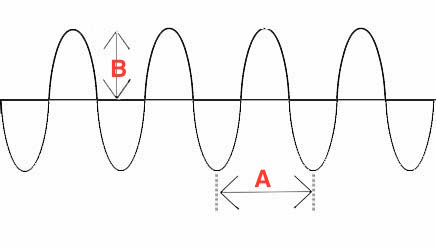
What property of this wave is represented by the letter "A"
a)
amplitude
b)
crest
c)
trough
d)
wavelength
13.
The highest point on a wave is:
a)
the crest
b)
the trough
c)
the top
d)
the coast 
14.
The lowest point on a wave is the:
a)
Amplitude
b)
Crest
c)
Trough
d)
Wavelength
15.
The type of waves that require medium to pass:
a)
Mechanical Waves
b)
Electromagnetic Waves
16.
What types of waves carry energy at a right angle or perpendicular to the direction of the energy flow?
a)
Longitudinal waves
b)
Transverse waves
c)
Sound waves
d)
P-waves
17.
What do waves carry from place to place?
a)
Energy, but not matter or particles
b)
Energy and matter or particles
c)
Matter or particles but not energy
d)
Neither energy nor matter or particles
18.
The most dense part of a longitudinal wave.
a)
Density
b)
Compression
c)
Rarefaction
d)
Amplitude
19.
What are the parts of a longitudinal wave?
a)
Compressions and rarefactions
b)
Crests and troughs
c)
Compressions and crests
d)
Rarefactions and troughs
20.
Which wave is pictured?
a)
Transverse
b)
Longitudinal
c)
Both
d)
Neither
21.
How would you describe the movement of a transverse wave?
a)
Up and down
b)
Back and forth
c)
In zigzags
d)
Linear
22.
Which wave travels parallel in relation to a medium?
a)
Transverse
b)
Longitudinal
c)
Both
d)
Neither
23.
Sound needs a medium to travel through.  What is a medium?
a)
solid, liquid, gas
b)
open space
c)
waves
d)
nothing
24.
The number of wavelengths that pass a point each per second is:
a)
frequency
b)
period
c)
longitudinal 
d)
transverse wave 
25.
When the frequency of a wave increases, what happens to the wavelength?
a)
The wavelength is not directly affected by the frequency of a wave.
b)
The wavelength increases.
c)
The wavelength decreases.
d)
More specific information is needed to form a conclusion about the wavelength.
26.
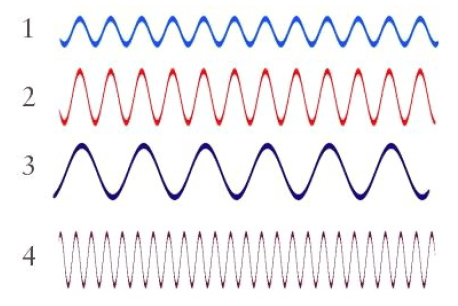
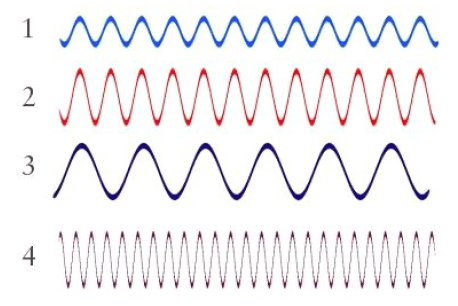
Which wave in the diagram has the greatest frequency?
a)
1
b)
2
c)
3
d)
4
27.
Which wave in the diagram has the greatest wavelength?
a)
1
b)
2
c)
3
d)
4
28.
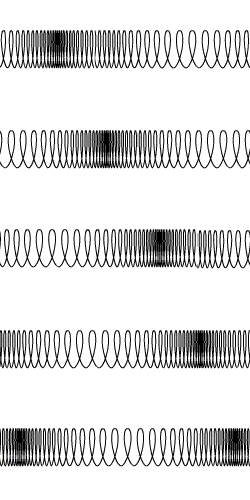
What type of waves have compressions and rarefactions?
a)
longitudinal
b)
transverse
29.
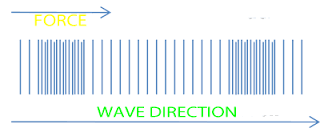
What type of wave is this?
a)
Longitudinal
b)
Transverse
30.

What type of interference is represented in this diagram?

a)

Constructive

b)

Destructive

31.

What type of interference is represented in the diagram?

a)

Constructive

b)

Destructive

32.

When a compression interferes with another compression, what occurs?

a)

They counteract and the wave stops.

b)

They combine to create a larger compression.

c)

They combine to create a rarefaction.

d)

None of the above.

33.

When a crest and a trough interfere, what occurs?

a)

They combine to create a higher amplitude wave.

b)

They counteract and the wave either lessens or stops completely.

c)

The wave changes into a longitudinal wave.

34.
When a wave strikes an object and bounces off
a)
medium
b)
refraction
c)
reflection
d)
interference
35.
a)
Constructive Interference
b)
Destructive Interference
c)
Refraction
d)
Diffraction
36.

What would you call this?

a)

Reflection

b)

Diffraction

c)

Refraction

d)

Friction

37.

What would you call this?

a)

Refraction

b)

Diffraction

c)

Bends

d)

Reflection

38.
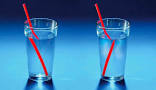
What is this called?
a)
refraction
b)
reflection
c)
reconstroction
d)
retraction
39.

A wave that needs a medium to travel is called a(n)

a)

electromagnetic wave

b)

mechanical wave

c)

ocean wave

d)

any way can do this

40.

A wave that can travel with or without a medium is called a(n)

a)

electromagnetic wave

b)

mechanical wave

c)

surface wave

d)

all waves can travel in any way

41.

Transverse waves have:

a)

crests and troughs

b)

troughs and rarefactions

c)

compressions and contractions

d)

rarefactions and crests

42.

Longitudinal waves have:

a)

crests and troughs

b)

crests and compressions

c)

compressions and rarefactions

d)

troughs and rarefactions

43.

What is the amplitude of this wave?

a)

3

b)

-3

c)

6

d)

4

44.

What is the wavelength of this wave?

a)

3

b)

10

c)

4

d)

8

45.

What would happen to the wavelength if the frequency was doubled?

a)

the wavelength would be halved

b)

the wavelength would be doubled

c)

the wavelength would stay the same

d)

frequency does not affect wavelength

46.

What would happen to the frequency is the wavelength was tripled?

a)

the frequency would be a third of what it was

b)

the frequency would be 3 times larger

c)

the frequency would stay the same

d)

the wavelength does not affect the frequency of a wave

47.

Which color has the lowest frequency?

a)

Red

b)

Pink

c)

Green

d)

Blue

48.
When the sound source moves, the frequency changes
ex. police car siren sounding lower pitch after the car passes

a)
pitch
b)
frequency
c)
Doppler Effect
d)
medium