wayground logo

Free Printable Worksheets

Font size

S
M
L
XL
Worksheets

Ecology & populations

Total questions: 38

Worksheet time: 36mins

Name
Class
Date
1.

What is the correct order for this food chain?

a)

Owl, Mouse, Grasshopper, Grass

b)

Grass, Mouse, Owl, Grasshopper

c)

Grass, Owl, Grasshopper, Mouse

d)

Grass, Grasshopper, Mouse, Owl

2.

Which of these organisms is the secondary consumer?

a)

Owl

b)

Mouse

c)

Grass

d)

Grasshopper

3.

What do herbivores eat?

a)

Animals

b)

Plants and Animals

c)

Plants

d)

Dead Animals

4.

How much energy is transferred between trophic levels?

a)

25%

b)

20%

c)

10%

d)

90%

5.

Volcano erupting would be an example of what type of succession?

a)

Primary

b)

Secondary

c)

Tertiary

6.

Which of these is an autotroph?

a)

Consumer

b)

Producer

c)

Decomposer

7.

The difference between weather and climate is that climate is:

a)

The average, year-to-year conditions

b)

The day-to-day conditions

c)

Described in terms of months at a time

d)

B and C are both correct

8.

Barnacles are animals that cannot move. In order to get food, they attach to whales and catch any floating plankton in the water. The whale is neither helped nor harmed in the interaction. What type of symbiosis is this?

a)

Mutualism

b)

Commensalism

c)

Parasitism

d)

Neutralism

9.

In the wild, some alligators gets their teeth cleaned by birds. The birds gets their food from the alligators' teeth.

What type of symbiosis is this?

a)

Mutualism

b)

Commensalism

c)

Parasitism

d)

Neutralism

10.

In an ecosystem, there are populations of moose, rabbits, grass, and pine trees. Suddenly, a fire blazes through the area, which kills all of the populations. As the months go on, new species of grass begin to take root. This attracts animals, and eventually the ecosystem is restored.


What type of ecological succession happened?

a)

Primary succession

b)

Secondary succession

c)

Tertiary succession

d)

None of the above

11.

In this photo, what is an abiotic factor?

a)

Deer

b)

Grass

c)

rain

12.

What is this picture describing?

a)

It is describing natural selection.

b)

It is describing direct competition between flamingos and ducks.

c)

It is describing abiotic factors of the tundra.

d)

It is describing the niche of each bird.

13.

What Biome is covered in permafrost (frozen subsoils)?

a)

Tropical Rain Forest

b)

Desert

c)

Tundra

d)

Tropical Savanna

14.

What Biome is also known as the grasslands?

a)

Tropical Rain Forest

b)

Desert

c)

Tundra

d)

Tropical Savanna

15.

What Biome is covered in a dense canopy and an understory?

a)

Tropical Rain Forest

b)

Desert

c)

Tundra

d)

Tropical Savanna

16.

What Biome is very dry; receives very little rainfall?

a)

Tropical Rain Forest

b)

Desert

c)

Tundra

d)

Tropical Savanna

17.
Members of a species in a defined area
a)
Ecosystem
b)
community
c)
biodiversity
d)
population
18.
What is the original source of almost all energy in most ecosystems?
a)
carbohydrates
b)
sunlight
c)
water
d)
carbon
19.
A collection of organisms that belong to different populations but all live in the same area and interact with one another.
a)
Population
b)
Ecosystem
c)
Community
d)
Ecosphere
20.
Individuals that can breed with one another make up a
a)
species
b)
population
c)
community
d)
ecosystem
21.
What may happen if the snowshoe hare was removed from the food web pictured?
a)
The insects in the habitat would increase.
b)
The shrew population would decrease due to being only hawk food source.
c)
The willow tree population would decrease.
d)
Foxes would dies due to no food source. 
22.
Which of the following leads to a decrease in biodiversity?
a)
protection of ecosystems
b)
pollution control
c)
selective cutting
d)
introduction of exotic or invasive species
23.

What happens if a population grows past its carrying capacity?

a)

The population keeps growing

b)

The population starts to die off

c)

The entire species will go extinct

d)

The carrying capacity just increases

24.

What does biodiversity mean?

a)

Only one species in an area.

b)

The different amount of species in an area

c)

All abiotic life

d)

Nitrogen fixation

25.

A diagram that shows the transfer of energy in an ecosystem by using several food chains.

a)

ecosystem

b)

food web

c)

environment

d)

food chain

26.
Organisms that hunt other organisms for food are called __________.
a)
predators
b)
prey
c)
producers
d)
heterotrophs
27.
What's missing from the food web?
a)
decomposers
b)
producers
c)
consumers
d)
autotrophs
28.
Based on the food web shown above, which of the following is most likely responsible for the rabbit population trend as shown in the graph? 
a)
increase in amount of grass
b)
decrease in amount of grass
c)
overpopulation in squirrel population
d)
increase in rabbit population
29.
Which of the following lists the level of biological organization in order, from least inclusive to most inclusive? 
a)
individual, community, population, ecosystem, biosphere, biome 
b)
individual, population, community, ecosystem, biome, biosphere 
c)
individual, community, ecosystem, population, biome, biosphere 
d)
individual, population, ecosystem, community, biosphere, biome 
30.
What is the order of succession shown in this figure?
a)
A, B, C, D
b)
B, A, D, C
c)
C, D, A, B
d)
D, A, B, C
31.
What factor describes when populations increase because animals are moving into a population?
a)
Emigration
b)
Limiting Factors
c)
Immigration
d)
Exponential Growth
32.
What does the graph represent?
a)
Emigration
b)
Exponential growth
c)
Immigration
d)
Logistic Growth
33.
Logistic growth has 3 phases. In Phase 1, the population grows rapidly. In Phase 2, population grows slowly. In Phase 3, growth stops. What causes growth to stop in the 3rd phase of logistic growth?
a)
Emigration
b)
Immigration
c)
Exponential Growth
d)
Carrying Capacity
34.
Which limiting factor would increase due to the number of individuals in a population?
a)
Unusual weather
b)
Natural disaster
c)
Births
d)
Disease
35.

What type of factor has an increasing impact as the population size increases?

a)

density-independent

b)

density-dependent

c)

cohort effect

d)

survivorship factor

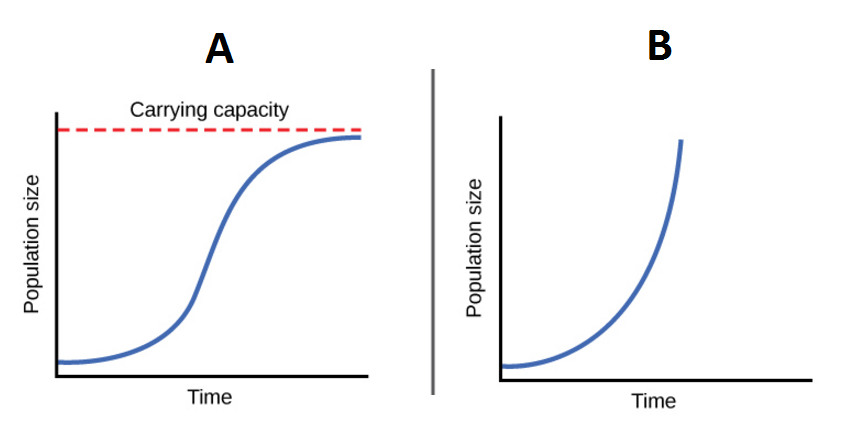
36.

What type of growth model is shown in image A?

a)

Exponential

b)

Logistic

37.
The way in which individuals of a population are spread out is called
a)
population density
b)
survivorship
c)
population dispersion
d)
logistic curve
38.

Which of the following are examples of a density independent factors?

a)

forest fire

b)

seasonal cycles

c)

storms

d)

disease