
NEW
Font size
 Worksheets
MM#11 Evidence of Evolution Adaptive Quiz
Total questions: 25
Worksheet time: 23mins

Which species’ DNA is most similar to the DNA of the toothed whale?
Hippopotamus
Baleen Whale
Grazing Mammals
Camels
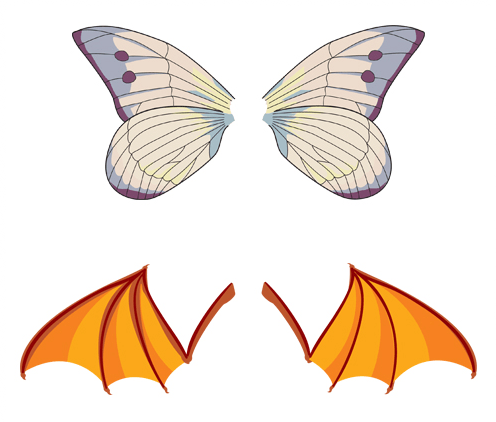
What is this an example of?
Homologous structure
Analogous structure
Vestigial organs
Functional adaption
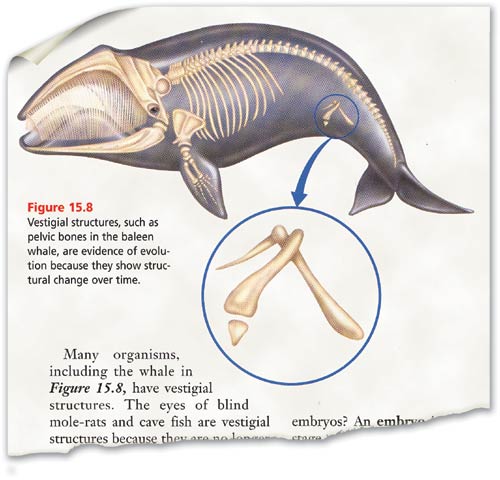
Which of the following is an example of a vestigial structure?
the wings of a red-tailed hawk
the hind limbs of a house cat
the fins of sharks
the tailbone of a human
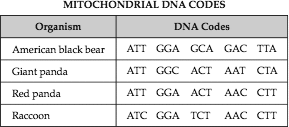
What conclusions can be made based on this table shown?
(Which animals have the most similar sections of DNA?)
the American black bear and the giant panda are most closely related
the giant panda and the red panda are most closely related
the red panda and the racoon are the most closely related
the giant panda and the racoon are most closely related

The picture shows the members of the Camelidae family. The physical features and the geographical origin of these animals provide evidence that -
they live in the same type of environment.
have slowly evolved to become herbivores.
have a common ancestor.
exchanged DNA in the past.

Which layer is the youngest
1
2
3
4

Which layer is the oldest
B
A
E
C
How do fossils provide evidence that evolution has happened on Earth?
Fossils show how the sizes of certain animals has changed drastically over millions of years
Fossils show that some species have gone extinct
Fossils show how life forms present today are different than those from the past
Different sedimentary rock layers provide evidence for how the environment has changed over time
If two organisms have similar traits of DNA they are probably
share a common ancestor
share a common environment
share a common population
speciation

Similarities in bone arrangements, like those in the picture, support the hypothesis that...
these organisms are not well adapted
these organisms share a common ancestor
these organisms all share the same DNA sequences
these organisms are members of the same species

Which statement provides the best evidence that Ambulocetus natans is an ancestor of Basilosaurus isis?
Homologous structures occur in each fossil
Similar nitrogenous bases are found in the DNA of each fossil
The fossils were found in different locations
The youngest fossils is larger than the older fossils
Genome maps provide the DNA sequences of chromosomes. Some scientists have compared the genome maps of a hedgehog and a sloth. What do these genome maps allow the scientists to determine?
The color patterns of the offspring of each species
How much the size ranges of the two species differ
The methods of protein synthesis that each species uses
How closely related the two species are to each other.
What conclusion can you draw from the fact that many modern whale species have vestigial pelvic and leg bones?
The ancestors of whales may have been land mammals
Whales could walk if they wanted to
Whales are preparing to evolve into land animals
Someday whales will be able to walk and will have legs

The fact that both these mammals incubate their immature offspring in a pouch provides evidence that they-
Belong to the same species
Must range great distances to eat
Have very similar skeletal structures
Are descended from a common ancestor

The picture shows similarities among the forelimbs of three animals. The similarities provide evidence for which of the following hypotheses?
Legs and wings may have evolved from flippers.
All mammals have evolved from an ancestor that was a bat.
A cat’s leg, a whales’sflipper, and a bat’s wing have identical functions
Cats, whales, and bats had the same ancestor millions of years ago.
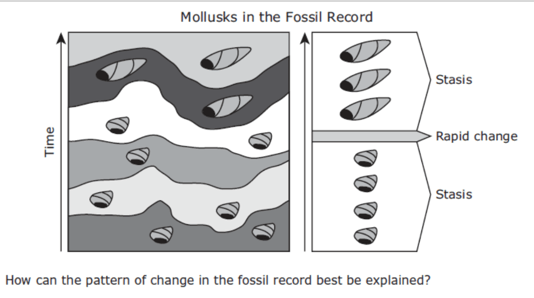
How can the pattern of change in the fossil record best be explained?
The mollusks were well adapted to their stable environment. A large, sudden change occurred in their environment. After the change the mollusks with the bigger shells were better adapted for the new environment.
The mollusks were well adapted to their stable environment. The mollusks hybridized with a smaller species of mollusk. A new species of mollusk with a bigger shell resulted.
The mollusks were not well adapted to their environment. The length of the mollusks' shells changed gradually over time. The mollusks in the original population that had small shells died over a period of many years.
Two organisms that are closely related would have:
similar DNA sequences
exactly the same DNA sequences
no proteins in common
completely different DNA sequences
What does Darwin's theory of evolution suggest?
species change over time
extinct species are not related to living species
different species can interbreed
animals that look alike are most closely related
Which of the following is NOT evidence for evolution?
Many animals have homologous structures
Many animals have vestigial structures from an ancestor
We can observe changes in life forms by observing the fossil record
Many organisms share the same colour

What best describes the hind leg bones seen in the whale?
The bones are analogous structures to the fins of living fish.
The bones are vestigial structures that had a function in an ancestor.
The bones are homologous structures to the wings of butterflies.
The bones are fossil structures from an extinct ancestor.
Mutations are important because they bring about --
death in the organisms in which they develop.
benefits for the individual, not the population.
genetic variation needed for a population to evolve.
equilibrium within a population.

According to the diagram, which organism is older?
gastropod
trilobite
fern
ammonite

The scientific theory of evolution is supported by different types of evidence. The diagram shows the skeletons of three different animal species. How does comparing the skeletons of these animals provide support for the scientific theory of evolution?
It provides information about the organisms' habitats.
It provides information to determine the organisms' ages.
It shows possible common ancestry between organisms.
It shows possible chromosomal similarities between organisms.

Amino acid sequences can be compared to determine relationships between species. When comparing the sequences provided, which two organisms are humans most closely related to?
horses and gorillas
gorillas and chimpanzees
chimpanzees and zebras
zebras and horses

The diagram illustrates an embryonic stage of two organisms.
Which of the following can be determined by observing the embryos shown in the diagram
The organisms share a common ancestry.
The organisms belong to the same genus.
The organisms are native to the same geographic areas.
The organisms will grow into anatomically similar adults.

